TL;DR
- India’s new payroll rules changed how wages, tax, and compliance are managed.
- Basic pay must now form at least 50% of CTC under the Labour Code.
- Payroll errors can trigger penalties, interest, and operational disruption.
- Multi-state and contract workforce compliance is becoming harder to manage internally.
- Payroll outsourcing helps businesses stay compliant and scale with confidence.
Between November 2025 and April 2026, two of the most sweeping regulatory reforms in Indian employment history, the four Labour Codes and the new Income Tax Act 2025, came into effect simultaneously. They have together revolutionised the classification of wages, the calculation of statutory contributions, the processing of employee exits, and the way payroll records are to be kept.
For organisations that still rely on legacy in-house payroll processes or, worse, manual systems and spreadsheets. These changes represent a material compliance risk. For those who have already moved toward outsourcing payroll, the reforms underscore why the decision was correct.
This blog is not a product pitch. It is an informed look at payroll processing and compliance in India’s current regulatory environment. Examining why payroll outsourcing compliance has become a strategic necessity, what the law actually requires, what the risks of non-compliance look like, and how to evaluate whether outsourcing is the right call for your organisation.
What Changed and Why It Matters?
The Four Labour Codes (Effective: 21 November 2025)
The Indian Ministry of Labour & Employment has managed to combine 29 distinct central labour laws into four separate but integrated codes. This represents the greatest reform in labour law since independence.
The four codes and their primary payroll impact are:
| Labour Code | Key Payroll Impact |
|---|---|
| Code on Wages, 2019 | Basic salary must be ≥50% of total CTC; redefines wage base for PF, Gratuity, ESI, and bonus. |
| Code on Social Security, 2020 | Expands EPF/ESI coverage to gig workers and contract labour; updates gratuity eligibility |
| Industrial Relations Code, 2020 | Mandates appointment letters for every worker; F&F settlement within 2 working days |
| Occupational Safety, Health & Working Conditions Code, 2020 | Digital attendance and wage records mandatory; centralised portal registration required |
The 50% wage rule under the Code on Wages is the most consequential change for payroll teams. Any salary structure where allowances push the non-wage component above 50% of CTC must now be restructured. This directly increases EPF contributions, gratuity provisions, and in some cases ESI applicability, all of which need to be reflected accurately in payroll calculations.
The Income Tax Act 2025 (Effective: 1 April 2026)
The Income Tax Act 2025 replaces the Income Tax Act of 1961, a statute that had governed Indian payroll TDS for over six decades. Key changes affecting payroll:
- Renumbering of TDS sections has been done.
- Replacement of Form 16 with Form 130.
- New format of Form 24Q which requires software compatibility.
- Incorporation of new tax slabs and calculation logic in payroll systems.
For organisations with thousands of employees across multiple states, implementing these changes mid-financial year is operationally complex. Getting it wrong triggers not just financial penalties but reputational exposure with employees who receive incorrect payslips or incorrect tax certificates.
Is Your Payroll Ready for India’s 2026 Compliance Changes?
Request a Free 30-Minute Payroll Compliance Assessment →
We will connect you shortly.
What Does Outsourcing Payroll Actually Mean (and What It Doesn’t)?
Outsourcing payroll is often mischaracterised as simply handing salary processing to a vendor. In practice, the scope of a well-structured payroll outsourcing arrangement is considerably broader and significantly more protective.
What a Comprehensive Payroll Outsourcing Engagement Covers
A mature payroll outsourcing provider in India typically delivers:
- The structure of salary designed adhering to the 50% basic pay formula of the Code on Wages
- Statutory calculations, like EPF, ESI, TDS, PT, LWF, gratuity, and bonus, are executed on the correct wage base
- Monthly filing and remittance to EPFO, ESIC, and income tax authorities before statutory deadlines
- Form management – ECR Filing, Half-Yearly Returns of ESI, Form 130 (replaced Form 16), Form 24Q
- Multi-State Compliance – Ensuring appropriate rates of professional tax and LWF as per state norms at all operations centres.
- Digital Documentation Management – Maintenance of Wage register, Attendance Register, PF/ESI Registers in format prescribed in Labour Code
- F&F Process Automation – Automated Settlement Process within a 2-working-day exit window
- Joiner Management – Creation of UAN, ESIC enrolment, PAN/Aadhaar linkage
- Audit and Advisory – Identification of systemic non-compliances before any Enforcement Proceedings
What outsourcing does not take away is the responsibility of the employer under the law. According to Indian labour laws, the organisation is still the principal employer. What outsourcing takes away is the responsibility for knowing what to do under a rapidly changing regime of laws.
Why Is Multi-State Payroll Compliance So Challenging?
For organisations operating across multiple Indian states, Indian Labour Law Compliance involves a layer of complexity that is frequently underestimated at the leadership level.
Why Multi-State Payroll Is So Complex
There is no single payroll compliance policy framework in India. The central legislature provides the floor while different state governments impose further compliance requirements. These include:
- Professional tax requirements vary from one state to another and even from one city/municipality to another within the same state
- Labor welfare fund requirements are state-specific with varying contribution and payment intervals
- Minimum wages vary from one state to another with periodic revisions, at times twice a year
- Work timings and leaves and other related compliance issues vary from state to state through the Shops and Establishments Acts
- Compliance with POSH requirements is state- and industry-specific.
A company with operations in Maharashtra, Karnataka, Telangana, Tamil Nadu, and Delhi is simultaneously subject to five different state-level professional tax structures, five different Shops Acts, different LWF obligations, and different minimum wage notifications, all of which need to be tracked in real time. For organisations that also manage teams across international locations, multi-country payroll introduces an additional layer of regulatory complexity that requires specialised infrastructure.
An internal payroll team managing this complexity without dedicated compliance expertise and real-time regulatory tracking infrastructure is, structurally, a compliance risk.
How Should You Evaluate a Payroll Outsourcing Partner?
Deciding to outsource is the first decision. The more consequential decision is how to evaluate a payroll outsourcing partner. The quality of Payroll Outsourcing Compliance delivery varies significantly across providers.
What to Evaluate When Selecting a Payroll Outsourcing Partner
Depth of Compliance Coverage
- Is their payroll system compliant with the updates in the Labour Code, including those implemented since November 2025?
- Has their payroll system been revised for TDS calculation in compliance with the Income Tax Act 2025?
- Have they operationalised all four Labour Codes or only one (Code on Wages)?
Multi-State Capability
- What states is the vendor currently monitoring on PT, LWF, and minimum wage updates?
- How fast can state-wise changes be updated in the computation process?
Technology Infrastructure
- Is the system cloud-based, with real-time updating ability for regulations?
- Can it be integrated into your HRMS and ERP systems?
- Does it create the required digital statutory registers as per the Labour Codes?
SLA and Accountability
- What are the contractual obligations concerning filing deadlines?
- Who is responsible for payment in the case of any penalty due to provider error?
Data Security
- How is employee payroll data handled under India’s Digital Personal Data Protection Act 2023?
- Where is data stored, and what are the data retention policies?
Reporting and Transparency
- Does the service have an integrated compliance dashboard showing live filing status?
- Are there any monthly compliance certificates provided?
Should You Manage Payroll In-House or Outsource It?
There is a significant difference in knowledge between specialist payroll compliance firms and non-specialist HR departments since the introduction of Labour Codes. It is important to note that this is not a criticism of the capabilities of the HR department; rather, it is the result of the changing regulations.
| Parameter | In-House Payroll | Outsourced Payroll |
|---|---|---|
| Labour Code implementation | Dependent on internal team’s update speed | Typically pre-implemented by specialist providers |
| Multi-state compliance | Requires state-wise tracking infrastructure | Handled within service scope |
| Income Tax Act 2025 transition | Requires software migration + staff retraining | Provider’s operational responsibility |
| F&F settlement SLA | Dependent on internal workflow design | Contractually mandated by provider |
| Gig/contract worker statutory coverage | Frequently missed internally | Part of comprehensive outsourcing scope |
| Cost of a compliance error | Penalties + reputational risk + management time | Contractually assigned to provider |
| Scalability during headcount growth | Requires proportional HR team expansion | Scales without proportional cost increase |
| Compliance visibility for leadership | Dependent on internal reporting | Dashboard and monthly compliance certificates |
Are You Meeting Compliance Requirements for Gig and Contract Workers?
One of the least-discussed compliance implications of the new Social Security Code is the extension of PF and ESI coverage to gig workers and contract labour in many states.
Organisations that use a large number of contractual employees would be missing out on a risk that is not covered in their payroll systems. The Social Security Code introduces provisions for:
- Social security funds for gig and platform workers
- Registration obligations for aggregators and employers
- Benefits includes life insurance and disability insurance, health benefits, and maternity benefits
Payroll Processes That Must Be Reviewed Immediately
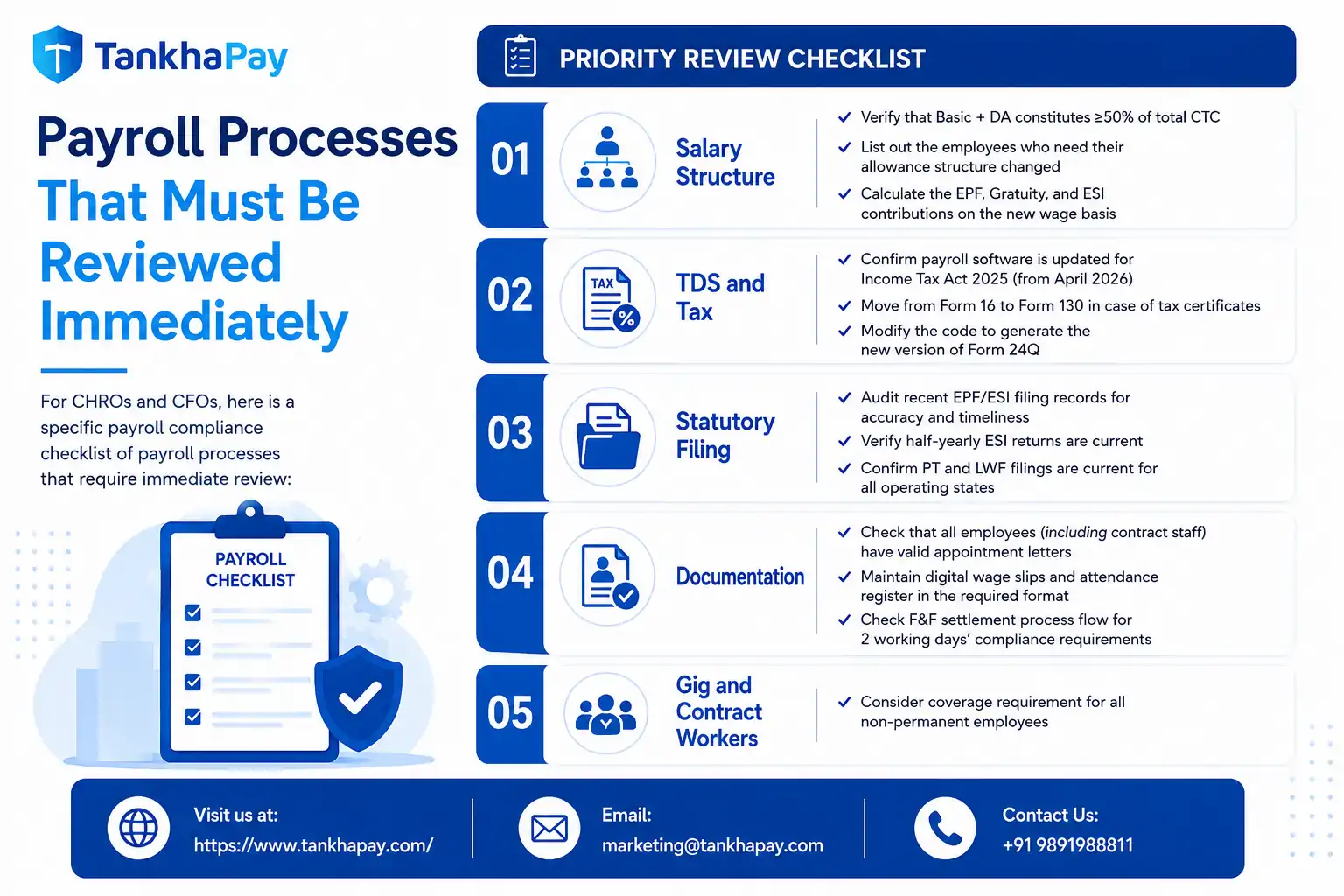
For CHROs and CFOs, here is a specific payroll compliance checklist of payroll processes that require immediate review given the current regulatory environment:
Priority Review Checklist
Salary Structure
- Verify that Basic + DA constitutes ≥50% of total CTC for every employee
- List out the employees who need their allowance structure changed
- Calculate the EPF, Gratuity, and ESI contributions on the new wage basis
TDS and Tax
- Confirm payroll software is updated for Income Tax Act 2025 (from April 2026)
- Move from Form 16 to Form 130 in case of tax certificates
- Modify the code to generate the new version of Form 24Q
Statutory Filing
- Audit recent EPF/ESI filing records for accuracy and timeliness
- Verify half-yearly ESI returns are current
- Confirm PT and LWF filings are current for all operating states
Documentation
- Check that all employees (including contract staff) have valid appointment letters
- Maintain digital wage slips and attendance register in the required format
- Check F&F settlement process flow for 2 working days’ compliance requirements
Gig and Contract Workers
- Consider coverage requirement for all non-permanent employees
- Check contractor contracts for compliance with the Industrial Relations Code
Key Statutory Deadlines for Indian Payroll in 2026
| Obligation | Deadline | Penalty for Default |
|---|---|---|
| TDS deposit | 7th of following month | 1.5% interest per month |
| EPF deposit | 15th of following month | 12% interest + up to 25% damages |
| ESI deposit | 15th of following month | Interest + legal notice |
| Professional Tax | State-specific | State-specific penalties |
| ESI half-yearly return | April 11 & October 11 | Interest + prosecution risk |
| Form 130 (replaces Form 16) | By June 15 annually | ₹100/day penalty |
| F&F settlement | Within 2 working days of exit | Penalty under Labour Codes |
| ECR (EPF) filing | Monthly with challan | Damages + inquiry |
What Does a Reliable Payroll Outsourcing Provider Look Like?
Below are the features that indicate maturity or readiness for compliance in a payroll outsourcing firm versus simply outsourcing processing:
- Proactive regulatory alerting – The provider notifies clients of upcoming regulatory changes (rate revisions, filing deadline changes, and new state notifications) before they take effect, not after.
- Structured compliance calendar – Clients receive a month-by-month compliance calendar covering every statutory filing deadline across all operating states.
- Post-filing confirmation – Evidence of successful filing and challan copies are shared with clients systematically, not upon request.
- Salary structure advisory – The provider actively flags structural non-compliance in client salary designs, particularly regarding the 50% wage rule.
- Error accountability – The provider has a clearly documented SLA and a financial liability clause for compliance failures caused by provider error.
- Data residency clarity – The company has a well-defined stance in regard to data residency, security, access, and compliance with the Indian Digital Personal Data Protection Act 2023.
Closing Perspective
The idea that payroll compliance is simply an administrative responsibility no longer reflects the reality of doing business in India.
With changing labour regulations, revised tax frameworks, tighter reporting expectations, and stricter enforcement, payroll today sits at the intersection of compliance, employee experience, financial governance, and operational stability. Organisations that continue relying on fragmented processes or reactive compliance approaches may find themselves spending more time correcting issues than creating growth opportunities.
Payroll management is not merely about accurate payment of employees. It goes beyond this by ensuring regulatory compliance for organisations, avoiding penalties, gaining trust from employees, and setting up systems that are scalable.
This is where having the right payroll infrastructure and expert support becomes increasingly valuable.
With TankhaPay’s managed payroll services, organisations can move beyond transactional payroll management and build a more reliable compliance framework. From payroll software and statutory calculations to multi-state compliance support, digital documentation, employee onboarding, and timely statutory filings, TankhaPay helps businesses simplify complex payroll operations while staying aligned with evolving regulations.
Rather than treating compliance as a recurring burden, businesses can use the right payroll partner to create a system that is accurate, scalable, and built for long-term growth.
TankhaPay, developed by Akal Information Systems (est. 2000, CMMI Level 5, ISO 27001), is India’s only payroll platform combining payroll software, managed payroll outsourcing, domestic and international EOR, NATS apprenticeship management, and global talent mobility under one platform. Trusted by 1,000+ enterprise clients including Bank of Baroda and UIDAI.