There’s a moment almost every founder knows. The team is small but is full of energy. On the last working Friday of the month, someone, usually the co-founder who also works in HR, opens a spreadsheet and starts figuring out how much everyone will be paid. It does work as long as it does.
But one wrong TDS deduction. One delayed PF submission. One employee who is skeptical about his paycheque begins to ask questions. In a matter of seconds, what started out as a task that took no more than five minutes suddenly stretches into a whole afternoon, and that trust your colleagues had in you, that quiet, foundational trust, is threatened.
This is what statistics show: 53% of businesses paid payroll fines in the last five years because of problems related to compliance. Here is the catch, though: the majority of these penalties could have been avoided.
The startups that avoid this trap aren’t lucky. They made one early decision: they outsourced payroll before it became a problem. This article breaks down exactly why it’s one of the smartest operational calls an early-stage company can make. But first,
What Is Payroll Outsourcing?
Payroll outsourcing is the practice of handing over your company’s payroll function, salary calculations, statutory deductions, compliance filings, and payslip generation to a third-party specialist instead of managing it internally.
However, in 2025, it will mean far more than just salary calculation. Based on the service provider, it may include all aspects of HR processes. At its broadest, it includes HR managed services, in which an outside service provider handles everything from recruitment to exit interviews.
For startups hiring across states or cities before their entity is fully set up, an Employer of Record (EOR) model takes it a step further, the EOR becomes the legal employer on paper, handling all local compliance and payroll so you can hire anywhere without waiting on entity registration.
Think of it like a spectrum: where basic payroll outsourcing takes care of salaries and filings, whereas HR managed services take care of the whole HR function, and EOR gets rid of all hiring barriers based on location. All three promise the same thing: your team will get paid correctly, your business will stay compliant, and your leaders will stop spending Fridays on spreadsheets.
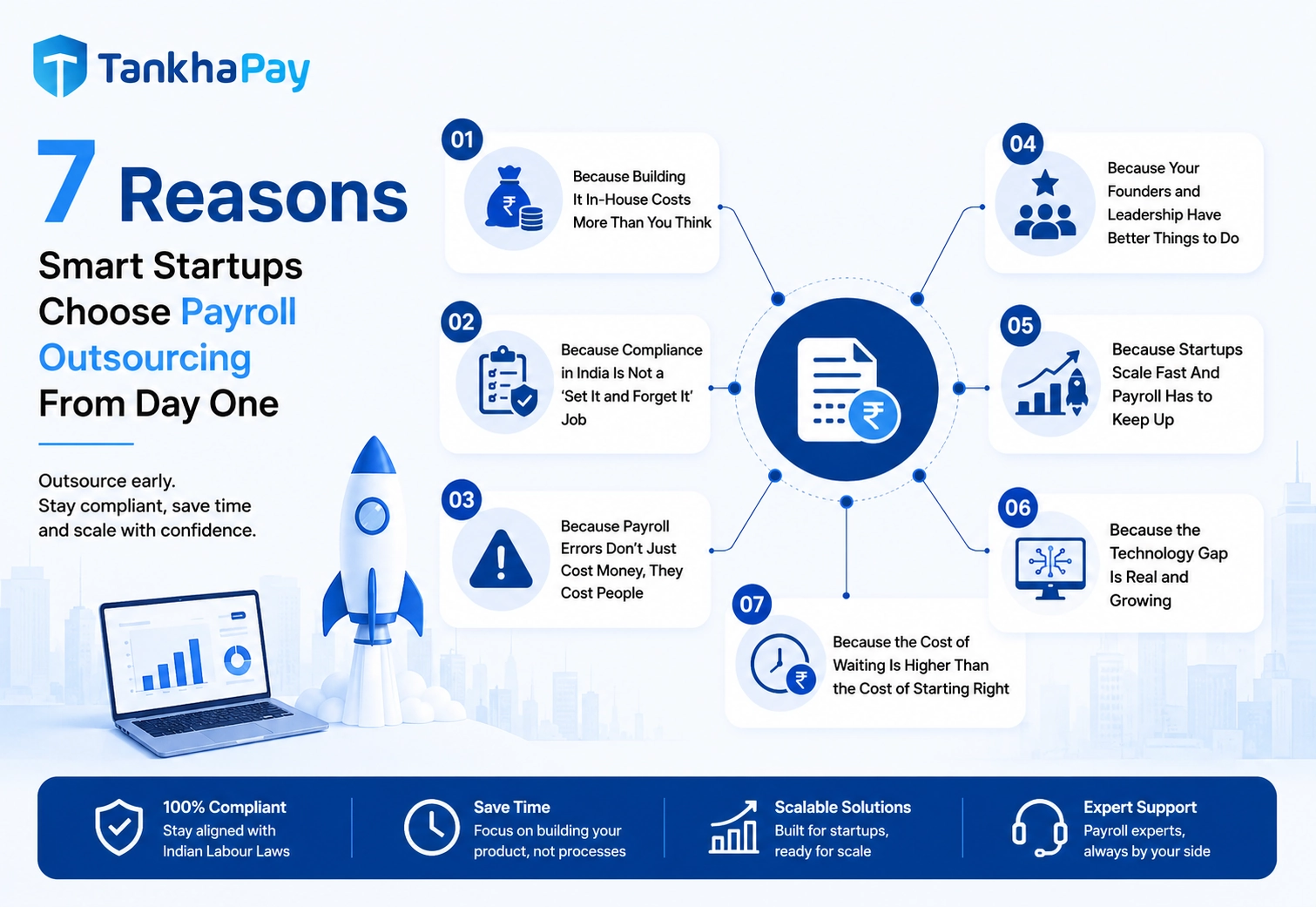
1. Because Building It In-House Costs More Than You Think
The instinct to manage payroll internally makes sense on the surface. You want things to go your way. The salary of the person doing the payroll is not usually the only cost of doing it in-house.
Hiring a dedicated payroll professional in India in 2025 can cost anywhere from ₹6 to 12 lakh per year in loaded costs. This doesn’t even include the costs of PF, ESIC, leaves, and training time for the employer. That’s a big part of the HR budget for a startup with 15 employees that is tied to one job.
By comparison, Indian Payroll Outsourcing services for professionals today cost around ₹625 to ₹2,100 per employee per month, dependent on the number of employees but independent of them in terms of costs. For most early-stage companies, the math isn’t even close. You get more expertise, better systems, and zero fixed overhead.
And the savings go beyond just salary. Fixing every payroll mistake costs a company an average of USD 291, either directly or indirectly. Fewer mistakes mean less money spent on firefighting, less time lost, and fewer awkward conversations with workers.
2. Because Compliance in India Is Not a ‘Set It and Forget It’ Job
India has one of the most dynamic regulatory environments for employment in the world, so if you’re starting a business there, you’re in one of the best places to do it. The list is long and always changing. It includes TDS slabs, EPFO circulars, ESIC thresholds, different professional tax rates in different states, the new Labour Codes that combine 29 central laws, and the Employment-Linked Incentive (ELI) Scheme, introduced in July 2025 and now active. Scheme, which requires EPFO integration and Aadhaar-linked payments.
The growth rate of the India Payroll Outsourcing Services Market is 5.71%, and the market will be worth USD 592.1 million in 2034 since the complexity of compliance has reached a stage where it cannot be handled without specific expertise.
3. Because Payroll Errors Don’t Just Cost Money, They Cost People
49% of workers quit their jobs after just two payroll mistakes. Modern payroll software that comes with outsourced platforms makes payslips, figures out salaries, and balances deductions all on its own. This can help you make fewer mistakes, up to 31% fewer, than if you did it by hand. Your employees always get paid on time and correctly. That’s not just being smart. That’s what culture is.
Read that again. Nearly half of your team is one salary mistake away from reconsidering whether they want to work for you.
In a startup, where talent is often the only real competitive moat, losing a great engineer, a strong ops lead, or a trusted salesperson because of a payroll slip-up is a wound that has nothing to do with your product or your market. It’s entirely operational. And entirely avoidable.
4. Because Your Founders and Leadership Have Better Things to Do
Time is the one resource a startup cannot manufacture more of. When a CEO, CFO, or CHRO is spending hours on payroll reconciliation or fielding “Why is my salary short this month?” queries, that time is coming from somewhere, usually from strategy, hiring, or product.
According to Deloitte research, 42% of the surveyed CEOs said their main motivation to outsource was their desire to access specialised talent rather than cut costs. The logic is straightforward: payroll specialists are better at payroll than generalists. What ‘outsourcing’ means for a company is not merely offloading an unnecessary function but actually improving the end result and freeing up valuable time for other purposes.
Think about it this way: if your CHRO is dedicating 20% of his/her working week towards payroll operations, then it means one day per week is being wasted that could otherwise have been used for recruitment strategies, building culture, or retaining talent. That means fifty days are wasted over a year due to inefficient use of time.
5. Because Startups Scale Fast And Payroll Has to Keep Up
Growth in a startup doesn’t come gradually. In a year, you go from having 12 employees to 80. You hire people in three new states. You hire full-time employees, interns, and contract workers all at the same time. Each of these changes makes payroll more complicated and requires new tax registrations, new compliance requirements, and new pay structures.
A payroll department that works well with 15 people can become total chaos with 75. When you use outsourced payroll services, scaling up is just a matter of changing the settings, not hiring more people. Your provider adds capacity on their end, and you just update the number of people and keep going.
This flexibility to do so makes it easier for small and medium enterprises to generate over 45% of payroll outsourcing services deals in the developing world in 2024. Being able to expand one’s payroll without having to expand payroll management personnel becomes critical for firms growing at a rapid pace.
6. Because the Technology Gap Is Real and Growing
The gap between what enterprise payroll software can do and what most startups actually have access to is enormous, unless they outsource.
Today’s payroll systems have real-time dashboards, automatic submissions to the government, self-service for employees, mobile payslips, cost centre analysis, and easy connections to HRMS and attendance management systems. More than 78% of payroll outsourcing companies use cloud-based infrastructure, which makes sure that processing happens in real time and compliance updates happen right away.
Building or licensing this kind of technology stack independently is expensive and time-consuming. When startups work with a professional payroll services provider, they get access to enterprise-grade infrastructure from day one, without the capex, the implementation timelines, or the ongoing maintenance burden.
What Full-Service Payroll Outsourcing Covers :
| Service | What it does for your business |
|---|---|
| Salary Calculation & Disbursement | Accurate gross-to-net processing, on-time bank transfers |
| Statutory Compliance | PF, ESIC, TDS, PT, LWF — filed correctly and on time, every time |
| Payslip Generation | Digital, detailed payslips — no more employee queries about deductions |
| Leave & Attendance Integration | Pay is automatically aligned with actual attendance data |
| Year-End Tax Support | Form 16, IT declaration, investment proof — managed without involving the HR team |
| Employee Self-Service Portal | Employees access payslips, raise queries, and track taxes independently |
| MIS Reporting | Payroll cost visibility by department, location, or cost centre |
| Reimbursement Processing | Travel, medical, and fuel claims processed within the payroll cycle |
That’s what’s included. For how much each tier actually costs based on your headcount, see our Payroll Outsourcing Cost breakdown.
Today’s most popular HR Managed Services Providers will include this technology within their services package, which means that you don’t just receive a service; you receive a complete management solution that will adapt to new regulations without requiring your team to do anything.
7. Because the Cost of Waiting Is Higher Than the Cost of Starting Right
This last one is probably the least appreciated reason of all. Many startups put off outsourcing payroll because they don’t think it’s important enough right away. Ten workers, easy payroll, and a spreadsheet that is easy to use. Why fix something that isn’t broken?
The longer you wait, the more difficult the transition becomes. Compliance gaps build up without anyone noticing. Backfiles are piling up. Workers get used to payslips that don’t always look the same. And by the time you decide to hire someone else, usually when the pain is really bad and you have 50 to 70 employees, you’re not just setting up a new system. First, you’re cleaning up 18 months of work that wasn’t done right.
The global payroll outsourcing market grew from around 17% of businesses in 2015 to 38% by 2019, and it has only gotten bigger since then. The businesses that are making that growth happen aren’t the ones that waited until they were in trouble. They were the ones who made the call early, set up clean operational infrastructure, and let their HR and finance teams focus on the work that actually moves the business forward.
Simplify Your Payroll for India’s Diverse Workforce
India’s startup ecosystem doesn’t just consist of salaried tech teams sitting in Bengaluru offices. It includes delivery fleets from logistics companies, store staff from retail brands, shift workers from manufacturing units, and gig riders from food-tech platforms. This is most of India’s working population, and traditional payroll tools weren’t always made for them.
TankhaPay operates as a full-stack HR Managed Services and a mobile-first platform that combines salary payments, compliance with the law, attendance tracking, and access to earned wages. For startups with mixed or distributed teams, it makes it easier to manage payroll while also making operations more complicated.
TankhaPay’s infrastructure also supports the EOR model, which is great for startups that need to hire people quickly from all over the world. This way, every worker is covered by the right local compliance framework, no matter where your registered office is.
In a nation where the labor codes, ELI programme, and Aadhaar-based payments are all evolving the definition of compliant payroll management, having software tailored to work in an Indian labor environment becomes crucial. TankhaPay is a provider that enables one to get things right from day one.
The Earlier You Fix Payroll, The Faster You Scale
Payroll brings together compliance, finance, and people. No one pays attention to payroll when it’s working properly, and that’s how it should be. When it fails, everyone takes notice, and the damage is usually more than just the balance sheet.
The best startups are the ones that don’t see payroll as a monthly chore but as a promise to their team. It isn’t about cutting corners to outsource it early. It’s important to make sure the base is strong before you build anything else on top of it.
The question isn’t whether to outsource your payroll. For most startups, the answer to that is already clear. The real question is, how much longer can you afford to wait?
TankhaPay, developed by Akal Information Systems (est. 2000, CMMI Level 5, ISO 27001), is India’s only payroll platform combining payroll software, managed payroll outsourcing, domestic and international EOR, NATS apprenticeship management, and global talent mobility under one platform. Trusted by 1,000+ enterprise clients including Bank of Baroda and UIDAI.