The practice of payroll outsourcing entails the delegation to a third party of certain or all responsibilities associated with processing payments to employees, including calculations of salaries, deductions according to statutory requirements, and submission of compliance returns and payslips. This could involve either a small portion or almost all of the tasks, depending on the chosen model.
That distinction, how much you actually hand over, is where most explanations of payroll outsourcing get vague. This guide is specific about it.
Quick Answer
- What is payroll outsourcing? Hiring a third-party provider to manage payroll processing, statutory compliance, or both, instead of handling it entirely with internal staff and software.
- What can be outsourced? Salaries calculation, PF, ESI, TDS, Professional tax calculation, preparing payslips, compliance, and reporting.
- Main benefits: Reduced administrative workload, access to compliance expertise, more standardized processes, and less dependence on any single internal employee’s knowledge.
- Who it suits: Growing companies where payroll is consuming excessive internal time, businesses expanding across states, and companies without deep in-house compliance expertise. It is not automatically the right fit for every business at every stage.
What is Payroll Outsourcing?
Payroll outsourcing refers to the practice of hiring an external service provider in order to manage some or all payroll-related functions, such as salary calculations, deductions, payslips, statutory contributions, payroll reporting, and related administrative tasks.
That definition covers a wide range of actual arrangements, and it helps to separate three models that get treated as interchangeable but aren’t.
Payroll software is technology a business operates internally. A company buys or subscribes to a platform, and its own staff enter data, run calculations, and manage the process. The vendor provides the tool; the business does the work.
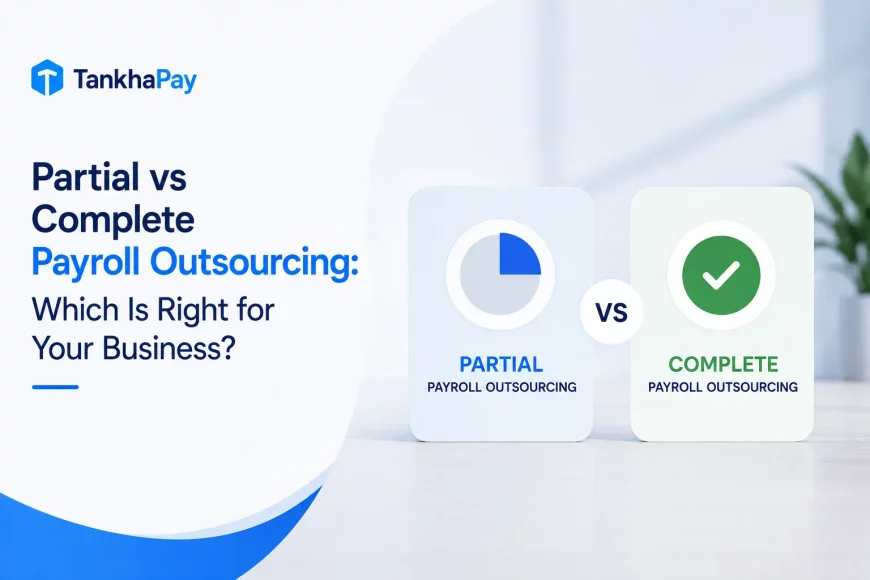
Partial payroll outsourcing involves outsourcing certain tasks which are generally compliance-orientated to the outsourcing service provider while retaining other core tasks within the organization. An example is when the in-house team is responsible for monthly salary processing while the outsourced service provider is responsible for filing all statutory reports as well as maintaining statutory compliance in the areas of PF, ESI, Professional Tax, and TDS.
Fully managed payroll outsourcing involves outsourcing of the complete payroll function, including calculations, compliance requirements, preparation of payslips, reporting, etc., to the outsourced service provider, where the business provides the inputs and then verifies the output of the process, but the provider takes care of everything in between.
However, these two concepts do not remain distinct because while providing managed payroll services, the outsourced service provider would be using some form of payroll software while the in-house service provider using payroll software can outsource only compliance tasks.
What Payroll Functions Can Be Outsourced?
Although the extent will vary depending on the vendor and the outsourcing agreement, the various services that can be outsourced are:
- Processing and verification of employee payroll data
- Processing salary/wages
- Processing attendance and leave data
- Processing variable pay/ incentive/ bonus data
- Deductions both statutory and non-statutory
- Preparation and distribution of payslips
- Generation of payroll reports and statutory registers
- Statutory compliance calculations (PF, ESI, TDS, Professional Tax, LWF)
- Generating payroll inputs for tax purposes, e.g., Form 16
- Full & final settlement processing
- Employee payroll queries administration
A business can outsource one of these, several, or all of them. The scope is a negotiated service agreement, not a fixed package every provider offers identically.
Also Read: Does Payroll Outsourcing Improve Employee Retention?
How Does Payroll Outsourcing Work?
Payroll outsourcing generally follows an eight-step workflow, though the exact steps vary slightly by provider.
- Inputs relating to employee and payroll cycle, such as new joiners, exit, attendance, and all variable pay components, are shared by the business for the cycle.
- The payroll vendor verifies the payroll inputs for consistency before the start of the payroll process.
- Payroll processing takes place where gross inputs are converted to net salary for each employee.
- The process for deductions and statutory elements like PF, ESI, TDS, and Professional tax is processed.
- Payroll gets reviewed and approved by the business itself, usually against the draft payroll register shared by the payroll vendor.
- Payroll outputs such as salary sheets and payslips for the employees are prepared.
- Payroll records are maintained according to the agreed scope of the service.
The one thing that needs to be made clear here is that just because payroll is outsourced, all the legal liabilities do not shift to the outsourcing firm. The liability is normally that of the employer depending on the terms set out in the service level agreement. Discussing these liabilities in written form before the agreement is made is the point of the agreement.

Payroll Outsourcing Example: Before and After
Let us take a case of a small organization growing at a fast pace with 300 employees that have been handling payroll using spreadsheets.
| Before Outsourcing | After Outsourcing | |
|---|---|---|
| Salary calculation | Manual, spreadsheet-based, cross-checked by one or two staff | Automated by the provider, validated before finalization |
| Statutory filings | Tracked manually across PF, ESI, PT, and TDS deadlines | Handled and filed by the provider’s compliance team |
| Payslip access | Emailed individually or distributed in batches | Available through an employee self-service portal |
| Compliance updates | Someone has to notice and interpret rate or rule changes | Monitored and applied by the provider |
| Internal team’s role | Running the full process end to end | Supplying inputs, reviewing and approving outputs |
The workload doesn’t disappear entirely, someone still needs to supply accurate inputs and review outputs, but the operational and compliance burden shifts substantially to the provider.
What Are the Benefits of Payroll Outsourcing?
- Reduced administrative workload. Delegation of calculations, filings, and reports can save significant time, especially where such activities are currently performed manually by an organization’s team.
- Access to payroll expertise that may be costly or slow to build internally, especially compliance knowledge that spans multiple states.
- More standardized payroll processes, since providers typically apply consistent validation steps across every cycle rather than relying on individual staff judgment.
- Better scalability as headcount grows or the business expands into new states, without needing to scale internal payroll staff at the same pace.
- Reduced dependence on individual internal employees. When payroll knowledge lives with one person, their absence or departure can disrupt an entire cycle. A provider distributes that risk.
- Access to payroll technology without the business needing to select, license, and maintain it independently.
- Better payroll reporting, since providers often deliver structured reports as a standard part of the service rather than something the internal team builds separately.
- More time for internal HR and finance teams to focus on work that isn’t repetitive payroll administration.
None of this is guaranteed uniformly. Outcomes depend on the provider chosen and how the engagement is implemented, and a poorly scoped outsourcing arrangement can fail to deliver several of these benefits. For a closer look at the reasoning specific companies apply when making this decision, see why companies choose to outsource payroll.
Potential Disadvantages and Risks of Payroll Outsourcing
The decision will not be complete without the negative aspect, in addition to the selling point.
- Reduced direct operational control. After outsourcing the payrolls, it is difficult to know how well the process is working based on information received from the provider rather than through personal observation. Counter this risk by arranging for real-time report access, not summary reports only.
- Vendor dependency. There may be difficulties when the partnership breaks down due to poor service delivery by the vendor. Avoid this risk by learning about your ability to leave the partnership before you sign.
- Data security considerations. The payroll system will handle salaries, banking details, and identification information. Ask about data encryption, security access controls, and any form of security certifications held by the vendor instead of blindly accepting what they say.
- Integration challenges. Where the payroll system is unable to integrate seamlessly with other systems like the attendance system, HRMS, or accounting systems, then outsourcing payroll may mean adding another manual process.
- Service quality differences between providers. Not all payroll outsourcing companies offer the same level of efficiency, compliance, and accuracy.
- Hidden or additional costs. A quoted per-employee fee may not include setup, off-cycle processing, or custom reports. Ask for a complete fee schedule before comparing quotes.
- Communication delays. Payroll services have to be timely. The lack of clear escalation procedures and response times may lead to one minor mistake turning into a problem with the payment period.
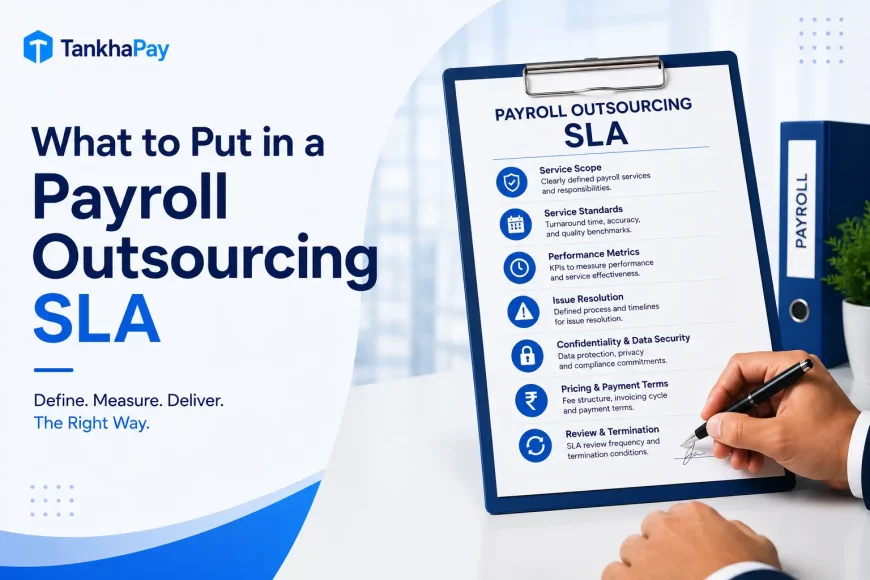
- Poorly defined service-level agreements. The single most common source of outsourcing disappointment is an SLA that never specified turnaround times, error resolution processes, or exactly which party is responsible for which compliance step.
In addition, there was no mention of who would do what regarding compliance issues. Most of the above risks can be controlled through having a properly defined agreement and choosing the right vendor; some cannot be mitigated at all even when staying in-house.
Payroll Outsourcing vs. In-House Payroll
| Factor | In-House Payroll | Outsourced Payroll |
|---|---|---|
| Internal workload | High, especially as headcount grows | Lower, shifts to the provider |
| Expertise required | Must be built or hired internally | Provided by the outsourcing partner |
| Technology | Business selects, licenses, and maintains its own | Typically included as part of the service |
| Scalability | Requires proportional internal investment | Generally scales with the provider’s infrastructure |
| Control | Full, direct operational control | Indirect, dependent on provider reporting |
| Cost structure | Fixed costs: software, staff, training | Variable costs: per-employee or service fees |
| Compliance support | Internal responsibility, requires ongoing expertise | Provider-supported, though ultimate liability terms vary by contract |
| Implementation | Ongoing internal ownership from day one | Requires an onboarding and transition period |
| Best suited for | Businesses with strong internal payroll expertise and stable, simple operations | Businesses with growing complexity, multi-state operations, or limited internal compliance capacity |
Read More: In-House Payroll vs Payroll Outsourcing
Neither model is universally better. The right choice depends on business complexity, internal capabilities, headcount, and growth trajectory, not a fixed rule that applies to every company.
Payroll Outsourcing vs. Payroll Software
These two terms get used loosely as if they mean the same thing. They don’t.
Payroll software is a technology tool an organization operates internally, with its own staff entering data and running the process. Payroll outsourcing is a service model in which an external provider performs agreed payroll activities on the business’s behalf.
The two aren’t mutually exclusive. Many payroll outsourcing providers deliver their service using their own payroll technology, meaning a business gets both the software and the operational team running it, rather than choosing one or the other. Some providers also offer payroll automation as a distinct layer, automating specific repetitive steps within an otherwise internally-run process, which sits somewhere between pure software and full outsourcing.
The practical question isn’t “software or outsourcing.” It’s “how much of this work do we want to do ourselves, and how much do we want someone else to own.”
When Should a Business Consider Outsourcing Payroll?
A few signals tend to indicate it’s worth evaluating:
- Payroll is consuming a disproportionate amount of internal time relative to the rest of HR or finance’s workload
- The company is growing quickly enough that current manual processes are starting to break down
- Payroll complexity is increasing, through variable pay structures, multiple entities, or a more diverse workforce
- The business operates across multiple states, each with its own Professional Tax, LWF, and compliance requirements
- Payroll expertise internally is restricted or exists in only one individual.
- Processes being manual have generated risks for non-compliance or errors.
- The company requires more standardized and auditable processes for payroll compared to what it currently has.
An internal payroll solution works well in cases where the company has a small and steady workforce, has existing payroll expertise within the company, and payroll processes are not becoming increasingly complex faster than the company’s capacity.
For startup-specific context, where the calculus often looks different from an established mid-market company, see why startups choose payroll outsourcing.
How Much Does Payroll Outsourcing Cost?
Providers generally use one of a few pricing structures:
- Per employee per month (PEPM): The most popular method scales according to the number of people employed
- Fixed monthly fee, commonly used by small and steady teams
- Tiered pricing, with rates that change at defined headcount thresholds
- Custom enterprise pricing, typically negotiated for large or complex organizations
- Additional charges for services outside the standard scope, such as off-cycle runs or custom reports
Considering the general pattern of price setting for payroll outsourcing across the industry in India, simple processing will usually lie in the INR 150-400 per employee per month category, processing of payroll along with statutory compliance will lie in the INR 300-800 category, and fully managed payroll services will usually lie in the INR 800-2,500 plus category. Additionally, there is also an additional setup cost of INR 5,000-30,000 approximately. This is a generic industry estimate, and the actual cost varies according to various parameters.
Key drivers behind price changes:
- Size of the workforce
- Complexity of payroll, including incentive payment methods
- Number of entities and business units
- Need to integrate with existing HRM system or accounting software
- Level of reporting required
- Requirements for implementation/data migration
Insist on seeing the total cost breakdown from any vendor, not just the stated price.
How to Choose a Payroll Outsourcing Provider
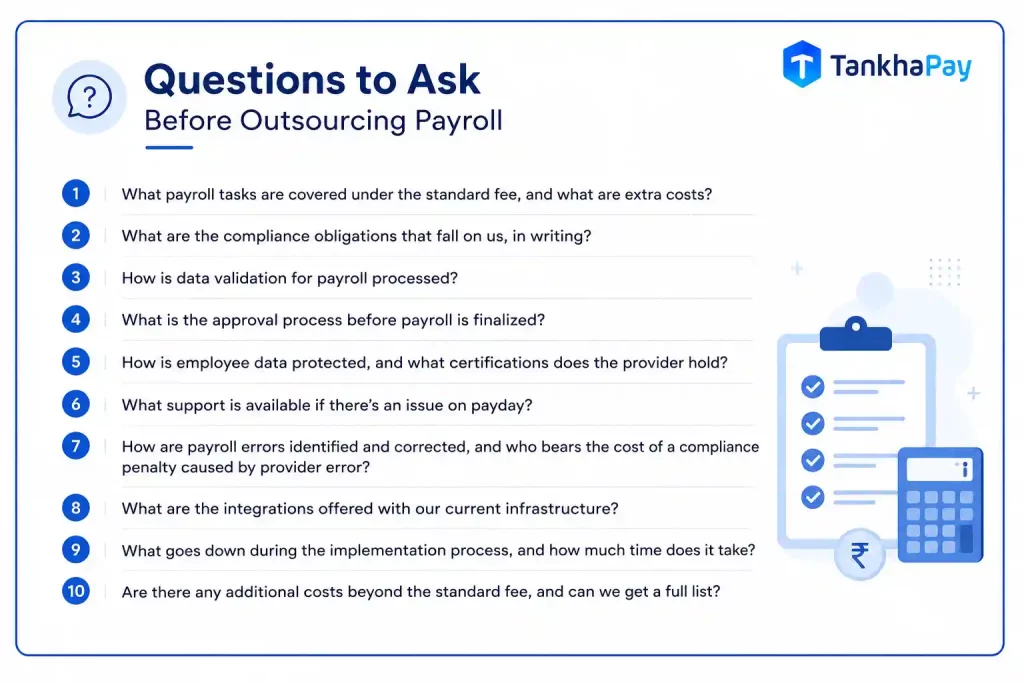
- Scope of services. Confirm exactly which functions are included, such as calculation, compliance filing, and reporting, and which remain your responsibility.
- Payroll expertise, particularly experience with businesses of your size and complexity, not just payroll processing in general.
- India-specific compliance knowledge, since Professional Tax, LWF, and other state-level requirements vary significantly across India, and a provider without deep multi-state experience can miss this.
- Technology capabilities, including whether the platform integrates with your existing attendance, HRMS, or accounting systems.
- Data security, covering encryption, access controls, and relevant certifications like ISO 27001.
- Integration options with the rest of your HR and finance tech stack.
- Implementation process, including realistic timelines and what’s required from your team during onboarding.
- Reporting depth, and whether you get real-time visibility or only periodic summaries.
- Support model, including response times and escalation paths when something goes wrong on a time-sensitive payroll date.
- Scalability, and whether the provider can handle your growth trajectory, not just your current headcount.
- Pricing transparency, with a complete fee schedule rather than a headline number that grows once you’re a customer.
- Service-level agreements, spelt out in writing, not implied in a sales conversation.
For a comparison of specific providers against these criteria, see our guide comparing payroll outsourcing companies in India.
How TankhaPay Approaches Payroll Outsourcing
A company assessing its decision to outsource payroll could consider the approach taken by TankhaPay in structuring its offerings. TankhaPay provides two approaches, namely complete payroll outsourcing, which entails the management of the entire payroll process, including statutory compliance, and partial payroll outsourcing, where companies retain the payroll process in-house but outsource some activities that require intensive compliance, such as PF, ESI, Professional Tax, and TDS filings.
The stated services provided by TankhaPay are statutory compliances in terms of PF, ESI, Professional Tax, LWF, and TDS, multi-state payroll services; and provision for various kinds of workforce like on-roll, off-roll, and contract workers.
Like any other service provider, compatibility lies in your hands depending on your organization’s payroll needs and manpower strength.
Frequently Asked Questions
What is payroll outsourcing?
Payroll outsourcing is where a company engages an outside firm in carrying out some or all aspects of payroll processing such as wage computations, tax deductions, preparation of pay slips, etc., instead of doing the job internally.
What is the meaning of payroll outsourcing services?
Payroll outsourcing services refer to the specific range of payroll activities a provider performs on a business’s behalf, which can range from a single function like compliance filing to the entire payroll cycle, depending on the service agreement.
How does payroll outsourcing work?
The company provides the inputs related to employees and payroll in each cycle; the vendor validates the inputs, computes payroll, makes statutory deductions and produces outputs, which are then verified and approved by the company before preparing payslips and making payroll payments.
What payroll functions can be outsourced?
Some payroll processes that can be outsourced include computation of salaries, statutory deductions (such as PF, ESI, TDS and Professional Tax), preparation of payslips, filing for compliance, payroll reporting and full & final settlement processing. This may vary depending on the vendor and contractual agreement.
What are the benefits of payroll outsourcing?
There is a reduction in the administrative burden, availability of compliance experts, increased standardization, improved scalability and less dependency on an individual in-house payroll expert.
Is outsourcing payroll cost-effective?
For many growing businesses, yes, particularly once the internal time and compliance risk of manual payroll are factored in against the outsourcing fee. It depends on company size and current payroll efficiency and isn’t automatically cheaper for every business.
Is payroll outsourcing suitable for small businesses?
Yes. Small firms which lack an in-house expert in this area may find outsourcing more efficient since it is cost-prohibitive to hire an expert in-house in small firms.
What is the difference between payroll software and payroll outsourcing?
Payroll software is a technology tool a business operates itself. Payroll outsourcing is a service where an external provider performs the work. Many outsourcing providers use their own payroll technology to deliver the service, so the two often overlap rather than being mutually exclusive.
What should you look for in a payroll outsourcing company?
Service scope clarity, expertise in compliance with laws unique to India, data protection measures, ability to integrate, price transparency, and an agreement on service levels in writing.
Can a company outsource only part of its payroll function?
Yes. There is a form of partial payroll outsourcing that consists of delegating specific tasks from the payroll process to a third party while retaining payroll processing in-house.
Conclusion
Outsourcing payroll services is an arrangement whereby an organization is able to outsource certain payroll services to an external agency based on mutual agreement. What matters most here is whether outsourcing payroll services is appropriate to the particular organization depending on various factors, including complexity of the payroll system, expertise, and organizational growth.
There’s no universal answer here, only a set of tradeoffs worth weighing against your own situation rather than a competitor’s case study.
If you’re ready to discuss what payroll outsourcing could look like for your organization, TankhaPay’s team can walk through your specific workforce size, complexity, and compliance requirements.
Discuss Your Payroll Outsourcing Requirements