Companies that once treated payroll as just another back-office checkbox are now rethinking it entirely, not because payroll has become simpler, but because it has become dramatically more complex. And many of them, from lean startups to large multinationals, are arriving at the same conclusion: managing payroll internally may no longer be the smartest use of their time, money, or talent.
This shift isn’t sudden. It’s been building steadily, and the numbers back it up. According to multiple industry reports, the global payroll outsourcing market was worth about USD 10-12 billion in 2024. It is estimated to grow at a CAGR of 6-7% to USD 17-21 billion by 2031.
So what’s really going on? Why are smart executives, people who’ve run payroll in-house for years, suddenly opening the door to Payroll Outsourcing Services? The answer is more layered than most people realise.
The Hidden Cost of Doing Payroll In-House
A Paychex study from 2024 found that almost two-thirds of business leaders spend at least 11 hours a week on HR tasks, which is more than a quarter of the whole work week.
SHRM (Society for Human Resource Management) noted that 57% of HR professionals are already working beyond capacity, contributing to burnout and turnover within HR teams themselves. In other words, the people you hired to support your workforce are being consumed by payroll paperwork.
The financial cost is just as striking.
- Payroll errors can cost companies up to 20% of total payroll expenses annually, according to PwC research.
- Around 33% of employers experience payroll mistakes every year, making it a widespread operational issue.
- For growing businesses operating across multiple states or countries, these errors tend to compound quickly.
- Payroll and tax compliance mistakes continue to carry significant financial consequences. According to the IRS Data Book, the agency assessed billions of dollars in civil penalties across tax categories in fiscal year 2024, reflecting the growing cost of filing and reporting errors.
- A significant portion of these penalties stemmed from errors that better payroll systems or specialist oversight could have prevented.
This is the real case for outsourcing. Not just convenience, but survival math.
What Does Payroll Outsourcing Actually Mean?
Before going further, it’s worth being clear about what we’re actually talking about, because “outsourcing” means different things to different people.
Payroll Outsourcing Services involve handing over some or all payroll-related responsibilities, salary processing, statutory compliance, tax filing, payslip generation, benefits management, and attendance reconciliation to a third-party provider. That provider employs specialists, runs dedicated payroll software, and takes on the liability of keeping your organisation compliant with the latest regulations.
There are generally two models:
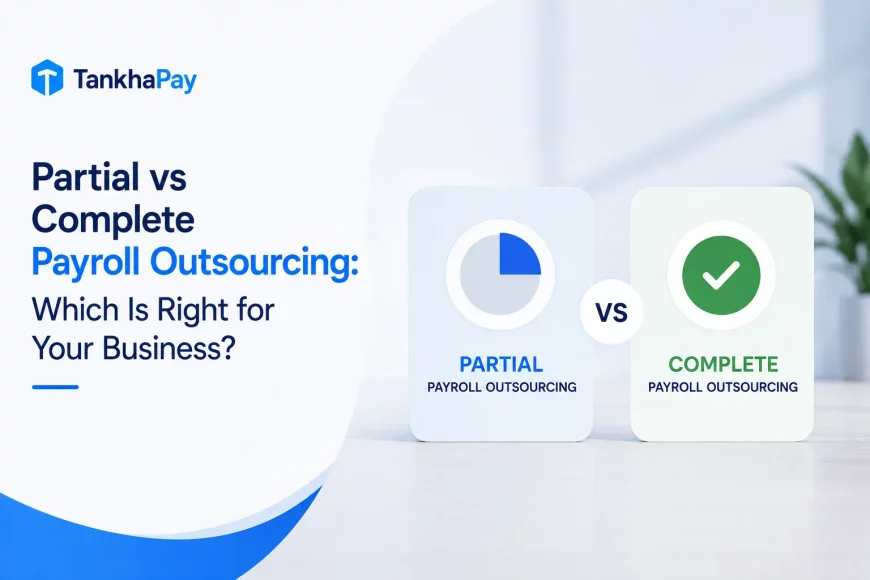
- Fully Managed Outsourcing: The provider owns the entire payroll function end-to-end. Your internal team only sees the output.
- Co-Managed / Hybrid Outsourcing: Your team handles some elements (like data input), while the provider manages the complex, compliance-heavy portions.
Both models are growing. According to Technavio, the hybrid payroll outsourcing segment was valued at USD 15.85 billion in 2024, reflecting continued demand for operating models that combine internal oversight with external payroll support.
Compliance keeps changing, and the risks are growing
If there’s one factor that’s accelerating the shift toward outsourced payroll more than any other, it’s compliance.
Labor laws, tax codes, and employment regulations are not static. They change constantly, sometimes quarterly. New codes, amended TDS rules, revised PF contribution structures, new state-level levies, and evolving GST implications for employee benefits.
India’s payroll compliance changes in 2025–26 – spanning the four Labour Codes and the new Income Tax Act – represent exactly this kind of significant shift.
70% of payroll problems are thought to come from complicated rules and regulations. And the results of making a mistake aren’t just financial; they also hurt your reputation. When employees get the wrong pay cheques, late payslips, or wrong tax deductions, they quickly lose faith in their employer.
These statistics are indeed alarming. For the past two years, HMRC (the revenue agency of UK) imposed penalties amounting to over £75 million for failing to report correct and timely data about payroll. The laws in India are no less stringent. There are mandatory deductions to the PF, ESIC, PT, and TDS, all of which are subject to audit.
This is exactly where outsourced payroll providers and HR Managed Services get their value. They absorb that regulatory complexity. They update their systems automatically when laws change. They carry the compliance risk so that CFOs and CHROs don’t have to lose sleep over a filing deadline they didn’t even know existed.
The American Payroll Association states that companies that outsource their payroll services are 65% less likely to be penalised for non-compliance issues. This is enough evidence in itself.
Hiring globally is easier with an EOR
One of the most significant developments in this space is the growing role of the Employer of Record (EOR) model, which has quietly become one of the most powerful tools for companies expanding globally or building remote-first teams.
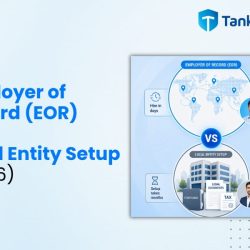
For instance: a company based in, say, Bengaluru needs to recruit a product manager from Germany and a software developer from Brazil. Establishing entities in each of the countries and complying with employment legislation in both nations is costly, time-consuming, and complex. The usual process can take between 6 and 8 months.
An EOR fixes this by being the official employer in the target country. The EOR takes care of local payroll, taxes, benefits, and compliance, but the client company is still in charge of the employee’s work. The result is that businesses can hire people in new markets in days instead of months, without having to set up a local business.
This model has become central to the global expansion strategy of hundreds of multinationals and high-growth startups alike. It sits at the intersection of Payroll Outsourcing Services and HR Managed Services, making it one of the most holistic tools available to modern CHROs and People Operations teams.
The Technology Leap That Made It All Possible
A decade ago, outsourcing payroll meant emailing spreadsheets and waiting three days for someone to call you back. It looks very different now.
Today’s payroll software is cloud-based, uses AI, and works well with HRMS, attendance systems, accounting tools, and employee self-service portals. Papaya Global said in January 2025 that its AI-powered payroll system was 99.7% accurate at delivering payments and sped up payroll processing by 40%. It also cut the time it took to set up the technology from 24 months to just 4 weeks.
The platforms provide:
- Real-time access to payroll dashboards by HR, finance, and staff
- Automatic tax calculation and filing
- Payroll in multiple currencies in different countries
- Real-time payslips generation and delivery
- Leave management connected to payroll deduction process
- Audit trail for each transaction
Businesses using automated payroll systems report 70% fewer compliance issues and 31% fewer errors, according to G2 research. The old stigma around outsourcing that you “lose visibility” simply doesn’t hold in the current generation of cloud payroll platforms.
The data shows a clear shift toward payroll outsourcing
| Metric | Statistic |
|---|---|
| Global Payroll Outsourcing Market (2024) | ~USD 10-12 billion |
| Projected Market Size by 2031 | ~USD 17-21 billion |
| CAGR (2025-2031) | 6-7% |
| US companies outsourcing at least one HR function | ~80% |
| Businesses outsourcing some/all payroll | ~60.6% |
| Reduction in compliance penalties (outsourced vs. in-house) | 655 less likely |
| Average monthly hours saved per company on payroll | ~21 hours |
| Cost savings for a 50-employee firm outsourcing payroll | ~USD 10,000/year |
| Average cost reduction from outsourcing payroll | 18-35% |
| Small businesses currently outsourcing payroll | 23% |
| Companies considering outsourcing most/all payroll | 69% |
| Payroll error cost (annual, as % of payroll) | Up to 20% |
| HR time saved on admin when payroll is outsourced | From 70% → 30% |
| Employee satisfaction improvement (outsourced payroll) | +15% |
Who’s Leading the Shift to Payroll Outsourcing?
It would be easy to assume that payroll outsourcing is primarily a small business solution, something you do when you can’t afford a dedicated payroll team. But the data tells a more nuanced story.
Small businesses are certainly driving volume. Companies with fewer than 50 employees often don’t have the in-house knowledge to handle payroll correctly. By outsourcing, they can get access to enterprise-level systems and experts at a much lower cost than if they did it themselves.
Mid-market companies, with 100 to 1,000 employees are switching because their payroll systems can’t keep up with their growth. What worked for 80 people doesn’t work for 300. New locations, new tax jurisdictions, remote workers, and different types of contractors all make things more complicated faster than most finance teams can keep up with.
Large enterprises are increasingly adopting HR managed services as part of broader digital transformation and cost rationalisation programmes.
Deloitte’s 2024 payroll survey found that organisations don’t outsource payroll purely to cut costs, they outsource because their internal technology can no longer keep up. “Technology limitations are the most pressing service delivery issues which respondents face in payroll,” the report noted.
The fastest-growing segment? Multi-country payroll outsourcing (MCPO) is becoming more popular because more and more teams are working from home and around the world. Companies that do business in more than one country need payroll providers who can handle different regulatory environments from a single platform. This is a skill that in-house teams just can’t replicate at scale.
Also Read: Does Payroll Outsourcing Improve Employee Retention?
What Do Payroll Mistakes Really Cost You?
There’s a dimension to this conversation that often gets overlooked in boardroom discussions, and it’s the most important one. The experience of the employee.
60% of employees believe that accurate payroll directly impacts their workplace satisfaction. Employees who get paid on time and correctly are 40% more likely to be involved at work. A wrong salary slip, a late reimbursement, or a wrong PF deduction doesn’t just make things tense; it also makes people doubt. It’s very hard to get rid of doubt once it’s in the employee relationship.
The right payroll partner changes this. Providers featured in our Top 10 Payroll Outsourcing Companies in India run dedicated compliance systems and teams whose only job is getting this right. They give employees self-service portals to check payslips, tax forms, leave balances, and investment declarations in real time.
When CHROs talk about “employee experience”, payroll is not glamorous enough to make it into most presentations. But it is the most fundamental touchpoint of the employer-employee relationship. Get it right, and it’s invisible. Get it wrong, and it’s all anyone talks about.
For many businesses, payroll outsourcing is no longer just about efficiency, it’s about avoiding costly compliance mistakes. Payroll errors can result in penalties, interest, legal disputes, and reputational damage. Learn more about payroll compliance penalties and how businesses can proactively reduce compliance risks.
How TankhaPay Brings Global Payroll Efficiency to Indian Businesses
India is not immune to this global trend; in fact, it’s one of the most compelling markets for payroll outsourcing, given the sheer complexity of the Indian regulatory environment. Between PF, ESIC, PT, TDS, LWF, gratuity, and variable pay structures that differ across industries and states, Indian payroll is among the most technically demanding in the world.
TankhaPay is built precisely for this reality.
Designed as a comprehensive payroll and HR compliance platform for Indian businesses, with particular strength in the blue-collar and contractual workforce segment, TankhaPay addresses the exact pain points that are driving the global outsourcing shift. It brings together automated salary disbursement, statutory compliance management (PF/ESIC/PT), digital employee onboarding, and attendance-linked payroll processing in one unified system.
For business owners that manage large teams across multiple states or countries, TankhaPay works as the payroll technology backbone, eliminating manual errors, ensuring compliance with labour law updates, and giving HR and finance teams the visibility they need without the administrative burden they currently carry.
What’s Stopping Companies From Outsourcing Payroll?
To be fair, not every company that considers outsourcing pulls the trigger, and the hesitations are legitimate.
Loss of control is the most cited concern. When payroll is internal, there’s a sense that issues can be resolved immediately. An outsourced model introduces a layer of dependency, and if the provider has a delay or error, resolution can feel slower.
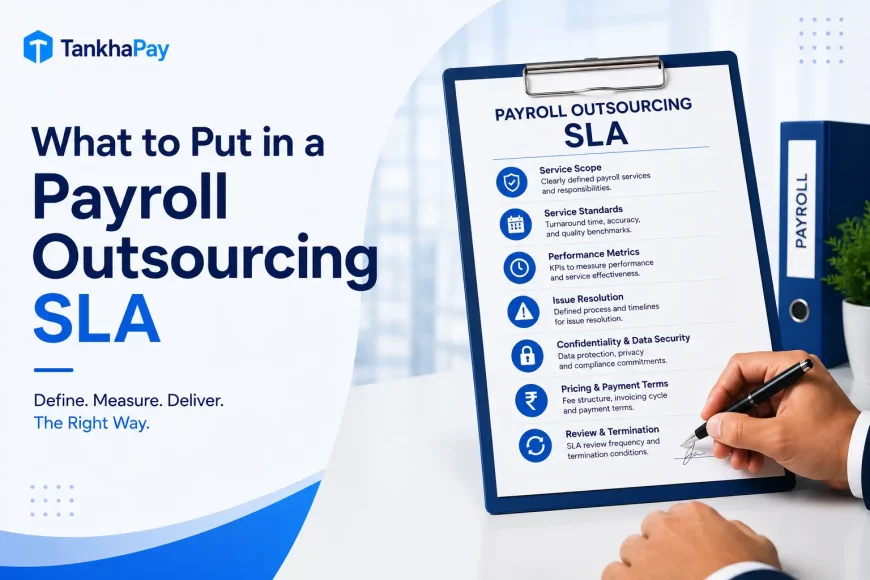
Data security is another real concern. Payroll data is one of the most sensitive data a company holds, salaries, bank accounts, PAN numbers, and addresses. Sharing it with a third party requires trust, robust data agreements, and a provider with strong security infrastructure.
Hidden costs can also surprise businesses. Setup fees, per-employee pricing, charges for off-cycle runs, and additional costs for statutory filing can add up if not scrutinised upfront.
These are genuine considerations, and any business evaluating outsourcing should address them head-on with potential providers. But it’s also worth noting: none of these concerns are unique to outsourcing. Data breaches happen with in-house systems too. Hidden costs exist in manual payroll processing (they’re just buried in HR salaries and overtime). Loss of control is often illusory; modern platforms give clients as much visibility as they want.
The question isn’t whether outsourcing is perfect. It’s whether it’s better than what you’re doing now.
The Verdict
Some trends pass. This one won’t.
The forces driving payroll outsourcing, regulatory complexity, global workforce distribution, and the talent cost of HR burnout and the technological superiority of specialised platforms are not going away. If anything, they are intensifying. As more companies hire cross-border, as tax laws continue to evolve, and as employees demand more transparency and real-time access to their own data, the case for outsourcing payroll only gets stronger.
What we’re witnessing is not just a passing preference, it’s an entire shift in the mindset of how companies approach their business infrastructure needs. Payroll is no longer just an office task. It can become so much more in the hands of a good payroll processing company.
The businesses that recognise this early, that invest in the right Payroll Outsourcing Services, the right payroll software, the right HR Managed Services partner, or, where necessary, an EOR, will carry a structural advantage into the years ahead. Not because they outsourced a problem, but because they freed their people to focus on what actually builds the business.
The quiet switch is underway. The only real question is, where does your business stand?