
Leaving a job or managing an employee’s resignation involves several formal processes, and one of the most important among them is the notice period. If you are wondering about the notice period meaning, it refers to the official duration an employee or employer must serve before ending employment. A proper notice helps ensure smooth communication, work handover, and business continuity while reducing workplace disruptions.
In this article, we will explain what is notice period, its types, duration, rules, and the importance of a notice period letter. We will also cover its formats, examples, and best practices for employees and employers.
What is a Notice Period?
A notice period is the official period of time between an employee submitting their resignation or receiving a termination notice and their final working day with the company. During this time, the employee is generally expected to continue performing their duties, complete pending assignments, hand over responsibilities, and support a smooth transition process.
It is a professional buffer that gives both the employer and employee enough time to prepare for the end of employment. It helps organizations maintain workflow continuity while allowing employees to close ongoing tasks properly.
The duration is usually defined in the employment contract and can vary based on company policy, job position, industry standards, and labour regulations. In some cases, companies may also offer alternatives such as buyout or pay in lieu of notice.
How to Submit a Notice
You should follow these steps when submitting a Notice:
- Give your employer a two-week notice to give the organisation time to prepare for your departure. Consider your position and responsibilities before giving more notice. Discuss a start date with your new employer and decide whether to take time off between jobs.
- Talk with your supervisor or manager to let them know you are leaving the company before submitting your resignation. Discuss all the relevant details regarding your decision and how to delegate your work.
- Writing a formal resignation letter is essential. It should follow a formal business letter format and include your contact information, the date, a statement of resignation with your final employment date, a line of gratitude, and your signature.
- After resigning, tell your coworkers. You can do it in person for close colleagues and email or message the rest.
- Prepare your team for the departure by training them, creating how-to guides, and organising your files. Ask your manager for guidance and plan a farewell gathering for closure.
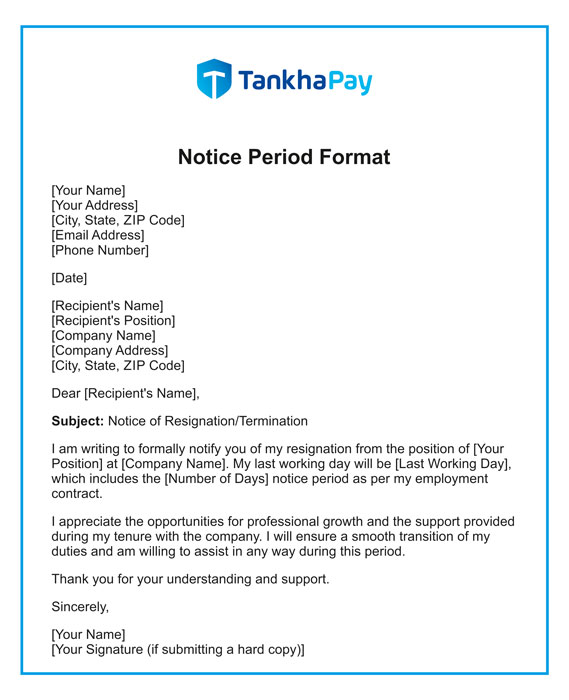
Notice Period Format
[Your Address]
[City, State, ZIP Code]
[Email Address]
[Phone Number]
[Date]
[Recipient’s Name]
[Recipient’s Position]
[Company Name]
[Company Address]
[City, State, ZIP Code]
Subject: Notice of Resignation
Dear [Recipient’s Name],
Main body
Paragraph 1
Mention the duration of the notice period and explain the reason for resignation.
Paragraph 2
Write briefly about your experience in the firm and express gratefulness.
Closing salutation
Sincerely/ regards
Applicant’s signature on the hard copy
Applicant’s name
Notice Period Format for Download
| Formats | Files |
|---|---|
Notice Period Format in Word |
Download |
Notice Period Format in PDF |
Download |
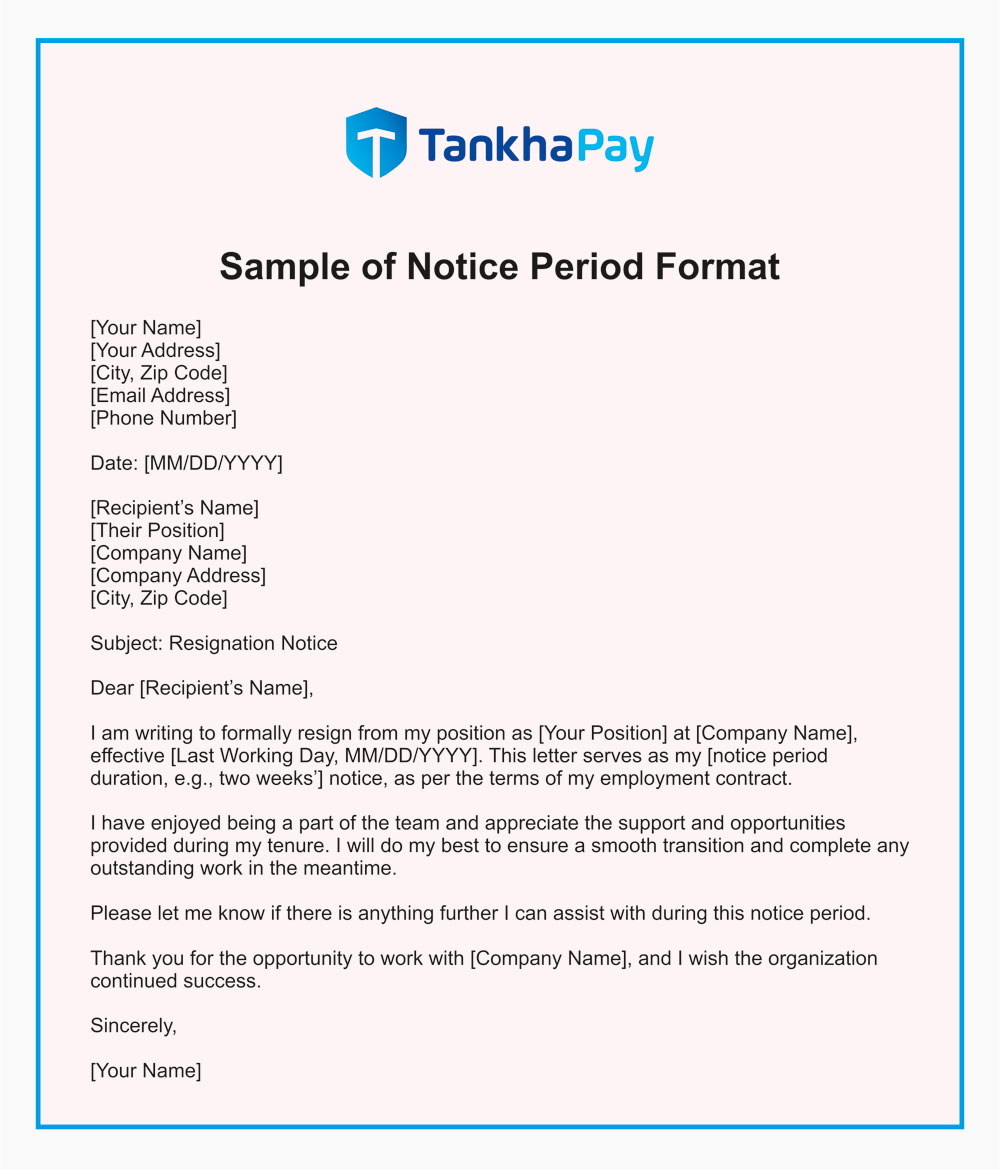
Sample of Notice Period Template
[Your Address]
[City, State, ZIP Code]
[Email Address]
[Phone Number]
[Date]
[Supervisor’s/Manager’s Name]
[Company Name]
[Company Address]
[City, State, ZIP Code]
Subject: Notice of Resignation
Dear [Recipient’s Name],
I am resigning from my position at [Company Name], effective one month from today. I have truly enjoyed my time at the company and feel privileged to have worked alongside such talented and fabulous colleagues. Thank you for your guidance during my time here, which has been an honour.
However, I have recently received an offer for a job that has always been my dream, and it is time for me to take my passion to the next level. I hope my contributions to the company have been valuable, and I am grateful for all the opportunities I have had here.
Please let me know how I can best assist during this transition period, and I will do my best to make the process as smooth as possible for you and the company.
Thank you again for everything.
Sincerely,
Applicant’s signature on the hard copy
Applicant’s name
Purpose of Notice Period
It has the following purpose:
- It protects the rights of both employers and employees, ensuring a responsible end to the employment relationship.
- Providing advance notice of resignation demonstrates commitment and respect for the employer’s needs and time.
- It facilitates a smooth transition of responsibilities, which is the primary purpose of a notice period. This includes handing over ongoing projects, training successors, and ensuring a smooth workflow.
- When departing employees can transfer their knowledge and expertise to team members. This knowledge transfer is crucial for maintaining continuity and preventing disruptions in the workflow.
- It allows an employer the time to adjust the employee’s departure. It allows the organisation to find a suitable replacement, adjust the remaining team, or find a solution for unfinished projects.
- Employees can tie up loose ends during the notice period, find another job, and inform other stakeholders before the official termination date.
Importance of Notice Period
The importance is as follows:
- Ensuring Smooth Transition: A notice period provides a smooth transition for employees and employers. Quitting a job with proper notice can prevent the team from scrambling to handle the departing employee’s tasks and find a replacement.
- Respect and Courtesy: Giving proper notice shows respect and courtesy towards the employer and colleagues. It allows everyone involved to plan and adjust to the upcoming changes in a more organised manner.
- Preparation for Departure: Providing an end date in advance helps employers prepare for the employee’s departure. They can start writing a job posting, reviewing applications, and initiating interviews to fill your position.
- Task Delegation: During the notice period, the employer can delegate the employee’s tasks to other colleagues or team members. This ensures that the workflow is not disrupted and responsibilities are effectively transferred.
- Helping with Transition: Contributing actively to the team’s transition process is essential. This can involve creating training materials, offering guidance to colleagues, and ensuring a smooth handover of your responsibilities.
- Leaving on Good Terms: Giving notice is a way to quit a job on good terms. When the team feels prepared for the departure, they are more likely to view the change positively, and the employee’s exit may be met with excitement rather than resentment.
- Professional Relationship Maintenance: Leaving a job with proper notice helps maintain professional connections. An individual may need to rely on old coworkers or employers for favours, references, or networking opportunities in the future.
- Positive Outlook for Future Interactions: By leaving in the kindest way possible, an individual sets the stage for positive future interactions with former colleagues and employers. This can be valuable for their professional network and may benefit their career journey.
Benefits of Notice Period
The benefits are as follows:
- Smooth Transition: The notice period gives employers time to find a replacement and ensures a smooth transition, minimising disruptions to the organisation’s operations and the risk of delays or errors in ongoing projects.
- Knowledge Transfer: Employees should transfer their knowledge and skills to replacements or remaining team members during the notice period to retain essential institutional knowledge.
- Risk Mitigation: It reduces the risk of legal disputes and helps the company comply with contractual obligations, such as paying compensation in case of breach of contract.
- Reputation Management: It helps employers manage their reputations and maintain positive relationships with departing employees, especially if they join competitors.
- Cost Savings: It helps employers plan and budget for replacement, reducing recruitment costs and minimising financial impact.
The different types of notice periods are as follows:
- Statutory Period: It is an obligation when an employer terminates an employee. It depends on the period of employment, i.e., one week for one year, two weeks for two years, and so on.
- Contractual Period: The employment contract specifies the notice period for the employer and employee, which cannot be shorter than the statutory notice. It can vary depending on the contract terms.
- Probationary Notice: It can range from one day to three months, depending on the employee’s position. Two exceptions are allowed – if an employee may pay compensation for the entire notice period to end their employment or an employee joins a competitor, they may serve the notice away from work and still be paid.
- Dismissal Without Notice or Gross Misconduct: An employee can be dismissed for gross misconduct or behaviour without being allowed to work or paid. If the behaviour is severe or alarming, it could be considered a breach of contract.
- Payment in lieu of Notice: When an organisation does not want a person to work through their notice, it pays the equivalent salary, allowing them to leave immediately.
- Garden Leave: The organisation pays the employee their regular salary for the duration of their notice to stay away, temporarily keeping them as an employee.
- Fixed Term Contract: The employer specifies the last day of employment; no notice period is required. If the employer terminates the contract early, they must give appropriate statutory notice.
- Redundancy Notice: Employees who are let go due to job elimination or redundancy must serve a notice based on their length of service. The notice period is one week for every year worked.
- Withdrawing Notice: It is impossible to cancel a notice until both parties, the employer and employee, agree to withdraw it.
- Notice Period for Resignation: Employees must give at least one week’s notice when resigning, but it can be extended up to one month, depending on the contract and seniority level.
Period of notice
The duration of notice periods can differ depending on various factors such as industry standards, employment contracts, and the position. Generally, it ranges between two weeks to three months. However, top-level positions may require more extended notice periods. The duration of notice can be discussed between both parties based on job complexity and replacement time.
When you sign an employment contract during onboarding, businesses often outline their notice expectations. Consider how much notice you should give and prioritise your career needs while being considerate of company operations. If you have another job lined up and are on good terms with your employer, you could give a more extended notice to ease the transition.
How to Manage Employees During Notice Period
- Communicate and Document: Employers must ensure employees understand the resignation process during the notice period. Confirm all details, document discussions and avoid legal disputes.
- Focus on the employee’s performance: Use the notice to maintain good employee performance. This benefits both employer and employee, especially when looking for a new job.
- Negotiate terms: Employers and employees can negotiate terms in the employment contract, such as full salary during the Notice Period or relinquishing vesting stock options.
How to implement an effective notice period system
Organisations can implement an effective notice period system with the following methods:
- Include the notice in the employment contract.
- Clearly explain the notice period policy, outlining both employer and employee obligations.
- Offer incentives, such as severance pay or a discretionary bonus, to encourage employees to provide notice of their departure, even if notice is not legally required.
- Conduct regular performance reviews and document any unsatisfactory or negative employment behaviour, addressing problems before they escalate.
- Ensure managers and HR staff receive adequate communication and problem-solving training to identify and address dissatisfied employees.
- Practice goodwill during the notice period by demonstrating courtesy and proper etiquette so that the employer and employee can part on respectful terms.
Conclusion
Notice periods are essential for a smooth transition when an employee resigns. By understanding their purpose and best practices, employers and employees can maintain professionalism, respect, and continuity of business operations. Effective management of notice periods fosters a positive organisational culture and strong relationships between employers and departing employees.
Frequently Asked Questions
What Is 'Garden Leave'?
Garden leave is a paid leave given to employees who have resigned, during which they are not allowed to work for their employer's competitors or themselves.
What is a standard notice period?
A standard notice period is between one to two months. They are determined mainly by the employment contract and the law.
What is the correct notice period?
If employed for less than a month, notice is optional. If hired for over a month, one week's notice is mandatory. Resigning in writing is recommended.
Can I refuse my notice period?
Employees must fulfil the specified notice period in their contract or face legal action from the employer. The employee can negotiate the period for compensation or to avoid work. The employer cannot extend the notice period without the employee's consent.
Is a notice period necessary?
Notice periods allow employees to finish projects and plan for succession while giving them time to look for a new job. The employer can use this time to find a replacement and plan for future work.
Can employers request employees to serve a notice period even if they resign?
Employers can ask employees to serve the entire notice period after resigning. Check the employment contract for the notice period.
Can employers terminate employees during their notice period?
Employers can terminate employees during their notice period. Still, they must pay the employee for the whole period respectfully.
Can I take leave during the notice period?
Leave during this period reduces the notice period workdays.