TL; DR:
AI recruitment is the use of artificial intelligence and machine learning to automate and improve hiring, from screening resumes and scoring candidates against past successful hires to scheduling interviews and predicting who is likely to succeed in a role. It speeds up sourcing and screening while leaving final hiring decisions to human recruiters.
Want to see this in action for high-volume Indian hiring? Explore TankhaPay’s AI Recruitment & Staffing Services.
What is AI Recruitment?
‘AI recruiting’ refers to the employment of artificial intelligence and machine learning in automating and optimizing the process of recruitment. It covers everything from writing job descriptions to shortlisting candidates and scheduling interviews.
AI recruiting differs from traditional recruiting because it evaluates, prioritizes, and predicts hiring through analysis of data rather than relying purely on the subjective evaluation of the recruiter. It does not replace recruiters but gets rid of all those mundane tasks that hinder their performance.
This technology combines three aspects: machine learning to recognize patterns, natural language processing to read CVs and correspondence, and automation to schedule and follow up on procedures.
How is AI Recruitment Different From Traditional Hiring?
Traditional recruitment relies on manual resume review, job board postings, and a recruiter’s subjective judgement at every stage. Each of these steps takes time, and none of them scale well when hundreds of applications arrive for a single role.
Evaluation of all the candidates is done by using the same set of criteria for everyone. If an application is analyzed at 9 o’clock in the morning, then it is evaluated by using the same criteria as one at 9 o’clock in the evening.
| Traditional Recruitment | AI Recruitment | |
|---|---|---|
| Resume review | Manually, one at a time | Automated, at scale |
| Sourcing | Job boards, referrals | Automated database and passive candidate search |
| Screening consistency | Varies by recruiter | The same criteria applied every time |
| Speed | Days to weeks per stage | Hours for initial screening |
| Scheduling | Manual back-and-forth | Automated, often instant |
How Does AI Recruitment Actually Work?
AI recruitment tools generally fall into five categories, each handling a different part of the hiring workflow.
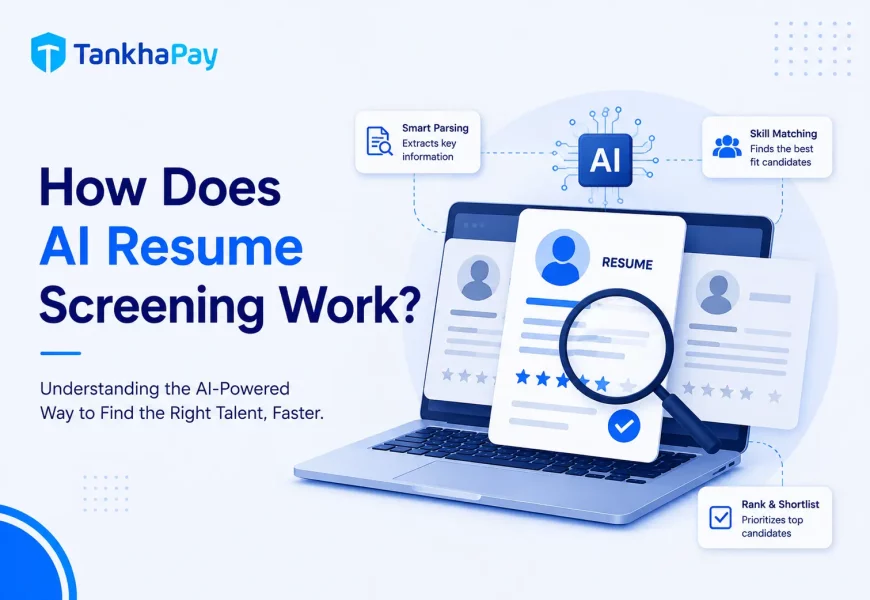
- Resume screening and candidate scoring. Natural language processing scans resumes for skills, experience, and keywords, then ranks candidates against the requirements of the role and, in more advanced systems, against the profile of past successful hires. See How Does AI Resume Screening Work for the full step-by-step breakdown
- Automated sourcing. AI tools search candidate databases and professional networks to find both active applicants and passive candidates who aren’t actively job hunting but match the role.
- Chatbots and candidate communication. AI-powered chatbots answer candidate questions, send status updates, and manage interview scheduling around the clock, without waiting for a recruiter to be free.
- Video interview analysis. Some platforms assess recorded interview responses for communication skills and role-relevant competencies, though this is one of the more debated applications and worth using carefully.
- Predictive analytics. By analyzing historical hiring data, AI can flag which candidates are statistically more likely to succeed in a role, and which sourcing channels tend to produce the strongest hires.
While these technologies explain how AI recruitment works, choosing the right platform is equally important. Compare the top AI recruitment software in India to see which solutions combine resume screening, candidate sourcing, interview automation, and hiring analytics.
What are the Benefits of AI Recruitment?
AI recruitment delivers four benefits that show up consistently across companies that adopt it.
Faster time-to-hire. Automating resume screening and interview scheduling removes two of the slowest manual steps in hiring. For a full breakdown of where hiring delays actually happen in India, see TankhaPay’s guide to average time-to-hire.
More consistent screening. Every candidate is evaluated against the same criteria, which reduces the variation that happens when different recruiters screen different batches of resumes.
Lower cost per hire. Less recruiter time spent on administrative tasks means more time spent on interviewing and closing candidates, not sorting through resumes.
Better data for hiring decisions. AI tools track which sourcing channels and job descriptions actually produce successful hires, turning hiring strategy into something you can measure rather than guess at.
AI Recruitment for High-Volume and Blue-Collar Hiring in India
Most AI recruitment content is written for white-collar, English-first hiring. High-volume and blue-collar recruitment in India works differently, and it’s where AI recruitment often makes the biggest practical difference.
Manufacturing, retail, logistics, and warehouse roles frequently generate hundreds of applications for a single posting. Manual screening at that volume is where hiring timelines break down the fastest.
Blue-collar hiring also carries compliance requirements that white-collar hiring doesn’t: PF and ESI eligibility checks, document verification, and multi-location consistency across branches or plants. An AI recruitment process built for the Indian market accounts for these from the sourcing stage, not as a separate step after someone is hired.
This is also where recruitment and payroll intersect directly. Once a candidate is selected, the same data used to screen them (documents, eligibility, compliance status) needs to flow into payroll setup without being re-entered a second or third time. TankhaPay’s AI Recruitment & Staffing Services are built around this handoff specifically, connecting AI-assisted screening to payroll and compliance activation in one workflow.
What are the Challenges of AI Recruitment?
AI recruitment isn’t without real limitations, and a credible hiring strategy accounts for them rather than ignoring them.
Bias in training data. AI systems trained on historical hiring data can replicate whatever bias existed in that data. Regular audits of AI screening outcomes are necessary, not optional.
Data privacy under the DPDP Act. Indian employers using AI to screen resumes and score candidates are processing personal data under the Digital Personal Data Protection Act. This affects what can be collected, how long it’s stored, and what disclosure is required to candidates.
Over-reliance on automation. AI can rank and shortlist, but it can’t assess cultural fit or read the nuance of a candidate’s career story the way an experienced recruiter can. The strongest processes keep a human in the final decision.
Reduced accountability if used carelessly. If AI screens out candidates before a human ever sees the application, an organization needs a clear answer for how and why that decision was made.
AI Recruitment vs. Automation vs. ATS: What’s the Difference?
These three terms get used interchangeably, but they aren’t the same thing.
| Term | What It Actually Does |
|---|---|
| Automation | Rules-based tasks with no learning or adapting, like auto-sending a rejection email |
| Applicant Tracking System (ATS) | Organizes candidate data and tracks where each applicant sits in the hiring pipeline |
| AI Recruitment | Analyzes patterns in candidate and hiring data to screen, score, and predict outcomes |
An ATS without AI is still just a filing system with a workflow attached. AI recruitment usually integrates with an ATS to add the analysis and scoring layer on top of it.
Does AI Replace Human Recruiters?
No. AI recruitment handles high-volume, repetitive tasks. Recruiters handle judgment, relationship-building, and the final hiring decision.
The organizations getting the most value from AI recruitment use it to surface a stronger, faster shortlist, then let experienced recruiters make the call on who actually gets hired. AI narrows the field. People still decide.
This division of labor also holds up better under scrutiny than a fully automated process, since a human is always accountable for the final decision, not an algorithm.
Frequently Asked Questions
Is AI recruitment the same as recruitment automation?
No. Automation follows fixed rules without learning. AI recruitment analyzes data, adapts, and improves its screening over time as it sees more hiring outcomes.
Does AI recruitment work for blue-collar and high-volume hiring?
Yes, and it’s often where AI recruitment adds the most value, since manual screening breaks down fastest when hundreds of applications arrive for entry-level or high-volume roles.
Is AI recruitment legal in India?
Yes, but it’s subject to the Digital Personal Data Protection Act, which governs how candidate data collected during AI screening can be used, stored, and disclosed.
Can AI recruitment reduce hiring bias?
It can, if properly audited. AI trained on biased historical data can also replicate that bias, so ongoing auditing of screening outcomes matters more than the technology itself.
Do I need an ATS before I can use AI recruitment?
No, but most AI recruitment tools integrate with an ATS to manage the candidate pipeline while the AI layer handles screening and scoring.
Bottom Line
AI recruitment is not a replacement for recruiters. It’s a way to remove the repetitive, high-volume work that slows hiring down, so the humans on your team can spend their time on the parts of hiring that actually require judgment.
For Indian companies hiring at volume, especially in manufacturing, retail, and logistics, the biggest gains come from combining AI-assisted screening with a process that already understands Indian compliance requirements and connects cleanly into payroll once someone is hired.