Written by 3:47 pm HR Glossary

Top 10 Payroll Outsourcing Companies in India (2026)

Payroll outsourcing compaines

Table of Contents

Introduction to Payroll Outsourcing in India

For many Indian companies, payroll outsourcing has rapidly developed from a straightforward cost-cutting technique to a strategic concern.  Managing payroll internally has grown more time-consuming and dangerous as businesses cope with multi-state operations, hybrid teams, and ongoing labour legislation revisions.  This is why more organisations now rely on Payroll Outsourcing Services to simplify payroll management, improve accuracy, and strengthen compliance.

Today, leading Payroll Outsourcing Companies in India go beyond basic salary processing. They combine automation with expert oversight to manage PF, ESIC, TDS, PT, LWF, and other statutory requirements — helping HR leaders avoid penalties and maintain audit-ready records. Moreover, outsourced payroll delivers faster payroll cycles, fewer errors, and a better employee experience.

Payroll outsourcing ultimately frees up companies to concentrate on expansion rather than administrative complication. To assist you in selecting the best payroll partner for 2025–2026, we’ve broken down the essential features, advantages, and assessment standards in this guide.

What is Payroll Outsourcing?

The process of collaborating with outside specialists to precisely manage your business’s entire payroll and statutory obligations is known as payroll outsourcing. Instead of handling everything internally, businesses now rely on specialised payroll outsourcing companies to collect payroll inputs, calculate salaries, manage deductions, and ensure month-on-month compliance with complete accuracy. In fact, these providers take care of every detail — from loss-of-pay adjustments, overtime, arrears, and bonus calculations to statutory deductions such as TDS, PF, ESIC, Professional Tax, and LWF.

Leading payroll outsourcing services also handle the filing of PF/ESI returns, the creation of challans, the timely submission of TDS returns, and the maintenance of audit-ready paperwork in addition to processing payroll. Along with this, they offer structured payroll reports, digital payslips, and secure employee self-service access that improves transparency and reduces HR dependency.
Payroll outsourcing has consequently gained popularity. More than 70% of India’s top 500 businesses now outsource payroll in order to lower compliance risks and improve operations, according to Forbes Advisor. At the same time, small and mid-sized businesses are rapidly adopting it as well, recognising how efficiently it cuts down manual work and improves accuracy across the entire payroll process.

How Payroll Outsourcing Works in India (Step-by-Step Process)

Payroll outsourcing in India may sound complex at first, but the process is actually highly structured and efficient—especially when handled by experienced Payroll Outsourcing Companies in India. Businesses receive a streamlined system where experts and technology collaborate rather than managing spreadsheets, regulatory deadlines, and cross-department collaboration. HR directors benefit from accuracy, quicker payroll cycles, and the assurance that legislative compliance is always current.
Moreover, modern Payroll Outsourcing Services integrate HRMS, payroll management tools, and cloud-based payroll software to ensure data flows smoothly from one stage to another.

Below is a clear breakdown of how the entire payroll outsourcing workflow operates in India:

1. Data Collection & Employee Information Setup

The process begins with gathering all essential employee details—personal profiles, bank information, salary structures, cost-to-company components, joining dates, variable pay, and more. This foundational step ensures payroll accuracy right from the start.
Additionally, outsourcing providers map your existing HR and finance workflows so that every payroll input aligns with your organisation’s structure.

2. Attendance & Leave Synchronisation

Next, the outsourced partner integrates your attendance and leave data—whether it comes from biometric devices, mobile apps, spreadsheets, or HRMS systems.
This ensures that working hours, overtime, weekly offs, holiday calendars, and LOP (Loss of Pay) deductions automatically flow into payroll processing. Consequently, HR no longer needs to manually reconcile multiple attendance sources every month.

3. Salary Calculation & Earnings/Deductions Automation

Once attendance is synced, the service provider uses payroll accounting software to compute salaries with complete precision.
Basic pay, HRA, allowances, overtime, variable incentives, arrears, bonuses, and all statutory deductions are calculated automatically. Because calculations are rule-based and system-driven, the risk of human error drastically reduces—ensuring smoother payroll runs.

4. Statutory Deductions & Compliance Check

One of the biggest advantages of Payroll Outsourcing Services is compliance accuracy.
At this stage, PF, ESIC, LWF, Professional Tax, TDS, and other statutory deductions are auto-applied as per state-wise and central labour laws. The system validates each employee’s eligibility, wage thresholds, and deduction slabs—keeping the entire payroll compliant without manual intervention.
Given India’s frequently changing labour regulations, this step alone saves organisations from penalties and audits.

5. Payroll Run & Validation by Experts

After calculations and deductions are finalised, payroll specialists conduct a thorough validation process.
They perform multiple checks—variance analysis, mismatch detection, CTC accuracy, overtime validation, and compliance cross-verification.
Only once everything is confirmed do they close the payroll run, generate salary sheets, and prepare bank transfer files. This expert-led verification is a major reason enterprises prefer Payroll Outsourcing Companies in India over in-house teams.

6. Payroll Reports, Analytics & Approval Workflows

Once payroll is processed, detailed reports are generated—salary register, reconciliation sheets, variance reports, cost center breakdowns, and department-level analysis.
CFOs and HR directors have a thorough understanding of personnel trends, payroll costs, and budgetary information. Authorised staff may access these reports at any time and from any location using cloud-based payroll software, guaranteeing transparency throughout the company.

7. Statutory Filings, Challans & Monthly Compliance Completion

Finally, the outsourcing partner prepares and files all statutory returns.
This includes PF ECR uploads, ESIC filings, PT challans, TDS returns, and digital record submissions.
All filings are done within government timelines, reducing compliance risk and strengthening governance. Additionally, audit-ready documents are stored securely for future reference—making the entire payroll and compliance cycle exceptionally smooth.

Why Should You Outsource Your Payroll?

1. Cost Savings

Payroll outsourcing greatly decreases the high operating costs involved with administering payroll in-house. Companies can outsource payroll to knowledgeable payroll outsourcing firms that already have cutting-edge systems in place rather of investing in salaries, training, software licenses, infrastructure, and risk management. As a result, companies obtain more predictable, transparent payroll operations without unforeseen overheads in addition to cutting costs.

2. Time Efficiency

By handing over payroll duties to professional payroll outsourcing services, organisations immediately free their HR and finance teams from repetitive, time-consuming administrative work. They might then turn their attention back to strategic initiatives like talent development, employee engagement, and organizational growth. This modification ensures more output while maintaining the accuracy of monthly paycheck.

3. Compliance with Local Laws

For internal teams, maintaining compliance can be difficult because Indian payroll and regulatory regulations are always changing. Payroll outsourcing firms, however, keep a close eye on state-specific legislation, labor laws, and tax revisions. This guarantees that your payroll always complies with the most recent legal standards, minimizing compliance gaps, preventing fines, and maintaining your organization’s audit readiness throughout the year.

4. Access to Expertise

Payroll outsourcing gives you direct access to seasoned professionals who are familiar with India’s intricate regulatory environment. Additionally, these experts have years of specialized experience with multi-state payrolls, arrears, TDS, PF, ESI, PT, and LWF. Throughout all payroll cycles, their experience guarantees perfect execution, fewer mistakes, and more seamless employee experiences.

5. Advanced Technology

Modern payroll software is used by payroll outsourcing companies to automate computations, speed up processing, and do away with the need for spreadsheets. The system as a whole becomes more precise and effective with integrated validation checks, real-time data, and cloud-backed processes. Consequently, businesses gain from effective payroll procedures without having to invest in expensive software or frequent updates.

6. Scalability

As your workforce expands—whether to new cities, regions, or employment categories—outsourced payroll services scale effortlessly. There’s no need to hire additional staff, upgrade systems, or train teams. Other than the size of the organization, payroll outsourcing firms ensure constant, dependable payroll delivery by skillfully managing the additional workload.

7. Risk Reduction

Payroll outsourcing significantly reduces the chances of miscalculations, compliance errors, missed deadlines, and data mishandling. Since payroll experts follow strict processes backed by automated checks, companies experience fewer operational risks. This not only protects businesses from legal issues and penalties but also improves the accuracy and reliability of every payroll run.

8. Bridging Cultural Barriers

Payroll outsourcing provides you with direct access to seasoned experts who understand the complex regulatory landscape of India. These professionals also have years of specific knowledge with arrears, TDS, PF, ESI, PT, LWF, and multi-state payrolls. Their experience ensures flawless execution, fewer errors, and more smooth employee experiences throughout all payroll cycles.

9. Confidentiality and Transparency

Outsourcing payroll improves data security since respectable payroll outsourcing firms follow strict confidentiality protocols, encrypted systems, and role-based access controls. Payroll computations, reports, and audit trails are all completely transparent while sensitive data, including salary, tax information, and banking information, is handled securely. This equilibrium guarantees clarity and trust throughout the company.

What Features Does Payroll Outsourcing Provide?

Payroll outsourcing companies offer far more than just monthly salary processing. In fact, with the right blend of expertise, automation, and statutory accuracy, payroll outsourcing services transform a company’s entire payroll function into a smoother, faster, and error-free operation. Furthermore, these services guarantee end-to-end compliance, a simple employee experience, and total peace of mind for HR and financial teams by fusing cutting-edge payroll software with committed specialists. Because of this, companies can confidently manage their workers and remain audit-ready all year long.

Features Of Payroll Outsourcing

1. Seamless Payroll Processing

Payroll outsourcing companies fully integrate payroll data with accounting systems and labor inputs to guarantee seamless, hassle-free payroll execution. Real-time synchronization also keeps financial data updated promptly and reduces the need for human updates. This guarantees that each payout is prompt, correct, and completely compliant with your company’s regulations.

2. Payroll Tax Filing & Compliance

Payroll outsourcing firms automate tax computations, TDS filings, and statutory transfers to reduce risks because labor and tax laws in India are constantly changing. Additionally, they precisely manage PF, ESI, LWF, PT, and other compliance components, guaranteeing that your payroll remains 100% compliant every month.

3. Employee Self-Service Portal

Modern payroll outsourcing services provide a dedicated employee self-service (ESS) portal, allowing staff to access payslips, tax documents, declarations, and personal details anytime. This increases transparency, reduces HR dependency, and enhances the overall employee experience with instant access to payroll information.

4. Flexible Employee Pay Options

To support diverse workforce needs, payroll outsourcing companies enable multiple payment methods—such as NEFT, IMPS, RTGS, and salary account transfers. As a result, employees receive timely payments in the mode they prefer, improving satisfaction and reducing follow-ups.

5. Year-End Processing & Reporting

Year-end payroll activities can be overwhelming, but outsourcing simplifies them entirely. Providers handle Form 16, Form 12BA, annual PF/ESI returns, and consolidated reports with complete accuracy. Consequently, businesses remain compliant with Indian tax authorities without last-minute stress.

6. Statutory Deduction Management

Payroll outsourcing services calculate and manage all mandatory deductions—PF, ESI, Professional Tax, LWF, and TDS—while ensuring timely remittances to government portals. This reduces compliance risks dramatically and keeps your payroll audit-ready throughout the year.

7. Comprehensive Payroll Reporting

Outsourcing partners offer detailed payroll reports, including salary registers, CTC analytics, tax summaries, and financial insights. These customizable reports give management better visibility into payroll operations and help drive informed decision-making across departments.

8. Secure Employee Recordkeeping

All employee data is safely kept on compliance systems, including financial records, statutory documentation, and payroll histories. This consolidated, secure archive protects sensitive data with cutting-edge security measures and guarantees simple retrieval during audits.

9. New Hire Reporting & Onboarding

Payroll outsourcing companies streamline onboarding by automating UAN creation, PF/ESI registration, and compliance setup from day one. As a result, employees become payroll-ready faster, and HR teams avoid delays or manual errors during the joining process.

10. Dedicated client Support

Payroll outsourcing services give dependable, skilled HR and payroll professionals who offer ongoing assistance in addition to technology. These experts make sure your payroll goes without a hitch by handling escalations, revising policies, and addressing problems.

Types of Payroll Outsourcing Models in India

Payroll outsourcing in India is not a one-size-fits-all solution. Different organisations—whether startups, SMEs, or large enterprises—have different HR, payroll management, and compliance needs. Therefore, before choosing a provider, it is crucial to understand the various types of payroll outsourcing models in India. Each model offers a different level of automation, expert involvement, and HRMS integration, helping businesses decide what fits their workforce structure, internal capabilities, and expansion plans.
Below is a detailed breakdown of the major outsourcing models that companies commonly use, along with how they align with modern Payroll Software in India, payroll management processes, and statutory compliance.

1. Fully Managed Payroll Outsourcing

In a fully managed model, the outsourcing provider handles end-to-end payroll management, ensuring that the entire process is done with high accuracy and strict compliance.

This includes:

  • Salary computation
  • Attendance & leave sync
  • Reimbursement cycle management
  • Statutory deductions
  • Challans & monthly filings
  • Payslip distribution
  • Helpdesk for employee queries

Because the provider manages everything, businesses can focus on strategic HR without worrying about payroll deadlines or compliance changes. This model is preferred by companies that want zero in-house payroll operations and expect a high level of reliability, transparency, and accountability.

2. Tech + Expert Hybrid Model (Most Popular in India Today)

This model blends cloud-based payroll software with human expertise, making it ideal for fast-growing organisations. While the payroll software automates salary structures, attendance sync, tax calculations, and reporting, expert payroll managers validate the data and ensure that compliance is always up to date.

This hybrid approach is popular because:

  • Companies get the speed of automation
  • They also get expert supervision for error-free operations
  • It reduces dependency on large internal HR teams
  • It balances cost with accuracy and compliance

Due to changing labour laws in India, many HR leaders now prefer this model because it gives them a strong mix of technology + manual validation.

3. HRMS + Payroll Bundle (Integrated Outsourcing)

An integrated HRMS + payroll bundle goes beyond payroll and covers the entire employee lifecycle, making it a powerful option for organisations wanting one unified digital system.

This bundle typically includes:

  • HRMS
  • Attendance & leave management
  • Payroll software
  • Employee self-service
  • Document management
  • Onboarding & exit workflows
  • Basic performance & workforce data

Because everything is connected, businesses don’t face the usual issues of data mismatch, manual entry, or scattered HR records. This model drastically reduces administrative effort and builds a strong foundation for scalable workforce management.

4. Compliance-Only Payroll Outsourcing

Some businesses want to keep their internal payroll team but outsource the statutory compliance part because it is the most error-prone and time-consuming.

This model focuses on:

  • PF, ESIC, LWF, PT, TDS compliance
  • Monthly challans
  • Government portal filings
  • Returns & registers
  • Audit-ready documentation
  • State-wise labour law alignment

It’s a great option for companies that are confident in internal payroll calculations but want professional support for compliance, especially if they operate across multiple states.

5. Payroll Process Outsourcing for Multi-State & Distributed Teams

As India expands into remote work, gig hiring, and multi-state presence, companies increasingly prefer a specialised outsourcing model that handles complex workforce structures.

This model includes:

  • Multi-state salary structures
  • Differential minimum wages
  • Region-specific PT, LWF, and labour law updates
  • Shift-based or project-based payroll
  • Regional compliance registers
  • Multi-location attendance & roster sync

Because payroll laws differ widely across states, this specialised model ensures smooth payroll operations without placing a heavy compliance burden on HR teams.

6. Modular Payroll Outsourcing

Businesses can select just the modules they require with this adaptable, contemporary outsourcing approach.

Modules can include:

  • Only attendance + payroll
  • Only payroll + compliance
  • Only tax management
  • Only reporting + analytics
  • Only reimbursements & F&F

This approach is cost-effective and suitable for companies with partial in-house payroll capability.

What factors matter most when selecting a payroll services provider?

Choosing the right payroll services provider is crucial because it directly impacts salary accuracy, statutory compliance, employee satisfaction, and overall business efficiency. A reliable provider should offer transparent pricing, data security, automation, and strong compliance capabilities to ensure smooth payroll operations. Before finalizing a partner, evaluate their expertise, service quality, support responsiveness, and ability to integrate with your existing HR systems. A good payroll provider not only processes salaries—it acts as a long-term compliance and workforce management partner.

factors of payroll

1. Evaluating Market Reputation and Credibility of Payroll Services Providers

A provider’s reputation speaks volumes about their reliability. Choose payroll partners known for precise processing, timely delivery, and deep expertise. Review client testimonials, case studies, and references to ensure the provider has a strong track record of operational performance.

2. Assessing Transparent and Cost-Effective Pricing Structures

Outsourcing HR payroll software is typically more cost-efficient than managing it internally, but pricing varies widely. Compare vendor pricing carefully and watch for hidden charges. Clear cost visibility ensures you choose payroll services providers that deliver value without unexpected fees.

3. Maintaining Reliable Accuracy and On-Schedule Payroll Processing

Payroll mistakes destroy employee trust quickly. Your vendor must consistently deliver precise, on-time payroll runs. Conduct a trial to confirm they can effectively handle your pay structures and timelines.

4. Confirming Strong Data Protection and Security Frameworks

Since payroll involves sensitive personal and financial information, strong security standards are non-negotiable. Check for certifications and ensure the vendor uses robust infrastructure with regular audits and security measures.

5. Reviewing Customisation Options and System Integration Capabilities

A provider offering integrated HR payroll software adds significant operational value. Seamless connectivity between HR and payroll eliminates manual work, improves data accuracy, and removes the hassle of coordinating across multiple systems or vendors.

6. Assessing the Responsiveness and Reliability of Customer Support

Payroll issues require immediate attention. Your vendor should offer prompt and dependable support, especially during payroll cut-offs. The ability to fix problems fast means staff get their paychecks right when they’re supposed to, month after month.

7. Choosing Providers with Proven Payroll and Industry Expertise

Choose a team that genuinely understands India’s payroll environment, complex pay structures, statutory requirements, multi-state operations, and industry-specific challenges. Experienced HR experts ensure smoother, compliant payroll operations.

8. Ensuring Comprehensive Compliance and Statutory Management

Payroll and compliance need to go hand in hand. Mistakes in PF, ESI, TDS, and Professional Tax filings can result in penalties and disrupt your operations. Select a provider that manages all statutory filings end-to-end, so you don’t have to deal with coordination headaches while staying fully compliant.

Who Should Outsource Payroll? (Startups, MSMEs, Enterprises)

Choosing to outsource payroll is no longer limited to large corporations. Today, organisations of every size — from early-stage startups to multi-location enterprises — rely on payroll outsourcing services to simplify compliance, reduce manual work, and ensure error-free salary processing. And as India’s regulatory landscape evolves, more businesses are realising that outsourcing payroll isn’t just a cost-saving move; it’s a strategic advantage.

Startups: Focus on Growth, Not Payroll Administration

Startups run on agility. However, managing payroll and compliance manually can slow them down, especially when founders or small HR teams already juggle multiple responsibilities.

By outsourcing payroll, startups gain:

  • Zero compliance stress: PF, ESIC, TDS, PT, LWF, and labour law updates are handled by experts.
  • Predictable, affordable costs: Instead of hiring in-house payroll specialists.
  • Scalable payroll management: As they grow from 5 employees to 50 or 500.

Most importantly, startups can dedicate more time to product, growth, and funding — instead of navigating statutory deadlines every month.

MSMEs: Reduce Costs While Improving Accuracy

Micro, Small, and Medium Enterprises are among the biggest adopters of payroll outsourcing services in India. Payroll mistakes, fines for noncompliance, and ineffective manual procedures can have an immediate negative effect on MSMEs’ cash flow and staff morale. This is the point at which outsourcing becomes revolutionary.
With outsourced payroll management, MSMEs benefit from:

  • Accurate salary calculations every month
  • Lower operational costs compared to running an internal payroll department
  • Automated statutory filings and challans
  • Professional support from payroll and labour law specialists

Additionally, cloud-based payroll outsourcing models help MSMEs manage their distributed teams across multiple states — without increasing overheads.

Large Enterprises: Standardisation, Governance & Multi-Location Control

Enterprises often have complex workforce structures — multiple cost centres, varied pay groups, shift differentials, and region-specific rules. Handling this internally demands large teams and robust systems.
This makes outsourcing an ideal solution, as enterprises get:

  • Centralised payroll governance across all branches and states
  • Standardised payroll processes that minimise discrepancies
  • Advanced reporting and analytics for financial planning
  • Expert-led statutory compliance, reducing enterprise-level risk

Moreover, modern payroll outsourcing companies in India offer SLAs, audit support, and multi-entity payroll capabilities — ensuring consistency even at scale.

Multi-Location Companies: Hassle-Free State-Wise Compliance

Businesses with offices, plants, or outlets across multiple states face the highest compliance burden. Every state has different PT, LWF, and labour law requirements, making manual payroll extremely risky.
Outsourcing helps such organisations:

  • Automatically apply state-specific rules
  • Maintain uniform payroll standards across all branches
  • Reduce the burden on regional HR teams
  • Speed up payroll cycles with centralised workflows

For companies with a distributed workforce, outsourcing ensures accuracy, transparency, and predictable payroll performance every month.

Contract-Heavy Companies: Manage Variable Workforces with Ease

Industries relying heavily on contractual staff — such as manufacturing, logistics, facility management, retail, and construction — experience frequent onboarding, exits, and variable pay structures.
Payroll outsourcing offers:

  • Smooth handling of high churn environments
  • Automated processing of overtime, shifts, incentives, and penalties
  • Full compliance with CLRA, labour laws, and contractor obligations
  • Digitised documentation and audit-ready records

For contract-driven organisations, outsourcing delivers reliability, compliance stability, and clear visibility into workforce costs.

In Summary

Whether it’s a startup trying to stay agile, an MSME optimising costs, or an enterprise running multi-state operations, payroll outsourcing services offer a reliable, scalable, and compliance-ready solution. As workforce structures evolve and regulations get tighter, outsourcing payroll is no longer optional — it’s the smarter way to run payroll in India.

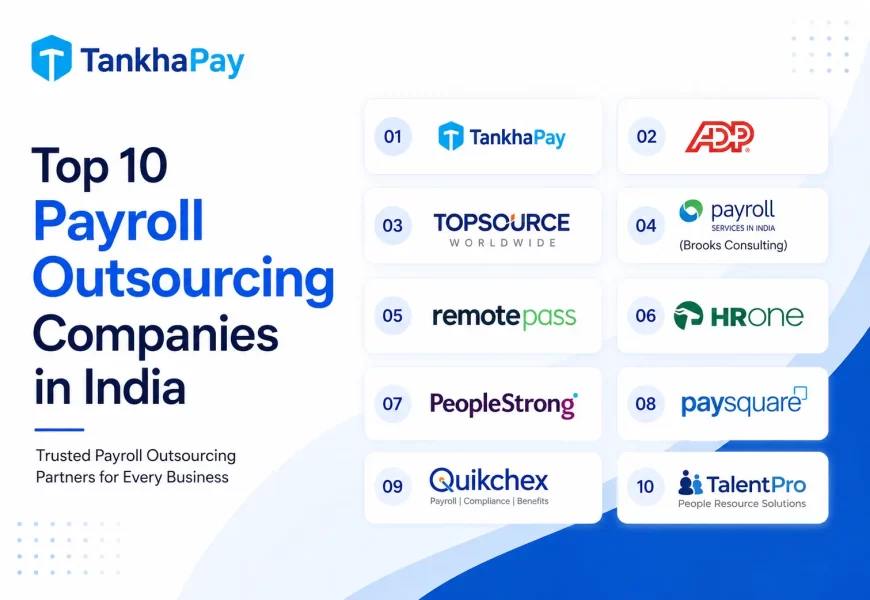
Top 10 Payroll Outsourcing Companies | Payroll List (2026)

1. Tankhapay

TankhaPay delivers one of India’s most complete payroll outsourcing ecosystems, seamlessly combining HR technology, payroll management, EOR services, and apprenticeship (NATS) administration within a single, mobile-first platform.Additionally, it simplifies personnel administration, workforce scheduling, regulatory compliance, and end-to-end payroll processing with a powerful HRMS that supports both on-site and remote teams. Businesses thus benefit from a single platform that improves operational continuity, accuracy, and transparency.

Additionally, backed by 25 years of payroll and compliance expertise from Akal Information Systems—which manages more than one million employees—TankhaPay offers far more than software. Instead, it functions as a full-suite payroll and compliance partner, covering PF, ESI, PT, and TDS management while eliminating the hassle of juggling multiple vendors for payroll processing, statutory filings, and workforce management. As a result, TankhaPay distinguishes itself as one of the top payroll outsourcing options in India by combining automation with specialized services to guarantee accuracy, regulatory compliance, and continuous payroll operations.

Pros:

HR Tech and Payroll Services, Multilingual Platform, 24×7 HR Support

Ideal for:

Enterprises, MSMEs, Government, and startups seeking a single partner to outsource payroll, compliance, HR tech, and apprenticeship operations without operational fragmentation.

Pricing:

₹60 per user per month.

Click here to read the complete guide on Payroll Software in India.

2. factoHR

factoHR is a cloud-based platform that simplifies payroll outsourcing by automating salary processing, regulatory compliance, attendance management, and employee data administration in a single system. Moreover, its mobile-first interface allows employees and managers to effortlessly access payroll, leave, and attendance workflows anytime. In addition, automation features such as geo-fenced and contactless attendance, continuous compliance updates, and strong data security ensure accuracy and reliability at scale. Finally, with real-time analytics and intuitive dashboards, factoHR enables leadership teams to monitor workforce costs and make informed decisions faster.

Pros:

Cloud-Based HRIS, Advanced Security

Ideal for:

Small to mid-sized companies and rapidly scaling businesses that want dependable outsourced payroll and compliance management in an integrated HR environment.

Pricing:

₹4,999 per month for up to 50 employees.

3. ADP

ADP offers a powerful payroll services ecosystem, supported by a robust HRIS, that helps organizations streamline end-to-end payroll, compliance, and workforce administration. Moreover, their outsourcing approach handles payroll automatically and takes care of compliance requirements for PF, ESI, PT, and TDS, ensuring every statutory filing is completed accurately and on schedule. Additionally, the system provides cloud-based access and integrates smoothly with existing ERP systems, allowing teams to work without disruption.

Furthermore, ADP equips leadership with real-time dashboards and actionable insights that enhance visibility into workforce performance and financial data. As a result, companies across the world rely on ADP for scalable payroll solutions that reduce operational complexity, improve compliance, and make HR processes run more efficiently.

Pros:

Seamless Integration, One-Stop Solution

Ideal for:

Large enterprises and multinational organizations seeking reliable, scalable payroll services supported by enterprise-grade technology.

Pricing:

Custom Pricing: On Request

4. Zing Hr

ZingHR offers payroll services built for mid-sized to large companies, and more importantly, its cloud platform enables complete end-to-end payroll processing with ease. In addition to payroll automation, it manages statutory compliance and centralizes workforce data, helping HR teams reduce manual effort and avoid errors. Furthermore, the platform unifies attendance, leave, performance, and talent management, giving organizations a single, integrated system for their entire HR and payroll ecosystem. With this unified approach, and operations across India, Singapore, Australia, and other regions, ZingHR effectively supports companies managing large or geographically distributed teams.

Pros:

Cloud-Based & AI-Driven, Integrated HRMS

Ideal for:

Mid-sized and large enterprises seeking a sophisticated, integrated platform to outsource payroll while digitizing broader HR operations.

Pricing:

Custom Pricing: On Request

5. Paybooks

Paybooks offers payroll outsourcing that over 3,000 Indian businesses depend on. The platform runs salary processing automatically, handles tax calculations, and connects with HRMS tools to cut down manual tasks for HR.

Its API setup links attendance, leave, and employee systems for accuracy throughout the payroll cycle. With fast setup and a service-focused approach, Paybooks makes the switch from manual payroll straightforward. Companies using their services see better accuracy, stronger compliance, and smoother operations.

Pros:

Quick Implementation, API-Driven Payroll Platform

Ideal for:

Small and mid-sized companies looking for payroll outsourcing that’s simple to set up, works well with their existing systems, cuts down on workload, gets the numbers right, and can scale as they grow.

Pricing:

₹2,499 per month for up to 30 employees.

6. HROne

HROne is a modern, cloud-based HRIS designed to support organizations looking to streamline and outsource their payroll operations. Its platform automates salary processing, statutory compliance, attendance management, leave management, and employee records, reducing the operational burden on HR teams.

With geo-attendance, flexible scheduling, approval workflows, and mobile-first self-service, HROne enables smooth coordination between employees, managers, and HR. Real-time dashboards offer leadership clear visibility into workforce data and payroll metrics, strengthening decision-making and operational accuracy.

Pros:

Real-Time Dashboards, Complete Lifecycle Management

Ideal for:

Mid-sized and large organizations seeking a seamless, technology-driven solution to outsource payroll while managing broader HR operations within one integrated system.

Pricing:

₹4,950 per month for up to 50 employees.

7. Keka

Keka is a cloud-based HR system designed for companies moving to payroll outsourcing. It brings together payroll, attendance, hiring, performance reviews, and essential HR tasks on one platform, cutting manual work and boosting accuracy across employee management. With automated payroll runs, compliance-ready calculations, employee self-service, and streamlined leave and timesheet management, Keka helps HR teams operate faster and more consistently. Real-time analytics offer leaders deeper visibility into workforce costs and productivity, enabling smarter, data-backed decisions.

Pros:

Cloud-Based Platform, Timesheet Management

Ideal for:

Startups, small businesses, and mid-sized companies that want an efficient, connected system for outsourced payroll and better HR performance overall.

Pricing:

₹9,999 per month for up to 100 employees.

8. Zoho Payroll

Zoho People is a cloud-based HRIS designed to support organizations seeking to streamline their payroll processes and transition to outsourced payroll services. The platform integrates essential HR functions, recruitment, attendance, performance, leave, and employee records, into one unified system, reducing manual work and improving data accuracy. Scalable and user-friendly, Zoho People provides a dependable HR foundation for businesses outsourcing payroll and modernizing their HR operations.

Pros:

Automation of Routine Tasks, User-Friendly Dashboards

Ideal for:

Small to mid-sized companies and fast-growing businesses looking for a simple, scalable HR platform that supports outsourced payroll and centralized workforce management.

Pricing:

₹1,250 per month for up to 25 employees.

9. SumHR

SumHR provides a cloud-based platform for companies switching to streamlined payroll services. Built for speed and compliance, it uses automation to reduce manual work in payroll processing. The system handles salary calculations, tax deductions, and statutory filings while pulling in attendance, leave, performance, and employee information on one dashboard. Whether you’re an early-stage startup or a growing mid-sized team, SumHR delivers reliable payroll outsourcing through a flexible, straightforward system.

Pros:

Automated Payroll Processing, End-to-End HR Workflows

Ideal for:

Startups, small businesses, and rapidly expanding teams looking for straightforward, scalable payroll outsourcing that makes compliance easier and brings HR operations together in one place.

Pricing:

₹69 per user per month.

10. Qandle

Qandle is a mobile-focused HR platform that helps companies modernize their payroll services. The customizable modules handle payroll processing, compliance, and core HR tasks, letting businesses adjust processes to fit how they work. With an easy-to-use interface and strong mobile features, employees and managers can approve requests and manage payroll tasks from anywhere, making things run smoother and cutting down on admin work.

Pros:

Highly Customizable Workflows, Clean UI & Mobile-Friendly

Ideal for:

Modern and fast-growing businesses that need a flexible, scalable HR platform to streamline and outsource payroll services and centralize everyday HR operations.

Pricing:

₹2,450 per month for up to 50 employees.

What are the Benefits of Outsourcing Payroll Services?

Payroll outsourcing services have become a strategic advantage for Indian businesses that want accurate, timely, and compliant payroll without expanding internal teams. By relying on experienced Payroll Outsourcing Companies in India, organisations streamline monthly operations, reduce compliance risks, and support HR teams with expert-driven processes. Below are the most important benefits — explained clearly and in a way that improves SEO and readability.
Benefits Of Outsourcing

1. Higher Accuracy & Reduced Payroll Errors

Because qualified experts manage wage inputs, attendance data, overtime computations, arrears, reimbursements, and regulatory deductions, outsourcing greatly increases accuracy. Additionally, each pay run is subjected to several validation checks, which lowers conflicts, increases transparency, and guarantees that workers are always paid correctly. It is quite challenging to continually maintain this level of accuracy with internal teams.

2. Lower Cost of Payroll Operations

Outsourcing provides a consistent and reasonable monthly cost as opposed to managing compliance specialists, purchasing software, and employing a whole internal payroll department. Additionally, businesses save money on training, software updates, infrastructure, and statutory filing expenses. Over time, this makes payroll outsourcing one of the most cost-efficient ways to manage end-to-end payroll in India.

3. Full Statutory Compliance Assurance

With frequent changes in PF, ESIC, PT, LWF, labour laws, and TDS rules, staying compliant is challenging. Payroll outsourcing companies continuously monitor legal updates and apply them instantly to payroll calculations. They also generate and file PF/ESIC returns, create challans, prepare TDS reports, and maintain audit-ready documents — ensuring there are no penalties, notices, or compliance gaps.

4. Time Savings for HR Teams

Since payroll is one of the most time-consuming monthly tasks for HR teams, outsourcing frees them from repetitive work such as data verification, preparing salary sheets, making adjustments, issuing payslips, and coordinating with finance. As a result, HR leaders can devote more time to strategic activities like hiring, performance management, employee engagement, and culture-building.

5. Multi-State and Multi-Entity Support

Businesses with multiple sites find it difficult to manage different state legislation, attendance systems, and legal obligations. Payroll outsourcing services facilitate uniformity by managing several companies under a single configuration, region-specific legislation, and multi-state compliance. This ensures consistency, accuracy, and standardisation across the entire organisation.

6. Timely & Transparent Payroll Processing

Payroll runs that are reliable and timely are among the main benefits of outsourcing. The outsourcing partner shares processing calendars, adheres to stringent deadlines, and guarantees that workers are paid on the same day each month. Additionally, transparent reports, audit trails, and self-service access improve employee trust and organisational credibility.

7. Access to Domain Experts & HR Advisors

Payroll outsourcing isn’t just about calculation — it’s also about guidance. Companies have access to HR advisors, payroll professionals, and compliance specialists that are knowledgeable with industry-specific pay structures, intricate legal requirements, and best practices. This professional assistance lessens internal reliance and guarantees that each payroll choice complies with operational and regulatory requirements.

Why you should Outsource your Hr and Payroll?

  1. Save Time: Shifts payroll work off HR teams so they can focus on growth, operations, and core business priorities.
  2. Reduce Payroll Errors: Automated calculations and expert checks minimise mistakes in salaries, deductions, and statutory filings.
  3. Strengthen Data Security: Uses secure, encrypted systems with backups and controlled access to protect sensitive employee data.
  4. Ensure Statutory Compliance: Tracks PF, ESI, PT, LWF, Bonus, Gratuity, and TDS rules and manages all filings on time.
  5. Integrated HR Data: Links payroll with attendance, leave, claims, and benefits for accurate information across the board.
  6. Employee Self-Service: Lets staff check their payslips, update personal information, review tax details, and monitor attendance from their phones.
  7. Cost Savings: Cuts down on penalties, corrections, and admin expenses, saving money over time.

Common Payroll Challenges Indian Companies Face

Even with digital adoption rising across industries, payroll continues to be one of the most error-prone and compliance-heavy functions for Indian businesses. And as organisations scale across states and hire diverse employee categories, the challenges often multiply. This is exactly why many companies eventually turn to Payroll Outsourcing Services or partner with leading Payroll Outsourcing Companies in India to manage accuracy, compliance, and timely salary processing.
Below are the most common payroll challenges organisations face today — challenges that outsourcing immediately helps resolve.

1. Frequent Regulation Changes and Compliance Uncertainty

Indian labour laws are constantly evolving. New PF rules, ESIC circulars, professional tax updates, and changes in TDS slabs often come without long notice. As a result, HR teams struggle to keep payroll management fully compliant month after month.
Additionally, every regulation carries strict penalties, which makes real-time accuracy crucial. This is where outsourcing comes in handy because professionals keep an eye on changes in the law and make sure payroll is updated without taxing internal workers.

2. TDS Complexities and Incorrect Tax Calculations

Another major challenge Indian employers face is managing TDS accurately for employees with varying salary structures, exemptions, and investment declarations. Even a small mismatch can lead to employee dissatisfaction, Form 16 disputes, and correction filings.
Moreover, when payroll is processed manually or on outdated systems, tax slabs are not updated in time, which increases compliance risk. Payroll outsourcing companies use advanced payroll accounting software to ensure accurate TDS calculations, automated tax projections, and error-free Form 16 generation.

3.Multi-State Compliance Variations

As soon as a company expands beyond one state, payroll management becomes significantly more complex. Each state has different rules for:

  • Professional Tax
  • Shops & Establishments
  • Labour Welfare Fund
  • Minimum wages
  • Leave policies

Without proper tracking mechanisms, HR teams find themselves navigating multiple rulebooks every month. Consequently, many multi-location businesses prefer outsourcing to ensure all location-based rules are applied correctly during payroll processing.

4. Attendance, Shift, and Data Mismatches

Reliable attendance data is critical to payroll accuracy. Attendance systems, biometric devices, leave data, overtime approvals, and shift schedules, however, do not always sync in many organisations. This leads to:

  • salary miscalculations
  • incorrect overtime payouts
  • disputes between employees and HR
  • delays in payroll cycles

By contrast, payroll outsourcing companies typically integrate attendance and payroll software to create a single source of truth — ensuring that salary calculation is always aligned with approved working hours.

5. Errors in Statutory Reporting & Challans

Another major pain point for Indian companies is the manual preparation of:

  • PF ECR files
  • ESIC monthly returns
  • Professional Tax challans
  • Labour Welfare Fund submissions
  • Quarterly TDS filings

Any errors here could result in fines, delays, or audits. Furthermore, without the proper infrastructure, keeping digital records for upcoming audits becomes time-consuming. Statutory reports are created automatically by outsourced payroll service providers, who also guarantee timely filings each and every time.

6. Scalability Issues During Growth Phases

As a company grows, its payroll workload doesn’t just increase — it becomes more complicated. More employee categories, more reimbursement types, more compliance layers, more locations, and more queries.
Yet, most in-house teams are not equipped to scale instantly. That’s why growing businesses find relief in outsourcing, because it gives them access to enterprise-grade payroll software, compliance experts, and automated workflows without increasing headcount.

Payroll Outsourcing vs Payroll Software

Before choosing between payroll outsourcing services and payroll software in India, it’s important to understand that both options solve payroll challenges — but in completely different ways. While one offers a hands-off, expert-driven service, the other empowers internal teams with digital tools for payroll management. As Indian businesses grow across states and employment types, this decision becomes even more crucial. Therefore, the best way to evaluate both approaches is to compare them side-by-side across cost, compliance, scalability, data control, and long-term efficiency.
Below is a comprehensive, SEO-optimised comparison table that highlights the key differences.

Criteria

Payroll Outsourcing Services

Payroll Software in India (Cloud / On-Premise)

Who Handles Payroll? Entire payroll is managed by external payroll outsourcing companies in India. Payroll is handled in-house using a payroll accounting software.
Level of Automation High — outsourcing partners use advanced systems + expert review. Very high — automation of payroll, tax calculations, payslips, compliance, etc.
Compliance Management Compliance is handled completely by experts including PF, ESIC, TDS, PT, LWF filings. Software provides automated calculations & reminders, but in-house teams must execute filings.
Cost Structure Subscription or per-employee service fees. Cost-effective for businesses wanting zero internal payroll load. Monthly software subscription. Additional cost for hiring internal payroll experts.
Scalability Extremely scalable — outsourcing partners manage multi-state, multi-entity, and seasonal workforce fluctuations. Cloud-based payroll software scales easily, but complex businesses need skilled payroll staff.
Ideal For Startups, MSMEs, enterprises without internal payroll staff, multi-location companies, contract-heavy industries. Companies that want control, have HR/payroll teams, or prefer cloud-based payroll software for internal processing.
Accuracy & Error Rate Very high — dual validation (software + human checks). High — accuracy depends on data entry and internal team expertise.
Time Savings Maximum — HR teams offload entire payroll and compliance workload. Moderate — software reduces effort but requires team involvement.
Data Control External partner handles data; SLAs ensure protection. Full internal control over payroll data and access.
Flexibility & Customisation Limited customisation depending on partner. Highly customisable salary structures, pay groups, rules, and workflows.
Dependence on Internal HR Team Low — outsourcing eliminates internal workload. High — internal staff must handle payroll management, exceptions, and corrections.
Best For Compliance-Heavy Companies Excellent — outsourcing companies ensure error-free compliance across states. Good — but dependent on how well internal teams interpret compliance updates.
Tech Adoption Needed? Minimal — your outsourcing partner uses the tech for you. Required — cloud-based payroll software must be used regularly.
Turnaround Time Set timelines via SLAs. Instant processing once data is validated.
Employee Self-Service Usually available depending on the outsourcing company. Always available in modern HR & payroll software.
Upfront Investment Low Low for cloud payroll, high for on-premise payroll systems.

Future of Payroll Outsourcing in India (2025–2030 Trends)

As Indian businesses continue to expand across states and adopt digital-first operations, the future of payroll outsourcing is set to transform rapidly. And because payroll complexity keeps increasing each year, organisations are now looking for partners who can deliver not just processing support but strategic value. Consequently, the next five years will redefine how Payroll Outsourcing Services and Payroll Outsourcing Companies in India operate.

1. Deep Automation Across Payroll Cycles

Going forward, automation will no longer be optional. Instead, payroll providers will automate everything—from attendance sync and validation to salary computation and statutory filing. This update will reduce manual dependence, minimise delays, and increase accuracy for companies managing diverse and distributed teams.

2. AI-Driven Compliance Management

By 2030, AI will play a central role in interpreting new labour laws, identifying risks, and suggesting corrective actions. As regulations continue to change frequently, AI-enabled payroll systems will help businesses stay compliant proactively rather than reactively.

3. Rise of Employer of Record (EOR) + Payroll Bundles

India is already witnessing a surge in EOR adoption. And as companies expand into new states or hire remote workers, combining EOR with managed payroll will become the preferred model. This integrated strategy will guarantee 100% statutory governance while enabling companies to enrol people from any location.

4. Cloud-First Payroll Operations

Furthermore, most organisations will move to cloud-based payroll operations for faster access, real-time updates, and secure collaboration across locations. Cloud adoption will also support hybrid work models, making payroll more scalable and resilient.

5. Strategic Outsourcing Instead of Just Processing

Finally, businesses will increasingly expect payroll partners to offer insights, compliance advisory, cost optimisation, and workforce analytics. In other words, payroll outsourcing will evolve from a transactional function into a strategic advantage.

Conclusion: Why Payroll Outsourcing Is Becoming a Strategic Priority in India

In conclusion, payroll outsourcing is rapidly evolving from an operational decision to a strategic one for Indian companies of all kinds. As regulations change and workforces move across many states, organisations are increasingly finding that processing payroll internally frequently results in needless risk, delays, and compliance burden. In this case, payroll outsourcing services are quite helpful.
Moreover, outsourced payroll partners bring together advanced technology, domain expertise, and statutory accuracy, ensuring error-free payroll runs every month. Companies benefit from decreased administrative burden, improved governance monitoring, and more seamless operations. In contrast to conventional in-house arrangements, outsourcing enables HR departments to refocus their attention from monotonous procedures to more significant tasks like strategy planning, talent development, and culture building.

Additionally, companies today want payroll systems that are accurate, scalable, and future-ready due to India’s growing propensity for remote and distributed labour. Payroll outsourcing, therefore, allows businesses to expand without worrying about resource limitations or compliance backlogs.
Finally, whether you’re a startup trying to avoid early-stage complexities, an MSME seeking cost-effective accuracy, or a large enterprise managing multi-location teams, outsourcing payroll offers a clear competitive advantage. By partnering with reliable payroll outsourcing companies in India, businesses can achieve greater accuracy, stronger compliance, and long-term operational stability.

Frequently Asked Questions

Companies outsource payroll to reduce administrative workload, eliminate compliance risks, improve accuracy, and gain access to expert support and technology without managing payroll in-house.

Most payroll outsourcing providers handle salary calculations, PF/ESI/PT/TDS compliance, challan & return filing, reimbursements, full & final settlements, payslip generation, and employee query management.

Yes. Small businesses often benefit the most because outsourcing eliminates the need for a full HR or finance team, reduces cost, and ensures error-free, compliant payroll every month.

Cost typically depends on the number of employees, scope of services, technology offered, and compliance requirements. Pricing usually ranges from per-employee monthly charges to bundled service fees.

Reputable payroll outsourcing companies use encrypted systems, access controls, and strict data governance policies to protect employee and financial data. Always choose a provider with strong data-security standards.

Payroll outsourcing partners usually manage statutory requirements like PF, ESI, PT, TDS, Form 24Q, payroll registers, challans, digital filings, and audit-ready compliance records.

Indeed. For smooth data flow and automated processing, the majority of contemporary vendors offer connections with HRMS platforms, biometric systems, leave modules, and attendance tools.

Outsourcing uses automation, standardized workflows, compliance rules, and expert verification to eliminate manual errors in attendance data, tax calculations, and salary payouts.

Choose a partner with strong subject experience, compliance capabilities, secure technology, clear pricing, and the flexibility to scale with your business needs.

Please Rate the Post

Click on a star to rate it!

Average rating 5 / 5. Vote count: 4

No votes so far! Be the first to rate this post.

(Visited 90 times, 1 visits today)
Close