“Technology is best when it brings people together.” – Matt Mullenweg.
In today’s rapidly evolving HR landscape, HRMS ESS (Employee Self Service) has moved far beyond simple back-end automation. Instead, it has become a core pillar of modern workforce empowerment. Through HRMS ESS systems, organizations can streamline operations while enabling employees to manage their personal data, requests, and documents independently—all through a secure and intuitive ESS portal.
Employees may easily update profile information, mark attendance, access paystubs, submit requests, and monitor approvals without frequent HR interaction when using a well-designed HRMS ESS portal. As a result, HR departments devote more time to strategic projects that propel company expansion and significantly less time to tedious administrative duties.
Furthermore, HR leaders increasingly recognize that Employee Self Service is not just a convenience—it’s a major shift toward a more transparent, efficient, and employee-driven workplace. This guide explains what HRMS employee self service is, why it matters, the essential features, its benefits, implementation challenges, and how TankhaPay delivers Employee Self Service capabilities designed for India’s diverse and distributed workforce.
What is HRMS ESS (Employee Self Service)?
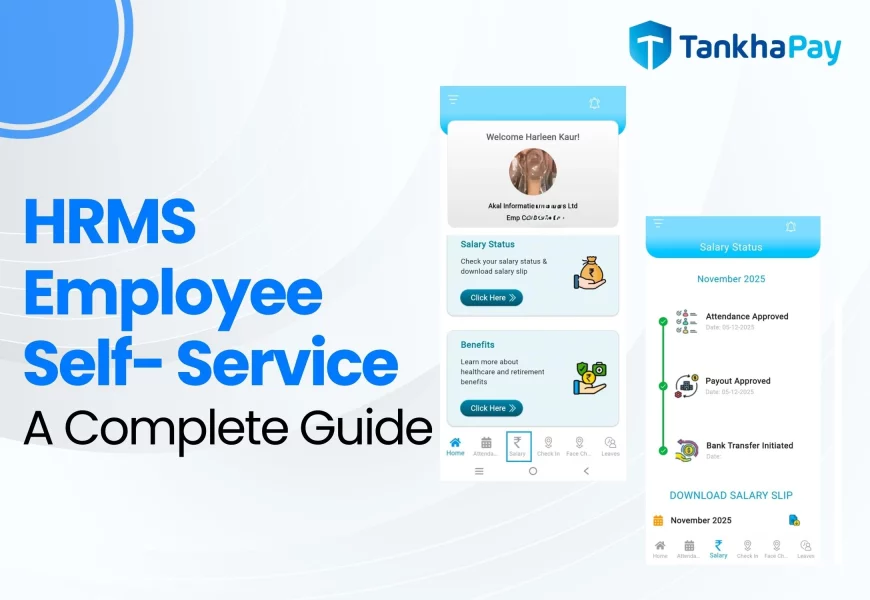
HRMS ESS Employee Self Service is a core module within modern HRMS platforms that empowers employees to independently access, update, and manage their personal, employment, and payroll-related data. Instead of depending on HR teams for routine requests, Employee Self Service ESS Portal provides a secure portal or mobile app where employees can quickly complete essential tasks on their own.
Through an intuitive employee self service portal, employees can:
- Download payslips, tax documents, and Form 16 directly from their HRMS ESS dashboard
- Update personal data, including addresses, phone numbers, and bank account information.
- Submit reimbursement claims, investment proofs, and declarations without delays
- Track attendance, leaves, and shift schedules in real time
HRMS ESS transforms the conventional HR model into a more transparent, autonomous, and highly effective system by decentralizing ordinary HR tasks. This not only reduces repetitive administrative workload for HR teams but also improves employee engagement, accountability, and overall productivity across the organization.
Why Does HRMS ESS (Employee Self Service) Matter?
As organisations continue to scale, even simple HR tasks—like leave approvals, payslip requests, or updating personal details—can create unnecessary delays and communication gaps. This is exactly where HRMS ESS steps in. By digitising routine workflows and empowering employees to manage their own data, HR teams can operate more efficiently while employees enjoy greater transparency and independence.
1. More Control in the Hands of Employees:
With a well-designed HRMS ESS portal, employees can instantly view payslips, apply for leave, check attendance, or update their personal details—without waiting for HR. This self-managed access not only speeds up everyday processes but also builds a deeper sense of trust and engagement across the organisation.
2. Lighter Workload for HR Teams:
Repetitive administrative work is greatly reduced with a robust HRMS ESS platform. HR teams may focus their time on strategic initiatives, such as enhancing policies, bolstering culture, and fostering employee growth, rather than responding to regular inquiries about leave balances or collecting previous pay stubs. Although there is less back and forth, operations become more seamless.
3. Better Accuracy and Fewer Compliance Issues:
When employees update their own records through HRMS employee self service, the data stays accurate and up-to-date. This directly reduces payroll errors, avoids compliance risks, and ensures statutory information (like bank details, PAN, or address changes) is always current. By eliminating outdated or mismatched data, organisations operate with stronger compliance and cleaner workflows.
4. Supporting a Hybrid and Remote Work Culture:
As remote and hybrid work environments become the norm, it’s essential that employees stay connected with HR processes—regardless of location. With mobile-friendly HRMS ESS, employees can access HR services anytime and anywhere, ensuring seamless coordination, elevated responsiveness, and higher productivity across distributed teams.
Overall, adopting a robust HRMS ESS solution is no longer optional—it’s a strategic requirement for modern organisations aiming to streamline operations and elevate employee experience. HRMS ESS HR Portal is an administrative function into a proactive, value-driven partner that promotes workforce empowerment and corporate growth by automating repetitive processes, facilitating self service access, and bolstering compliance.
Key Features of a Good HRMS ESS (Employee Self Service) Platform
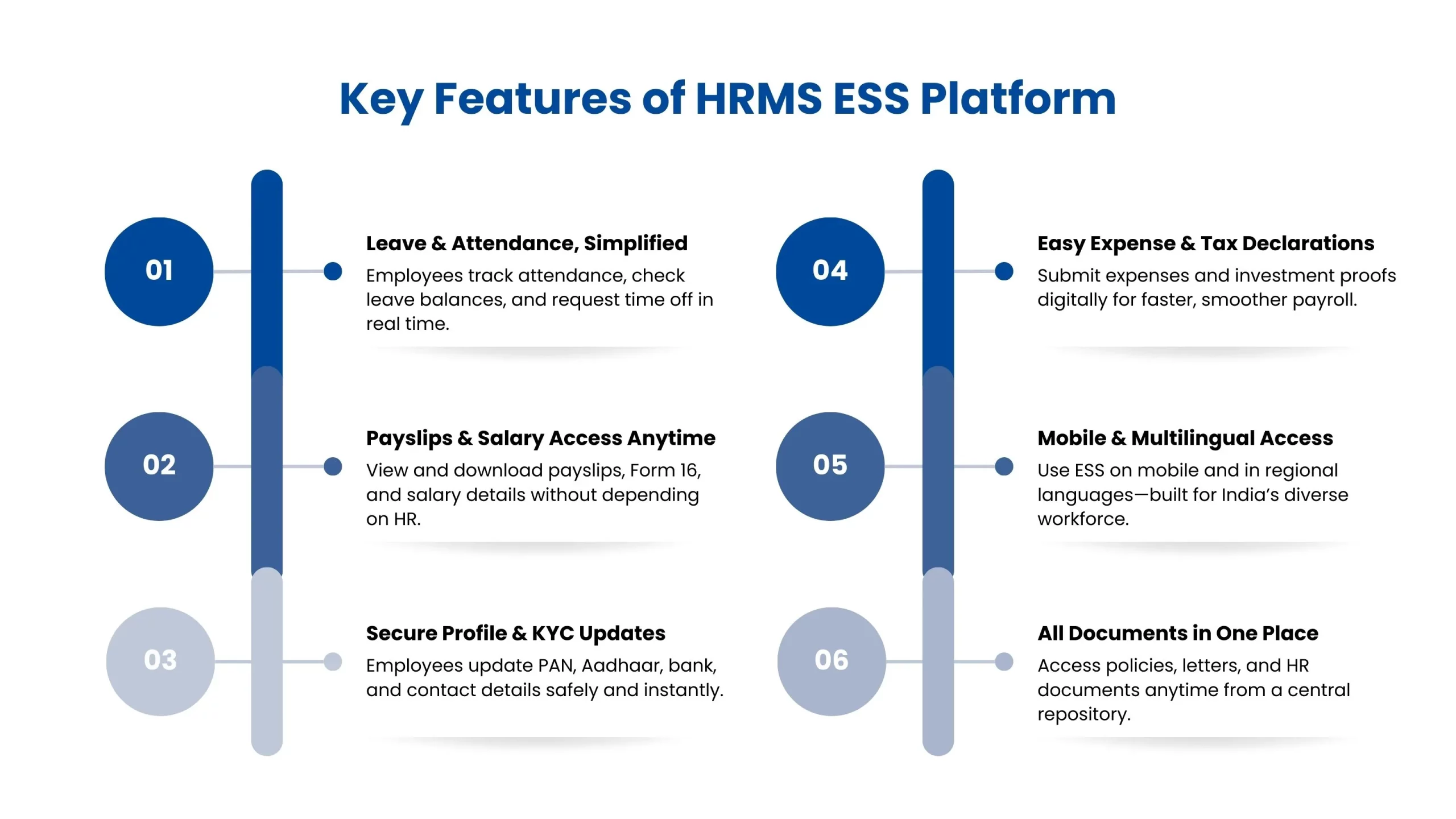
A strong HRMS ESS platform must be simple, intuitive, and accessible across all devices. It should help employees complete daily HR tasks independently while ensuring accuracy and security. Moreover, an advanced HRMS ESS (employee self service) system must support diverse teams, multilingual needs, and seamless usability.
1. Leave and Attendance Management
Employees may simply verify their attendance, keep an eye on their leave balances, and make real-time leave requests. Additionally, instant alerts speed up approvals and improve transparency.
2. Payslip and Salary Information:
The ESS (Employee Self Service) portal should allow users to view and download payslips, Form 16, and salary details anytime. This reduces HR dependency and improves employee satisfaction.
3. KYC and Profile Updates
Workers are required to securely update their PAN, Aadhaar, bank account information, and contact details. As a result, HRMS ESS (Employee Self Service) maintains accurate and compliant personnel data.
4. Expense and Tax Declarations:
A modern HRMS ESS system enables digital expense claims and investment submissions.This reduces paperwork and speeds up payroll processing.
5. Mobile and Multilingual Support:
ESS access on mobile apps and regional languages is crucial due to the diversity of Indian teams. This guarantees that every worker may utilize the platform without difficulty.
6. Centralised Document Repository
Employees can quickly find HR policies, letters, and company documents in one place. Therefore, it removes confusion and improves communication.
A well-built HRMS ESS (Employee Self Service) platform does more than simplify HR tasks—it transforms the way employees interact with their workplace. By offering self service access, real-time updates, and seamless workflows, an HRMS employee self service system enhances efficiency across the organisation. Ultimately, it empowers employees, reduces HR workload, and creates a more transparent, connected, and future-ready workplace.
Benefits of HRMS ESS(Employee Self Service) for Employers and HR Professionals
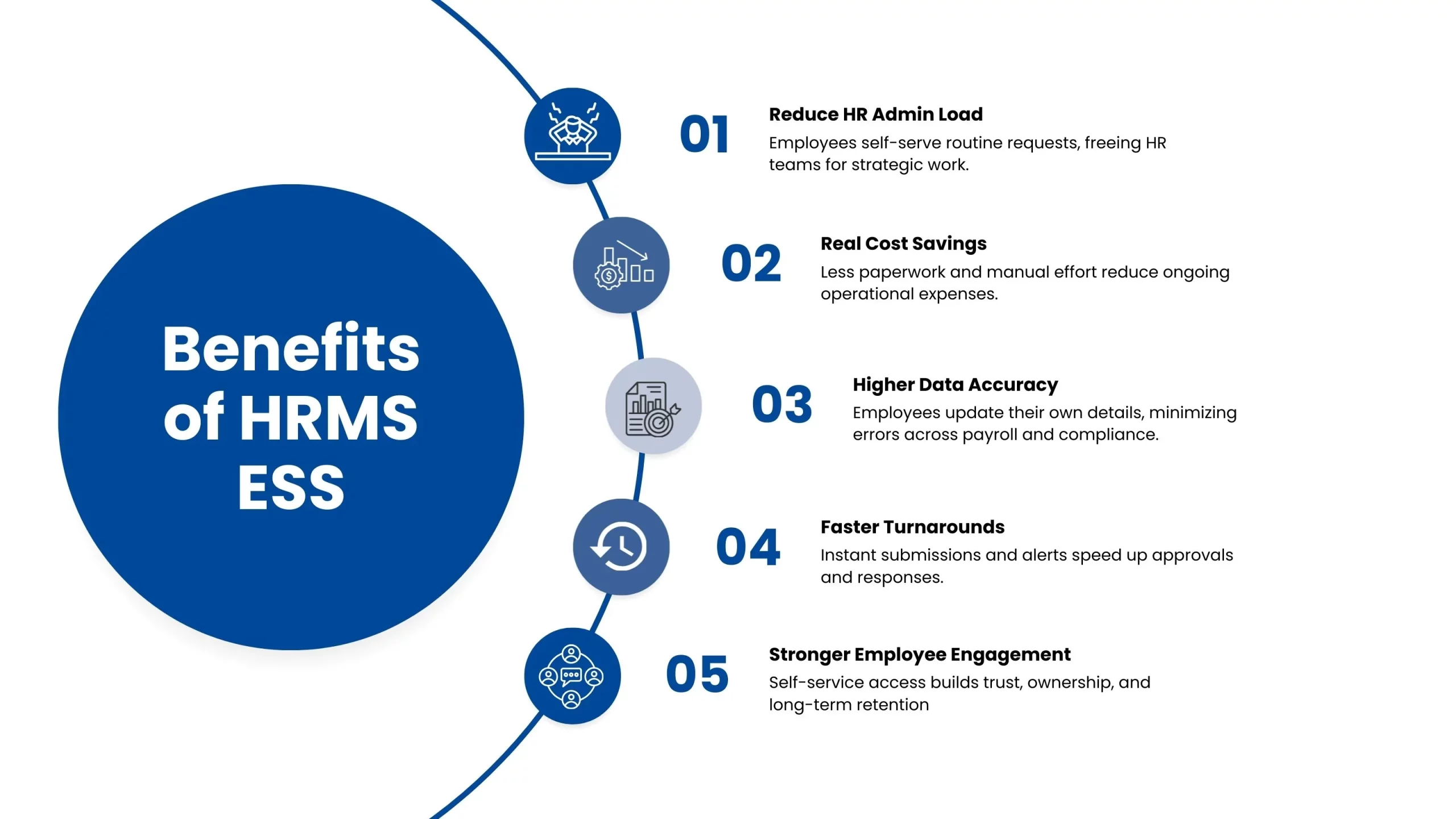
Benefits of HRMS ESS (Employess Self Services)
HRMS ESS delivers clear advantages for both HR teams and employees by simplifying and speeding up everyday processes. As companies grow, HR responsibilities increase. Therefore, HRMS employee self service becomes essential for reducing manual work, improving accuracy, and supporting efficient communication across the organisation.
Reduced Admin Workload:
Employees handle basic duties on their own with HRMS ESS (Employee Self Service), which greatly reduces the number of recurring HR inquiries.HR staff may now concentrate on strategic, high-impact tasks thanks to this change.
Tangible Cost Savings:
HRMS ESS eliminates paperwork and manual entries, reducing operational costs consistently. These savings accumulate over time, improving efficiency without extra investments.
Better Data Accuracy:
HRMS ESS (Employee Self Service) makes it simple for employees to update personal data, which lowers error rates. When data is correct, payroll, compliance, and HR processes stay reliable and consistent.
Faster Response Times:
HRMS ESS enables quick submissions and instant notifications for approvals. As a result, employees experience faster responses and smoother interactions with HR.
Boosted Employee Engagement:
With HRMS ESS (Employee Self Service), employees feel trusted and empowered through easy access to their information. This autonomy strengthens involvement, builds confidence, and improves long-term retention.
In short, modern enterprises now need HRMS ESS. Employee engagement rises, accuracy is improved, and effort is immediately reduced. Additionally, HRMS employee self service creates an efficient, transparent, and responsive HR ecosystem that adjusts to your business’s needs, making it a powerful tool for companies hoping to expand smoothly and sustainably.
HRMS Employee Self Service Implementation Challenges (And How to Overcome Them)
Implementing HRMS ESS brings many benefits. However, a few challenges can slow down adoption if not handled correctly. Therefore, understanding these roadblocks early helps organisations plan better and ensure a smooth transition.
Resistance to Change:
Many employees hesitate to use new digital tools. Consequently, they may struggle to engage with the HRMS employee self service portal confidently. This hesitation often delays adoption across the organisation. To address this, companies should offer simple onboarding sessions and hands-on training. As a result, employees feel supported and use the system more comfortably.
Data Security Concerns:
An HRMS ESS (employee self service) platform must be smoothly integrated with payroll, attendance, and compliance systems. Otherwise, disconnected tools cause delays, duplication, and misunderstandings for HR and staff. As a result, choosing a platform that supports open APIs and modular integration becomes essential. This approach also ensures seamless syncing with payroll software in India, enabling error-free, real-time workflows across all HR functions.
Organizations can more successfully install HRMS ESS by identifying these issues early on. The shift is made easier with the appropriate integrations, security precautions, and training. In the end, HRMS employee self service increases adoption, promotes efficiency, and empowers employees.
5 Common Challenges Faced Without HRMS Employee Self Service
HR activities frequently become laborious, tedious, and extremely error-prone in the absence of a dependable HRMS ESS platform. These gaps cause conflict between HR teams and employees in addition to interfering with workflows. Therefore, productivity and employee trust are directly impacted by the lack of a robust HRMS employee self service system. Here are the most common challenges organisations face without employee self service portal:
Too Much Miscommunication
Without an ESS portal, HR updates often get missed or buried in email threads. As a result, employees struggle to access accurate information quickly.
Outdated or Incorrect Records
When there is no unified system, employee records become outdated easily. This leads to errors in payroll, communication, and compliance tasks.
Higher Risk of Manual Errors
Errors are more likely when data entry is done manually. Even minor mistakes in IDs or bank information can subsequently lead to more serious payroll problems.
HR Teams Pulled Into Routine Tasks
In the absence of HRMS ESS (Employee Self Service), HR teams spend time on repetitive requests. This includes re-sending payslips or making basic profile updates.
A Growing Sense of Disconnect
Without easy access to personal records, employees feel less informed. Gradually, this lack of visibility reduces trust in internal HR systems.
When these issues accumulate, they slow down operations and reduce employee morale. Therefore, adopting a modern HRMS employee self service platform becomes essential for efficiency, transparency, and employee satisfaction.
Discover TankhaPay: All-in-One HRMS Employee Self Service Software
TankhaPay places HRMS ESS (Employee Self Service) at the centre of its HR ecosystem instead of treating it as an add-on. The platform is built for India’s distributed and informal workforce and offers a mobile-first, multilingual HRMS ESS experience. Moreover, its simple interface ensures employees can access essential information without depending on HR teams.
Employees may rapidly update KYC information, request leave, and record attendance with TankhaPay. Additionally, they can easily file reimbursement claims, track salaries, and download payslips. Quick tax declarations, PF and ESI checks, and automatic query submission are all made possible by the platform. Through a safe mobile app, all of these capabilities operate flawlessly, assisting staff members in managing their everyday HR requirements at any time and from any location.
How TankhaPay Solves Real-World HRMS ESS (Employee Self Service) Challenges
At TankhaPay, we deliver more than a basic Employee Self Service portal. Instead, we offer a powerful platform built to support HR teams and employees effortlessly. Additionally, our HRMS ESS system focuses on productivity, compliance, and transparency—right from the first employee self service login to every automated notification.
-
-
- Easy for Everyone to Use:
To begin with, TankhaPay ensures simplicity. Employees can use the HRMS ESS features without training. The interface is clean, intuitive, and fully multilingual. - Mobile-First, Anytime Access:
Moreover, HR tasks don’t happen only in the office. With our mobile-first HRMS ESS, employees can view payslips, track leave, update KYC details, or submit requests anytime and from anywhere. - Real-Time Notifications & Smart Approvals:
Furthermore, TankhaPay reduces delays by sending instant alerts. Employees receive real-time updates on approvals, leave status, document submissions, and queries—removing the need for manual follow-ups. - Built-In Compliance and Data Security:
Additionally, TankhaPay protects all employee data using enterprise-grade encryption. Our HRMS ESS (Employee Self Service) also stays aligned with Indian labour laws, ensuring safe and compliant HR operations. - Empowerment Without Complexity:
Finally, employees feel genuinely empowered. They no longer depend on HR for every small request, improving clarity, trust, and organisational efficiency.
- Easy for Everyone to Use:
-
By embedding powerful HRMS ESS features across our platform, TankhaPay does more than enable ESS. It simplifies processes, supports scale, and makes HRMS ESS accessible for every employee—no matter where they work.
Click here to learn more about the best HR software in India
Frequently Asked Questions (FAQs)
How does HRMS ESS improve HR productivity?
HRMS ESS reduces repetitive admin work through automation. As a result, HR teams can focus on strategic areas such as talent development, performance, and employee experience.
What are the key features of a good HRMS ESS portal?
A strong HRMS ESS portal includes mobile access, multilingual support, payslip downloads, attendance tracking, leave requests, KYC updates, role-based permissions, and secure logins.
Can HRMS ESS be customised for different employee types?
Yes, modern HRMS ESS systems are designed to support on-roll, off-roll, contract, and field staff, ensuring simple and consistent employee self service across all workforce categories.
How does HRMS ESS enhance employee engagement?
HRMS ESS gives employees direct access to their data and tasks, building transparency and autonomy. Therefore, engagement, satisfaction, and trust naturally increase.
Is HRMS ESS secure for sensitive employee information?
A well-built HRMS ESS uses encryption, OTP-based login, authenticator apps, and permission-based access to safeguard personal records, salary details, and identity information.
How does HRMS ESS support compliance?
HRMS ESS keeps employee records accurate, tracks attendance in real time, supports timely approvals, and helps companies meet labour laws and payroll compliance requirements.
What are the cost benefits of using HRMS ESS?
HRMS ESS lowers expenses by reducing paperwork, manual data entry, printing, and repetitive HR support—saving time and operational cost over the long term.
How does HRMS ESS support remote and hybrid teams?
HRMS ESS provides employees with anytime, anywhere access to essential HR information, making remote and hybrid work smooth and efficient.
Which HRMS in India offers the best employee self service experience?
TankhaPay is one of India’s top HRMS platforms with a powerful, multilingual, mobile-first HRMS ESS module, along with integrated payroll, compliance, and workforce management features.