What Does Payroll Mean in the UAE?
Payroll in the UAE is the monthly process of calculating what each employee is owed under Federal Decree-Law No. 33 of 2021, paying it electronically through the Wage Protection System, and keeping the records that prove you did. There is no income tax to withhold. Everything else is more regulated than most newcomers expect.
Since 1 June 2026, salaries for one month should be paid by the beginning of the next month, without any grace period. An employer will be considered to be in compliance if at least 85% of salaries are deposited in their bank account by the stipulated deadline.
Emiratis on your payroll must now earn at least AED 6,000 a month, carry pension contributions of 26 percent of salary, and count toward Emiratisation quotas that cost AED 9,000 a month per unfilled position. None of those three things existed in this form two years ago.
So “no tax” does not mean “no compliance”. It means the compliance sits in wage timing, statutory benefits and government reporting rather than in a tax return. For the platform side, see TankhaPay’s HR and payroll software for the UAE.
Which Laws Govern Payroll in the UAE?
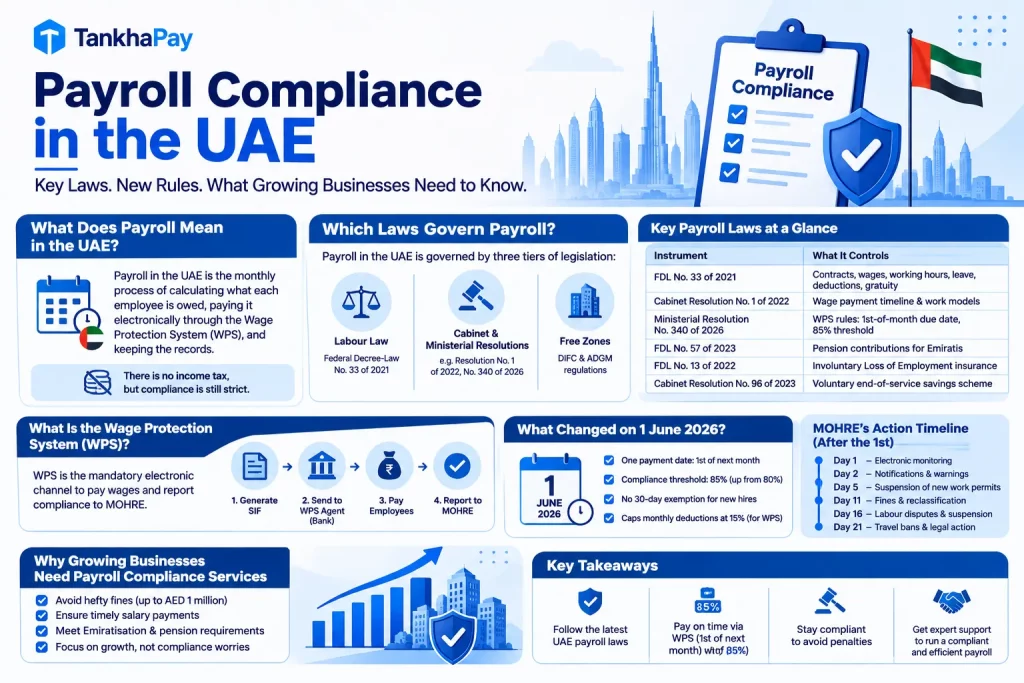
The determination of a UAE salary and its payment is done in accordance with three tiers of legislation; however, the payroll staff must take into account all three tiers. The first is the Labour Law, the second is the Cabinet/Ministerial Resolutions and third is that of Free Zones.
Decree-Law No. 33 of 2021 relating to the Regulation of Labour Relations in the private sector became effective from 2 February 2022. Cabinet Resolution No. 1 of 2022 is the decree’s implementing regulation. Federal Decree-Law No. 9 of 2024 increased the upper limit of fines for violations to AED 1 million.
Ministerial Resolution No. 340 of 2026 constitutes the actual wage protection system guide, which has been effective since 1 June 2026 and has replaced Resolution No. 598 of 2022. This is the largest payroll reform in the UAE of the decade.
| Instrument | What it controls for payroll |
|---|---|
| Federal Decree-Law No. 33 of 2021 | Contracts, wage definition, working hours, overtime, leave, deductions, gratuity, final settlement |
| Cabinet Resolution No. 1 of 2022 | Implementing rules, including the wage payment timeline and permitted work models |
| Ministerial Resolution No. 340 of 2026 | Wage Protection System: the 1st-of-month due date, 85 percent threshold, escalation ladder, exemptions |
| Federal Decree-Law No. 57 of 2023 | Pension contributions for Emiratis registered with GPSSA on or after 31 October 2023 |
| Federal Decree-Law No. 13 of 2022 | Involuntary Loss of Employment insurance |
| Cabinet Resolution No. 96 of 2023 | Voluntary end-of-service savings scheme as an alternative to gratuity |
| DIFC Employment Law No. 2 of 2019 and ADGM Employment Regulations 2024 | Separate employment regimes for the two financial free zones, outside MOHRE and outside WPS |
Domestic workers, government employees and the armed forces sit outside this framework under their own legislation.
What Is the Wage Protection System and How Does It Work?
The Wage Protection System, or WPS, is the mandatory electronic channel through which every MOHRE-registered employer pays wages, and it is also the mechanism the Ministry uses to watch you do it. It was introduced in 2009 and overhauled in 2026.
The process has four steps. The employer generates a Salary Information File, known as an SIF, from its payroll system. The SIF goes to a WPS agent, which is a bank or exchange house licensed by the Central Bank. The agent transfers the funds to each worker’s account or card. The transaction data flows back to MOHRE, which matches it against registered contracts.
MOHRE is not checking whether you paid. It is checking whether the amount, the worker and the date match the contract it holds on file. A payment that is correct but late, or on time but short, is flagged either way.
What changed on 1 June 2026?
The decision by the Ministry under No. 340 of 2026 took all private employees to one payment date and eliminated the flexibility that existed in the previous payment system. Payments for wages earned in the previous Gregorian month are to be made on the first day of the next month.
Early payment at month-end is understood to be treated as compliant. The employers hit hardest are those who paid monthly in arrears around the middle of the month, which was common.
The compliance threshold rose from 80 percent to 85 percent of total wages due. A worker is also treated as paid if they receive 85 percent of their wage, provided the shortfall comes from lawful deductions. In practice that caps monthly deductions at 15 percent for WPS purposes, even though the Labour Law itself allows more.
There are two more changes that affect the payroll department. Firstly, the 30-day exemption rule no longer applies to new entrants. This means that any new recruit is automatically covered under the WPS rules from the very beginning. Secondly, an organization can outsource payroll to another party if MOHRE knows about it.
| Days after the 1st | What MOHRE may do |
|---|---|
| Day 1 | Electronic monitoring begins where wages are unpaid |
| Day 2 | Notifications and warnings to the establishment |
| Day 5 | Suspension of new work permits |
| Day 11 | Administrative fines and reclassification to the Third Category for repeat violators within six months |
| Day 16 | Automatic registration of labour disputes and suspension of work permits for employers of 25 or more in high-risk sectors |
| Day 21 | Precautionary attachment, travel bans on responsible individuals, referral to the Public Prosecutor |
The resolution names construction, transport and storage, security, cleaning, recruitment agencies and domestic worker recruitment offices as higher-risk sectors where the harsher measures apply first.
Published figures for per-worker fines under the new regime vary between secondary sources and are not reproduced here. The escalation ladder above is drawn from the resolution itself as summarised by law firm commentary. Confirm the current fine schedule directly with MOHRE before building it into a risk model.
How Is a UAE Salary Structured?
A UAE salary is split into basic wage and allowances, and the split is not cosmetic, because gratuity, pension and overtime are all calculated on basic wage alone. This is the structural decision that drives most payroll disputes.
The Labour Law defines basic wage as the amount agreed in the contract, excluding allowances and benefits. Total wage adds housing, transport and any other allowance. The contract registered with MOHRE must show both figures, and the WPS file must match them.
The federal minimum wage for expatriate workers does not exist. As for the Emiratis in the private sector, the Ministry of Human Resources and Emiratisation announced a minimum wage of 6,000 AED monthly for the holders of new, renewed, and amended work permits starting from 1 January 2026, while current contracts must be adjusted by 30 June 2026. Any Emirati with a lower income as of 1 July 2026 is exempted from the total number of Emiratisation.
With a very small basic salary, with a lot of allowances, the liability to pay gratuity will be minimized on paper. However, such arrangements attract the attention of authorities, and under the WPS, the basic salary of the UAE national will be considered for the minimum floor of AED 6,000.
What Are Working Hours, Overtime and Leave Rules in UAE Payroll?
Standard hours are 8 a day and 48 a week, and overtime is paid at a premium on basic wage plus the hourly value of the extra time. Payroll has to calculate it correctly because MOHRE can compare paid hours against the contract.
Overtime is capped at two hours a day unless the work prevents serious loss or accident. Daytime overtime attracts an additional 25 percent of the hourly basic wage. Overtime between 10 pm and 4 am attracts 50 percent, except for shift workers. Work on the weekly rest day earns a substitute day or basic wage plus 50 percent.
During Ramadan the working day is reduced by two hours for all employees, which changes the overtime baseline for that month. Leave entitlements below are the statutory minimums, and most are paid on full wage, not basic.
| Leave type | Entitlement under Federal Decree-Law No. 33 of 2021 |
|---|---|
| Annual leave | 30 calendar days after one year of service; 2 days per month after six months |
| Sick leave | 90 days a year: first 15 at full pay, next 30 at half pay, final 45 unpaid |
| Maternity leave | 60 days: 45 at full pay, 15 at half pay; no minimum service |
| Paternity leave | 5 working days within six months of birth |
| Bereavement leave | 5 days for a spouse, 3 days for a parent, child, sibling, grandchild or grandparent |
| Study leave | 10 working days a year after two years of service, for a UAE-accredited institution |
| Public holidays | As declared annually by the Cabinet, paid |
Unpaid leave does not count toward service for gratuity. Unused annual leave must be paid out on termination at basic wage.
What Deductions Are Allowed From a UAE Salary?
The Labour Law allows deductions only for the reasons it lists and caps them, and the 2026 WPS rules now cap them further. Payroll teams in the UAE have less latitude here than in India, where a wider range of deductions is routine.
Article 25 of the Labour Law enables deductions in regard to loan repayment after obtaining written consent from employees, recovery of extra payment made for salary, deduction for pensions and insurance, subscriptions to employee savings funds, disciplinary deductions that have been endorsed by MOHRE, and court orders. The maximum loan deduction can only be 20% of the wage.
The actual limit is however much lower since 1st June 2026. This is because the worker will only be considered to have been paid through WPS if he gets paid 85 percent of his pay, and so any deduction exceeding 15 percent will not appear as a shortfall.
There is no personal income tax, so there is no tax withholding. The only statutory deductions from employee pay are pension contributions for GCC nationals, the small unemployment insurance premium if the employer collects it, and any MOHRE-approved fines.
What Statutory Contributions Does a UAE Employer Make?
For an expatriate, the employer’s statutory cost on top of salary is end-of-service gratuity, mandatory health insurance and the unemployment insurance scheme. For an Emirati or GCC national, a pension replaces gratuity, and the cost is higher.
Gratuity is earned in the ratio of 21 days’ base salary for the first five years of employment and 30 days for every year after that, but limited to two years’ pay in total. It becomes payable after one year’s uninterrupted employment, whether it be a voluntary resignation or termination of services, and the entire amount is to be paid in 14 days of the date of termination of employment.
Alternatively, employers can enroll employees in the voluntary savings scheme upon termination of service through Cabinet Resolution No. 96/2023, which requires them to pay 5.83% of their basic salary monthly for the first five years, followed by 8.33% for the rest of the time into a registered trust. The gratuity earned before switching will be payable.
| Contribution | Who pays | Rate or amount | Applies to |
|---|---|---|---|
| End-of-service gratuity | Employer | 21 days’ basic wage per year up to 5 years, 30 days thereafter, cap 2 years’ wage | Expatriates with 1+ year of service |
| Savings scheme (optional alternative) | Employer | 5.83 percent of basic wage monthly, 8.33 percent after 5 years | Expatriates, where the employer opts in |
| GPSSA pension (new law) | Employer 15 percent, employee 11 percent, government 2.5 percent where salary is below AED 20,000 | 26 percent of contribution salary | Emiratis first registered on or after 31 October 2023, all emirates except Abu Dhabi |
| GPSSA pension (old law) | Employer 15 percent, employee 5 percent | 20 percent of contribution salary | Emiratis registered before 31 October 2023 |
| Abu Dhabi Pension Fund | Employer and employee shares set by ADPF | Separate rates | Emiratis employed by establishments headquartered in Abu Dhabi |
| GCC nationals | Employer and employee | Home-country rates under GCC pension coordination | Nationals of other GCC states |
| Unemployment insurance (ILOE) | Employee | AED 5 a month if basic wage is AED 16,000 or below; AED 10 above | All private-sector employees outside DIFC and ADGM |
| Health insurance | Employer | Plan cost; basic scheme mandatory nationwide for residency issue and renewal | All employees |
GPSSA contributions are due by the 15th of each month. Late registration attracts AED 200 for each day of delay, and late contributions attract a daily additional charge. ILOE is the employee’s cost, but an employee who has not subscribed cannot renew a work permit, so most employers enrol staff and recover the premium through payroll.
What Is Emiratisation and How Does It Affect Payroll?
Emiratisation is a quota on UAE national hiring that is enforced through payroll data, because MOHRE cross-checks WPS salary transfers against Nafis registrations to decide who counts. It is the one UAE obligation with no Indian equivalent.
Firms employing 50 workers or more are obligated to increase the proportion of nationals in skilled jobs by 2 percent every year, with an annual target of 10 percent of their workforce by 2026, with a goal of achieving 1 percent annually each June. Firms employing 20 to 49 workers in selected 14 sectors are required to have one national by 2024 and two by 2025.
The contribution for a missed position started at AED 6,000 a month in 2023 and has risen by AED 1,000 each year. In 2026 it is AED 9,000 a month per unfilled role, or AED 108,000 a year. For the 20 to 49 bracket it is collected as an annual lump sum in January after the compliance year ends. Free zone companies are currently outside the quota, though that is policy rather than statute.
An Emirati only counts if they are on a registered contract, paid at least AED 6,000 through WPS, enrolled with GPSSA or ADPF, and registered on Nafis. “Ghost Emiratisation”, meaning a salary paid without real work, is prosecuted, and the Nafis support received must be repaid.
How Does Payroll Work in UAE Free Zones?
Most free zones follow the federal Labour Law and the Wage Protection System in substance, but two do not, and a handful run their own wage transfer channel. Which category your licence falls into decides your payroll setup.
WPS was carried out by Jebel Ali Free Zone and DMCC using their respective websites and not directly via MOHRE. It remained unclear whether Jebel Ali Free Zone and DMCC would follow the 1st-of-month rule as per Resolution No. 340 of 2026. Contact the authority to clarify this point.
DIFC and ADGM are separate common-law jurisdictions. Neither uses WPS. DIFC replaced gratuity with the DIFC Employee Workplace Savings plan, known as DEWS, into which employers contribute 5.83 percent of basic wage for the first five years and 8.33 percent after that, with a minimum basic wage of 50 percent of total. Since March 2024, DIFC employers must also make contributions for UAE and GCC national employees. ADGM runs an equivalent requirement.
| Jurisdiction | Employment law | Wage channel | End-of-service |
|---|---|---|---|
| Mainland (MOHRE) | Federal Decree-Law No. 33 of 2021 | WPS via MOHRE | Gratuity, or voluntary savings scheme |
| JAFZA, DMCC and most other free zones | Federal law applied by the zone | WPS via the zone’s own portal or MOHRE | Gratuity |
| DIFC | DIFC Employment Law No. 2 of 2019 | Direct transfer per contract | DEWS mandatory |
| ADGM | ADGM Employment Regulations 2024 | Direct transfer per contract | Qualifying scheme mandatory |
ILOE applies in all free zones except DIFC and ADGM. Emiratisation quotas do not currently apply to free zone companies.
Does Payroll Attract Tax in the UAE?
There is no personal income tax, no social security tax on expatriates and no payroll tax, but corporate tax now makes payroll records a tax document. That is a change from 2023 that many payroll guides still miss.
Federal corporate tax at 9 percent applies to taxable profits above AED 375,000. Salaries, allowances, gratuity accruals and pension contributions are deductible expenses. The Federal Tax Authority can therefore ask for payroll records to support the deduction, and a payroll that does not reconcile to the WPS files and bank transfers is a tax problem as well as a labour problem.
Value Added Tax at 5 percent does not apply to wages. It does apply to payroll outsourcing fees, recruitment fees and the margin on an Employer of Record arrangement. Emiratisation contributions are not deductible for corporate tax.
What Records and Payslips Must a UAE Employer Keep?
Each individual is expected to have an MOHRE-approved contract, along with a record of monthly pay slip and wage slip. It is the responsibility of the employer to maintain the document for two years following the termination of the employment relation. The WPS resolution of 2026 included maintenance of evidence of payment.
The contract has to be in the standard MOHRE form, in Arabic with a translation if the employee does not read Arabic. It must state the basic wage, allowances, hours, leave and the work model. Any change to pay has to be reflected in an amended contract before the WPS file changes; otherwise, the file will not match.
A payslip is not prescribed in a fixed format, but it has to show gross wage, each deduction and net paid so that the employee can verify it against the WPS transfer. Records of overtime, leave taken and disciplinary fines must be kept because each one changes what WPS expects to see.
What Does a Monthly UAE Payroll Cycle Look Like?
The practical calendar runs backwards from the first of the month, and the whole month-end has to compress into the last few working days. Under the old 15-day window there was room to fix errors after cut-off. There is now almost none.
Monthly attendance and overtime are processed near the 24th. Monthly variable pay, leave, and new joiners are entered by the 26th. The SIF is prepared and sent to the WPS agent in good time, such that the bank will have cleared the funds by the 1st, which practically means by the 28th or 29th of the month in question. GPSSA contributions are then processed by the 15th while ILOE premiums follow the employer’s selected payment cycle.
A newly joined individual commencing from the 29th will be enrolled in the WPS right away. For a leaver leaving on the 20th, there should be an end-of-service settlement completed in 14 days, which includes gratuity and any leave not taken by the leaver, and this process must be done via WPS too.
| Working day | Task |
|---|---|
| 22nd to 24th | Attendance, overtime and leave cut-off |
| 25th to 26th | Variable pay, joiners, leavers and contract amendments loaded |
| 27th | Payroll run, review of deductions against the 15 percent WPS limit |
| 28th to 29th | SIF generated, submitted to the WPS agent, funds cleared |
| 1st | Wages must be in workers’ accounts |
| By the 15th | GPSSA and ADPF contributions remitted for Emirati staff |
| Within 14 days of exit | Final settlement including gratuity paid through WPS |
Employers running payroll from India for a UAE entity need to account for the Friday-to-Sunday weekend difference between the two countries and UAE bank cut-off times, both of which eat into the window.
Frequently Asked Questions
These are the questions that come up most often when a company sets up or outsources payroll in the UAE.
What is WPS in UAE payroll?
WPS stands for Wage Protection System. It is the mandatory electronic salary transfer system run by MOHRE with the Central Bank, through which all private-sector wages must be paid via licensed banks and exchange houses. Since 1 June 2026, Ministerial Resolution No. 340 of 2026 requires payment by the first day of the following month and treats an employer as compliant only if 85 percent of total wages due have been transferred by then.
Is there income tax on salary in the UAE?
No. The UAE has no personal income tax, so there is no tax deducted from salary. The employer’s statutory costs are gratuity or pension, health insurance and, for Emiratis, Emiratisation obligations. Corporate tax at 9 percent applies to the company’s profits, and salaries are a deductible expense.
How is end-of-service gratuity calculated in the UAE?
An employee with at least one year of continuous service receives 21 days of basic wage for each of the first five years and 30 days of basic wage for each year after that, capped at two years’ total wage. It is calculated on the final basic wage, excludes unpaid leave, and must be paid within 14 days of the termination date along with any unused annual leave.
Do expatriate employees pay pension contributions in the UAE?
No. Pension contributions apply only to UAE nationals and nationals of other GCC states. Expatriates receive end-of-service gratuity instead, or contributions to a savings scheme where the employer has opted into one.
What is the minimum salary in the UAE?
The statutory minimum wage for expatriates is not applicable. For Emiratis working in the private sector, the MOHRE has set a monthly minimum of AED 6,000 since 1 January 2026, and existing contracts need to meet the same by 30 June 2026.
Does WPS apply in free zones?
In most free zones, yes, either through MOHRE or through the zone’s own portal. DIFC and ADGM are the exceptions. They have their own employment laws, do not use WPS, and require contributions to a workplace savings scheme instead of gratuity.
What happens if an employer pays salaries late in the UAE?
Under the 2026 rules, MOHRE begins electronic monitoring on the due date, issues warnings from Day 2, suspends new work permits from Day 5, and can impose fines and reclassify the establishment from Day 11. From Day 16 and Day 21 it can register disputes automatically, attach assets, impose travel bans on responsible individuals and refer the case to the Public Prosecutor, with the harshest measures applied first to construction, security, cleaning and similar sectors.
Can a company outsource payroll in the UAE?
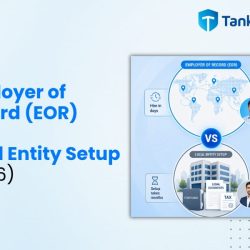
Yes, because Resolution No. 340 of 2026 authorizes the delegation of payroll to any other party as long as MOHRE is informed about the delegate and his responsibilities. However, the responsibility of paying the employee lies completely with the employer. Businesses that do not have a local entity in UAE can also hire via Employer of Record (EOR).
How Should an Indian Company Approach UAE Payroll?
Treat the UAE as a wage-timing and statutory-benefits jurisdiction, not a tax jurisdiction, and build the payroll calendar around the first of the month before anything else. Most errors Indian employers make in the UAE come from importing Indian assumptions about grace periods and deductions.
These three habits will prevent the majority of the problems. Record all changes to salary as an amendment to the contract before it is reflected in the WPS file. Do not exceed a deduction of 15% of salary per month, unless there is a good reason for it. Also, process all settlement payments using WPS within the 14-day period.
TankhaPay’s HR and payroll software for the UAE generates WPS-compliant SIF files for submission through licensed agents and runs payroll to the UAE calendar. For companies without a UAE entity, TankhaPay’s Employer of Record service starts at USD 199 per employee per month as a flat fee with no setup cost. That figure is the published rate and is indicative rather than a quoted price.
To map your UAE headcount, free zone position and Emiratisation exposure against the rules above, Book a Strategy Call with TankhaPay’s UAE team.