Nobody changes payroll providers because things are going well. By the time a company starts looking, there is usually a pattern of errors, a missed filing, or a query nobody could answer.
The transition itself carries more risk than the situation you are leaving. Two bad cycles in front of the entire workforce undoes more trust than a year of small errors ever did.
How do you switch payroll outsourcing providers without breaking a pay cycle?
Switching to a new payroll provider involves less the switch itself and much more in ensuring that you manage the process well without relinquishing control over the payroll, compliance, or your employees’ data.
The most secure strategy is to divide the process into clearly defined three stages, each focusing on different risks before moving to the next.
- Schedule the switch at a natural milestone, if possible, the start of a new fiscal year.
- Perform an audit of the year-to-date data prior to the start of migration.
- Specify tax filing responsibility in writing prior to the start of the month of transition.
- Run two full parallel cycles before go-live, and reconcile line by line.
- Confirm multi-state statutory registration continuity, and put employee data-privacy terms in writing with both providers.
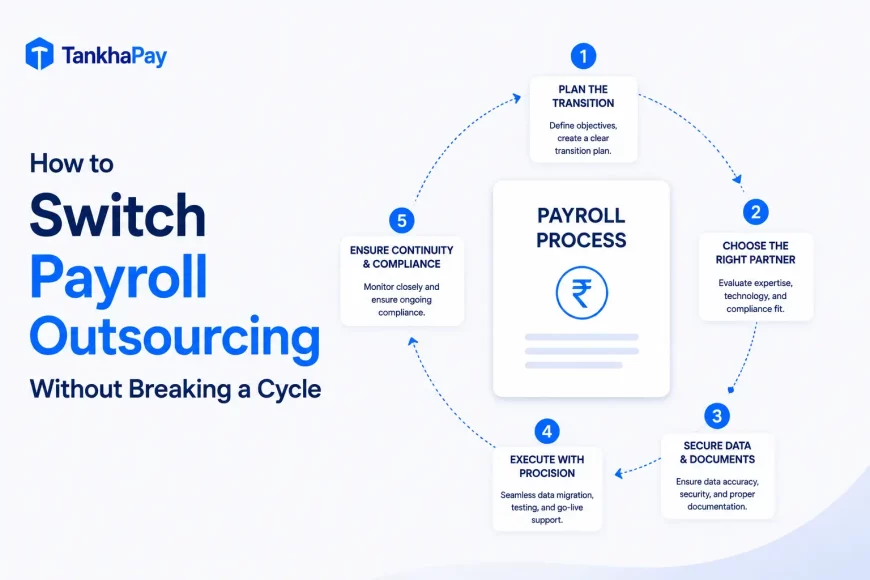
Below are the three phases encompassing the entire process. Each phase contains a failure point that can only occur if it is skipped.
What should you do before a payroll outsourcing transition starts?
Pre-transition planning decides whether the rest goes smoothly, and it happens before you give notice to your existing provider. Most of what goes wrong in a payroll transition traces back to a decision, or a non-decision, made in this phase, weeks before anyone notices a problem. Get these six items settled first.
- Pick the boundary date. Align go-live with the start of a financial year where possible, or a quarter boundary if not. A 1 April start means year-to-date figures are zero and nothing has to carry over.
- Review the contract that is currently in effect. Make sure to understand the notice period and any exit charges before you give a notice of termination, not after. Data handover details are negotiable while you are still a paying customer.
- Assign one internal owner. Only one person who oversees the data handover process will be responsible for all the details and timeline. If there is more than one, the handover will have compliance issues along the way.
- Agree on the data format in writing. Confirm what the outgoing supplier provides, how, and for which period. A report does not suffice.
- Identify who responds to historical enquiries. Staff will enquire about their payslips for periods when the outgoing supplier was running the payroll system. If nobody else is responsible, it’s HR by default.
- Lock outgoing-provider access rights. Signature certificates for e-filing purposes, contact details recorded by your Employer’s Provident Fund Organisation (EPFO) and Employer’s State Insurance Corporation (ESIC) employer portals, and authorised signatory details for the Tax Deduction and Collection Account Number (TAN) are generally associated with the person who was responsible for payroll last. If they remain associated with the outgoing provider post-exit, then it is an access control issue and not just a data issue. Make sure you change them during the handover process.
What data must transfer when you change payroll outsourcing providers?
The figures for the year to date are more important than the figures of the current month. The new provider can easily calculate this month’s salary starting from scratch. But the year is not possible without the history.
Eight categories have to move, and each breaks something different if it does not:
| Data | What breaks without it |
|---|---|
| Year-to-date gross, tax deducted at source (TDS) and taxable income | The annual TDS certificate is wrong for every employee |
| Provident Fund (PF) and Universal Account Number (UAN) details with contribution history | Electronic Challan-cum-Return (ECR) filings reject, and employee passbooks show gaps |
| Employees’ State Insurance (ESI) Insured Person (IP) numbers and contribution history | Coverage continuity fails and benefit claims are refused |
| Investment declarations and proofs already submitted | Employees are taxed again on income they already declared |
| Leave balances and loss of pay history | Balances disagree between systems and employees see it on the payslip |
| Loan and advance balances with repayment schedules | Deductions restart, stop, or double |
| Gratuity accrual and valuation history | The gratuity payout at exit is calculated on an incomplete service record |
| Statutory bonus computation history under the Payment of Bonus Act | The bonus register does not reconcile, and the eligibility calculation restarts from zero |
The first row causes the most damage and surfaces the latest. An employee discovers it the following June, when the annual certificate does not match what they were actually paid.
Apart from the data, there are three pre-processing steps that should be considered during this stage.
- Employee master should be cleaned up before migration and not after. It is more cost-effective to clean up inactive employees, out-of-date bank account information, and lack of statutory IDs through an Excel sheet than through the payroll system.
- Map out clearly the cut-off of attendance. Both the providers need to be clear on whose punching records belong to which cycle. Overlapping results in double payments, while a gap creates loss of payments to workers.
- Write down who files taxes and for what periods. Specify for PF, ESI, TDS, Professional Tax, and Labour Welfare Fund who files in which period. Both overlapping and missing months create problems, and that happens in the month of handover.
What happens to employee data privacy during the switch?
Permanent Account Number (PAN), the employee’s Aadhaar-linked UAN (Aadhaar is India’s national identity number), bank account details, and ESI IP numbers all move between two commercial vendors during this transition, and that handoff is not just a data-format problem. It is a data-protection one.
Do three things in writing before any data is transferred.
- Ensure that the two parties are under an agreement for data processing that outlasts the transfer, rather than an agreement for services alone from the original service provider.
- Specify a deadline for when the original service provider must delete or return the data related to the employees once the contract has expired.
- Write an agreement that the data was collected exclusively for payroll and no other purpose so that the data can never sit indefinitely.
AKAL Information Systems, TankhaPay’s parent company, holds ISO 27001 certification for information security management, the kind of independently audited control this exact handover calls for. Whichever provider you choose, ask the same question of them: who audits how they handle data in motion, not just data at rest.
What does execution and go-live involve in a payroll outsourcing switch?
Execution is the stage where employees experience the change, which means that communications become just as critical as configuration. Six tests will determine whether you have a smooth go-live or a mess during the second week. Not one of these will be costly to do right but will be costly to do wrong later on.
Conduct two parallel runs of an entire payroll. This involves the processing of the same month by both service providers without reconciliation; the reconciliation will be done prior to the payment being made to either. Conducting two will verify that the second provider can generate the payroll twice. Budget for it: having two providers running in parallel will mean paying two providers for the month, in addition to whatever fees there may be for termination or onboarding. It’s a tiny cost compared to a failed first run.
Line item reconcile, do not reconcile samples. Gross and net amounts per employee, statutory deductions per head, employer contributions with employees’ deductions, and bank reconciliation with the payroll records.
Tell employees before the first live cycle. Payslip format changes and portal access changes are visible immediately. Told in advance it is a transition. Discovered afterwards, it becomes a rumour about the company’s finances.
Provide issue portal access early on. If employees migrate to a new self-service portal, provide them with access and a brief guide prior to the first payslip appearing there, not along with it.
Check variable values before signing off. Overtime, shifts, loss of pay, and any incentive element. These are the values that vary from system to system, as these are the values that are dependent on configuration and not the master file.
Audit the third cycle independently. Everyone watches the first. The third is when attention has moved on and errors stop being caught, which makes it the right one to check.
What should stay unchanged during a payroll outsourcing transition?
The salary date. Change one variable at a time, and the provider is already the variable.
Moving the payment date during a provider change guarantees that any timing question becomes a question about whether the new provider is working. Hold the date through at least three cycles, then move it separately if you need to.
The same applies to salary structure changes, new allowance categories and revised leave policies. All reasonable projects. None belongs in the same month as a provider change.
Is it safe to switch payroll outsourcing providers mid-financial-year?
But it can be done, albeit with more difficulty, and that difficulty is continuity, not computation. TDS is based on the entire year’s calculation, so switching mid-year means the new vendor has to start where the previous one left off.
Three items need explicit handling.
- TDS Year-to-Date. The new service provider should get precisely what has been withheld to date, failing which the end-of-year calculation will not be correct. From 1 April 2026 onwards, the Income-tax Act, 2025 changed the numbering of relevant forms. The form in which the new service provider is filing the quarterly return is Form 138 (earlier known as Form 24Q). The certificate an employee eventually receives, Form 130 (formerly Form 16), is only generated after the full tax year closes and the final quarterly return is filed, so it will not surface a handover error until months after go-live. Get the quarterly filing right in real time; do not wait for the annual certificate to catch a mistake; it will be too late to fix easily. See the Income Tax Department’s own transition FAQ for the full form mapping.
- Declarations for investment. Declarations made by the employees at the beginning of the year using Form 12BB, which from 2026-27 will be called Form 124. In case those declarations are not carried forward, employees have to make the declarations again, or they will be considered as having not done the declaration at all.
- Statutory Registrations. PF & ESI registration is for your establishment and not for the service provider. Make sure that there are no duplicate or missing months in your filings.
How long does a payroll outsourcing transition take in India?
Two to four weeks is usually considered to be the minimum time taken by a single entity in one state, with data available and without the parallel cycle. In case of a multistate company in India running parallel cycles, the realistic timeframe is eight to twelve weeks.
It is not a matter of the effort put in but rather what is being measured.
Two to four weeks describes the execution phase for a single-entity, single-state employer with clean data, no parallel run, and a provider configuring a standard setup. That situation exists and the number is fair for it.
Eight to twelve weeks describes what most Indian employers actually face:
| Stage | Time | Why it takes that long |
|---|---|---|
| Data extraction and cleansing | 2 weeks | Employee master, year-to-date figures, statutory IDs |
| Configuration | 2 weeks | Salary structures plus separate statutory setup per state |
| First parallel cycle and reconciliation | 2 weeks | Differences found and resolved |
| Second parallel cycle | 2 weeks | Confirms the first was not luck |
| Go-live and third-cycle audit | 4 weeks | Catches what the first cycle’s attention missed |
If you operate in one state with one entity and clean data, take the shorter number. If you run several plants across states, or engage contract labour, or are switching mid-year, plan for the longer one. The cost of the extra weeks is far below the cost of a failed first payroll.
Does a payroll outsourcing transition affect statutory compliance?
The liability remains on your shoulders all through, despite who processes it. A change in the provider will not halt any deadlines of PF, ESI, TDS, or Professional Tax, and no one will consider a changeover as a reason for your delay in filing.
The month of transfer will be the most risky period, since the liability may be shared by two providers. Specify the party responsible for each liability in the month of transfer in writing.
If your setup spans several states, that list is longer than it looks. Each state carries its own Professional Tax slab and Labour Welfare Fund calendar, with no central notification when either changes. TankhaPay maintains registered presence across all 28 states for exactly this reason: tracking that many separate calendars is easy to get right in month one and easy to lose track of by month six, regardless of which provider is running payroll.
Common questions about switching payroll outsourcing providers
A few questions come up in transition planning that the sections above do not cover directly.
When is the best time to switch payroll outsourcing providers?
The start of a financial year, because year-to-date figures reset and nothing has to carry over. A quarter boundary is the next best option. Mid-year switches are possible but need year-to-date TDS and investment declarations migrated explicitly.
Should we run parallel cycles if the new provider says we do not need to?
Yes. A provider declining a parallel run is telling you something about how it handles risk. The cost of two parallel cycles is small against the cost of a failed first payroll in front of the workforce.
Who is liable if the transition causes a missed statutory filing?
The Employer. The statutory responsibility falls on the company rather than the Payroll Provider, which is why it is important to have the person accountable for each filing stated in writing prior to the transition.
Can we switch payroll providers without employees noticing?
No, and it is pointless to even try. Changes in payslip layout and portal are going to be noticed. Announcement in advance prevents unnecessary speculations.
What if the outgoing provider will not hand over clean data?
Raise it before you give notice. Data format and completeness should be settled in writing while you still have negotiating room.
What happens if an employee resigns during the transition?
Name one provider as the F&F (full and final settlement) owner for the handover month before it starts. Gratuity, leave encashment and notice-pay calculations all depend on continuous service records, the same records this transition is already migrating, so treat an exit in that month as a data problem you have already solved, not a new one.
In payroll outsourcing, the transition is the risk, not the provider
Most companies evaluate providers carefully and then treat the switch as an administrative step. It is the reverse. The provider decision is reversible. A botched first payroll in front of the whole workforce is not.
Proper timing of boundaries, an auditable year-to-date audit, documented tax ownership, and dual parallel processing cycles will keep nearly everything out of it.
If you’re evaluating a shift and would like your migration planned prior to making a commitment, our payroll outsourcing services group migrates into multi-state and multi-entity environments frequently. Request a Risk Assessment, and we’ll show what has to be moved and what month is at risk during the handover prior to any decisions on who will run it after.