TL;DR
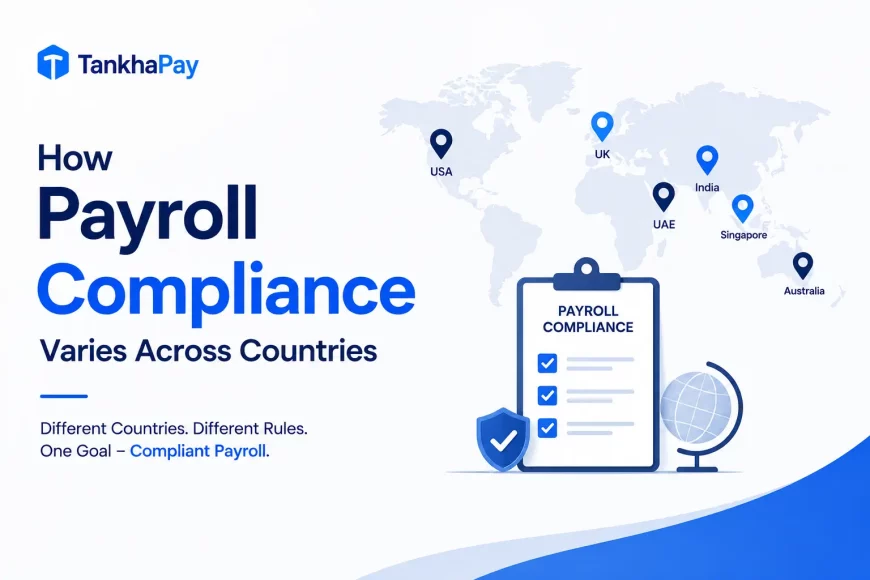
- Payroll compliance varies across countries along four structural axes rather than randomly.
- The first axis is who carries the income tax withholding obligation, whether the employer or the individual, and at what cadence.
- The second is how social insurance is funded and how the cost is split between employer and employee.
- The third is which benefits are statutory rather than contractual or customary.
- The fourth is how often the state requires reporting: either every payday in some countries or annually in others.
- Contribution rates change annually, but the structure changes rarely, which is why you plan around the structure.
A payroll manager who has run India Payroll for a decade can be wrong about almost everything in Germany within a week of starting there. Not because the calculation is harder. Because the things that are mandatory, the things that are customary, and the things that are illegal sit in different places.
Why does payroll compliance differ between countries?
Because payroll is not an accounting function. It is the mechanism through which a state collects tax and funds social insurance, and every state built that mechanism differently.
Four things vary, and they explain almost every difference you will encounter:
- Who carries the withholding obligation. In India, the United Kingdom and Australia, the employer withholds and remits. In some jurisdictions, the individual carries more of that burden directly.
- How social insurance is funded. Germany splits contributions close to evenly across several separate insurance funds. Singapore runs a single central provident fund with age-banded rates. The UAE levies contributions only for a subset of the workforce.
- Which benefits are statutory. A thirteenth-month payment is legally required in some countries, customary in others, and unheard of elsewhere. Getting this wrong is the most common and most expensive error when entering a new market.
- How often the state wants to hear from you. The United Kingdom and Australia require reporting on or before each payday. Others reconcile annually. This single difference determines whether your payroll calendar is monthly or continuous.
Payroll Compliance by Country: Structural Comparison
The contribution rate and threshold vary each year, and a table of figures will become outdated in twelve months. However, structure stands and the complexity score depends on two factors: the number of parallel systems employer needs to meet, and how often the government demands filings.
The table below compares structure, not rates.
| Country | Income tax withholding | Social security | Pay frequency | Mandatory bonus | Reporting cadence | Record retention | Data privacy | Complexity |
|---|---|---|---|---|---|---|---|---|
| India | Employer withholds TDS (Tax Deducted at Source) on salary, slab-based | PF (Provident Fund) and ESI (Employee State Insurance), both employer and employee funded, ESI wage-capped; both schemes now administered under the Code on Social Security, 2020 | Monthly, statutory payment deadline | Statutory bonus under the Code on Wages, 2019 (formerly the Payment of Bonus Act, 1965), eligibility-based | Quarterly TDS return, monthly PF and ESI filings | Multi-year, varies by Code and state | DPDP Act, 2023 | High |
| United States | Employer withholds federal, state and often local | FICA, split employer and employee, annual wage base for the pension element | Commonly biweekly or semi-monthly, state-regulated | None federally | Quarterly federal return, annual employee statements | Multi-year, federal and state layered | No single federal law, state statutes apply | High |
| United Kingdom | PAYE (Pay As You Earn), employer withholds | National Insurance, employer and employee, plus auto-enrolment pension | Monthly typical, weekly permitted | None | RTI (Real Time Information) on or before every payday | Several years after tax year end | UK GDPR and Data Protection Act | Medium |
| Germany | Lohnsteuer, employer withholds | Multiple separate insurances, split close to evenly | Monthly | None statutory, thirteenth month common contractually | Monthly electronic filings | Long, and among the strictest here | GDPR, plus works council involvement | High |
| Singapore | No employer withholding for most residents | CPF (Central Provident Fund), age-banded rates, citizens and permanent residents only | Monthly, statutory payment deadline | None statutory, annual wage supplement customary | Annual employer return | Multi-year | PDPA | Low |
| UAE | No personal income tax | Pension contributions for UAE and GCC nationals only | Monthly, via the WPS (Wage Protection System) | None | WPS transfer file each cycle | Multi-year | PDPL | Low |
| Australia | PAYG withholding | Superannuation Guarantee, employer funded, plus state payroll tax above thresholds | Commonly fortnightly or monthly | None | STP (Single Touch Payroll) on each payday | Multi-year | Privacy Act | Medium |
| Canada | Federal and provincial withholding | CPP or QPP, plus Employment Insurance | Commonly biweekly or semi-monthly | None | Periodic remittance, annual statements | Multi-year | PIPEDA, plus provincial statutes | High |
Three things this table shows that most country guides obscure:
- Low tax does not mean low complexity, and the reverse is also true. Singapore and the UAE are structurally simple. Canada has moderate rates and high complexity because federal and provincial rules stack.
- Reporting cadence matters more than rates for operations. Both the UK and Australia demand one submission every payday, which is through HMRC’s RTI system and the Australian Taxation Office’s STP system, respectively. This is not just a difference in rates but rather a different operational strategy that makes teams fail who prepare on the basis of a monthly schedule. Australia is taking this step further since from July 2026 onwards, superannuation will be required every payday rather than quarterly.
- India is the outlier for a specific reason. It is not the level of the rates, which is moderate, but the multiple systems of taxes: central acts, state professional tax, state labor welfare fund, and the establishment act, depending on whether your business is industry or office.

How does tax withholding actually change between countries?
The employer’s role is the variable, not the tax.
In most of the countries above, the employer computes and remits. What differs is how much of the annual position the employer is expected to get right during the year.
In India, the employer must calculate the whole year’s tax liability of the employee, along with their investments for that year, and deduct taxes based on this calculation for 12 months. This method of tax calculation imposes a greater burden on the employer as compared to the flat-rate method.
Singapore takes almost the opposite approach for resident employees, with the individual settling directly with IRAS. A payroll team arriving from India will look for a withholding process that does not exist.
Why Social Security Is a Major Payroll Cost Variable Across Countries?
This is where employer cost diverges most sharply between countries and where budgeting for expansion most often goes wrong.
Three models:
- Split contribution. India, Germany, the United States, the United Kingdom and Canada all split funding between employer and employee in different proportions across different funds. In India, current contribution rates and wage ceilings are published by the EPFO and ESIC, and both change by notification rather than on a fixed calendar.
- Employer-funded. Australia’s Superannuation Guarantee is an employer obligation on top of salary, not a deduction from it. Budget it as a cost, not a withholding.
- Restricted population. The UAE levies pension contributions only for UAE and GCC nationals. For an expatriate workforce the employer cost profile looks entirely different, replaced by end-of-service gratuity accrual.
The planning error to avoid: modelling headcount cost on gross salary and adding a single social security percentage. The employer-side load differs by country, by fund, by wage band and sometimes by employee age. Model it per country before you commit to headcount.
Pay Frequency, Benefits and Overtime: How Payroll Rules Vary by Country
- Frequency becomes law more than it does preference. There are several jurisdictions that have statutory due dates for payments and do not allow frequency to be negotiated. Just because the head office pays monthly does not mean that you can pay monthly.
- Statutory versus customary benefits is the trap. The 13-month salary in the Philippines is a statutory obligation, industry practice in Germany, and non-existent in the United Kingdom. The statutory benefit in India, which, under the current Payment of Bonus Act, has been codified as the Code on Wages, 2019, is a statutory obligation and is not discretionary, as international organizations mistakenly believe.
- Overtime rules follow the establishment type, not the job title. Overtime regulations for workers in India are covered under the “Occupational Safety, Health and Working Conditions Code, 2020” (amalgamation of the “Factories Act, 1948”) as a statutory multiple of their ordinary pay, whereas a similar office employee in accordance with a state’s “Shops and Establishments Act.” Most nations which seem to have easy overtime laws also have such a division beneath the surface.
Data privacy and payroll records
Payroll holds identity data, bank account details, salary details, and sometimes health data. It is one of the most confidential data sets held by an employer.
Europe has GDPR, which restricts the transfer and processing of payroll information. The DPDP Act of 2023 in India has the principles of consent and purpose. This principle is enacted in the form of regulations that were issued in 2025. There is no such act in the USA, and the obligations depend on the location of the workers.
Practical consequence: Using a single payroll system with a single region containing all employee data may not be legal in all countries that you do business in. Check the data residency requirement before you sign, not when you implement.
Worker classification: The Most Expensive Payroll Compliance Mistake
Every country distinguishes employees from contractors. The line sits in a different place in each.
Despite variations in language, there is one common point in the tests – that is, control, integration, exclusivity, and source of tools. In other words, a contractor who has been hired by you and who works regular hours on your system, under your instructions and supervision, is an employee for almost all purposes.
The risk is in case the reclassification finding lands is back-dated: unpaid social contributions, unpaid taxes, penalties, and, in some places, statutory entitlements for the entire duration of the engagement.
This is the single largest financial risk in international payroll, and it is entirely avoidable at the point of engagement.
Cross-Border Payroll Challenges: Managing Compliance Across Countries
- Permanent establishment. Employing someone in a country can create a taxable presence there. This is a tax question that arrives disguised as an HR decision.
- Currency and payment timing. Salary agreed in one currency and paid in another shifts exchange risk onto someone. Decide who, in writing, before the first payroll.
- Entity or Employer of Record. An Employer of Record legally hires your employees in the country without having an entity of its own. While you direct the operations, it will handle all payroll and statutory compliance responsibilities for you. Creating a legal entity would be the correct option past a certain number of employees and period. Before that, an EOR would often be cheaper and quicker. This would depend on the duration you plan to stay and not on the number of employees. For India, organizations like TankhaPay have a registered presence in all 28 states because many statutes are state-level.
- Local payroll calendar collisions. Statutory filing deadlines rarely align across countries. A consolidated global close date that ignores local deadlines produces late filings somewhere every month.
Payroll Compliance Factors to Evaluate Before Entering a New Country
A working checklist. These nine questions surface almost every structural surprise described above, and the cheapest time to answer them is before the first offer letter goes out.
- What is the total employer cost per hire, including every social contribution, not just gross salary?
- What benefits are statutorily mandated as opposed to customarily provided, and what is the cost of the customary package if you forego it?
- What is the frequency of reporting, and is your current process able to handle it?
- Does employment here establish a permanent establishment?
- Where is the payroll data to be held, and is your system able to provide it?
- What is the classification test, and will your proposed engagement model pass the test?
- What is the statutorily mandated notice and termination fee, before you hire as opposed to after?
- Entity or Employer of Record, based on intended duration?
- Who signs the local filings, and are they resident in-country?
Payroll mistakes multinationals make most often
The errors outlined above are common among organizations of all sizes, and they have a common root: assumptions carried over from the domestic market that have not been put to the test of foreign laws. Each is inexpensive to avoid but costly to reverse.
- Assuming home-country structure travels. The salary structures designed under one tax system will not meet the minimum statutory requirements in the other.
- Treating customary benefits as optional. Legally defensible, commercially damaging. You will not retain anyone.
- Consolidating the payroll calendar to the head office. Local statutory deadlines do not move for your close date.
- Choosing a global platform without checking country depth. Most global platforms are excellent in a handful of markets and thin in the rest. Ask specifically about the countries you are entering, not the count on the homepage.
- Hiring contractors to avoid entity setup. The most common route into a classification finding.
India Specifically: What Foreign Employers Get Wrong About Payroll Compliance
Most global payroll guides give India one paragraph. Here is what that paragraph misses.
- There are four parallel regimes, not one. Central statutes (TDS under income tax law and the PF and ESI schemes under the Code on Social Security), state Professional Tax, state Labour Welfare Fund, and the establishment law that governs you. A company operating in five states manages five Professional Tax registrations and five remittance calendars.
- Which law governs you depends on what you operate. The factory comes under the Code on Occupational Safety, Health and Working Conditions (the former Factories Act). The office comes under the State Shops and Establishments Act, which was not subsumed by the Labour Codes. Separate registers, separate working hours, and separate inspection systems. This has been extensively discussed in terms of compliance changes with regard to payroll.
- Contract workers sit inside your compliance perimeter. The principal employer carries fallback liability when a labour contractor defaults. A position carried forward into the OSH Code from the former Contract Labour Act. Foreign employers routinely assume the contractor’s obligations end with the contractor.
- Attendance records are statutory evidence. During a labour inspection, the attendance record is what supports the wages you filed. This is an operational requirement, not a reporting nicety.
- The regulatory position changed in 2026. The four Labour Codes took effect on 21 November 2025 per the Ministry of Labour and Employment’s gazette notification, subsuming 29 central labour laws. Major rules applicable in May 2026 include those of the states which are yet to be notified. The major impact on the employer in terms of the costs incurred due to the new rules is the definition of “wages”: at least 50% of total remuneration shall constitute “wages”, thereby increasing the computation base for PF, Gratuity, and Statutory Bonus in many salary structures. Additionally, the new Income-tax Act of 2025 replaces the 1961 Act from April 2026, renaming the forms issued by payroll systems.
For platform-level detail, see the best payroll software in India or, if you would rather not run it in-house, payroll outsourcing companies in India.
Best practices for multinational payroll
None of the practices below require new tooling. They are operating decisions, and the companies that run multi-country payroll well tend to have made all six deliberately rather than by default.
- Standardise the process, localise the rules. One approval workflow and one data model globally. Country-specific statutory logic underneath.
- Keep one source of truth for employee data. Most global payroll errors are data errors, not calculation errors.
- Run a parallel cycle in every new country. One month, both ways, before going live.
- Appoint in-country responsibility. Someone who lives there, who signs the returns and answers the regulatory authority.
- Annual review, not after problems. The contribution levels change year by year in almost all countries.
- Ask suppliers about depth, not coverage. “We support 150 countries” and “we file statutory returns in India” mean two different things.
How does payroll software help, and where does it stop?
Good multi-country payroll software maintains statutory rules per country, applies them automatically, generates local filings, and gives finance one consolidated view.
What it does not do: registering your organization, determining your category, selecting where your data resides, or being your representative during the audit. All of that remains the decision of a human.
The realistic question is not whether to use software. It is whether you need software plus in-house expertise or a provider who runs the function for you in each market.
To Conclude
Payroll compliance does not vary randomly across countries. It varies along four axes, and once you can name them, you can assess a new market in a day rather than discovering it over six months.
These errors, which cost actual money, do not involve miscalculations. Instead, they are structural in nature. These include the assumptions that a benefit is discretionary while it is actually a statutory benefit; that a subcontractor is actually a contractor; and that a global closure date will supersede a local filing deadline.
If India is one of the markets you are entering, that is the one we know from the inside. Book a strategy call, and we will map your intended workforce against the statutory position, state by state.
FAQs
Why does payroll compliance vary between countries?
Each state depends on payroll for its tax revenue and its social insurance fund; therefore, each state has designed its own payroll system. There are four variations in each state’s payroll system, namely, who is responsible for withholding, how the social insurance is financed, what the statutory benefits are, and the frequency of reports.
Which country has the most complex payroll?
Complexity is a result of jurisdictional layers and not high rates. India, Germany, Canada, and the US are all characterized by multiple overlapping regimes. India uses state level Professional Tax and Labour Welfare Fund in addition to central legislation.
What is the biggest risk in international payroll?
Worker classification. Treating an employee as a contractor triggers back-dated social contributions, unpaid tax, penalties and sometimes statutory benefits for the full engagement period. It is the most expensive error and the most avoidable.
Do I need a legal entity to hire abroad?
Not always. The Employer of Record (EOR) acts as the one who hires you and assumes the compliance responsibility in that country. Forming an entity makes sense after you reach a certain number of people and for a certain period of time. It is all about the duration, not about the number of people.
Can one payroll platform handle every country?
Technically, yes but with some qualifications. Most international platforms are solid in a handful of countries and weak in others. Be specific about your country of interest and the kinds of legal filings the platform will make in that country.
Where can payroll data be stored?
It depends upon the region. GDPR prohibits data transfer out of Europe, but the Indian DPDP Act of 2023 is based on the concepts of consent and purpose. Verify the residency constraints of the data before selecting the platform.
What is a thirteenth-month salary?
An extra payment, usually done on an annual basis. It is a legal requirement in countries like the Philippines, a contractual practice in other countries, and non-existent in yet other countries. India’s statutory bonus, according to the Code on Wages, 2019 (Payment of Bonus Act) is a legal requirement for qualified employees.
What changed in India’s payroll compliance in 2026?
The four Labour Codes took effect from 21 November 2025, subsuming 29 central labour laws, with central rules notified in May 2026 and state rules following. The new wages definition raises the base for PF, gratuity and bonus in many salary structures. The Income-tax Act, 2025, also replaced the 1961 Act from April 2026.
How often should international payroll rules be reviewed?
Once a year at least. The contribution rates and wage bands vary almost every year in most countries. In India, the status quo changed significantly in 2026 with the Labour Codes and Income-tax Act, 2025.