Written by 3:29 pm blog, Payroll • 3 Comments

Best Payroll Software in India 2026 | Features, Benefits and Compliance

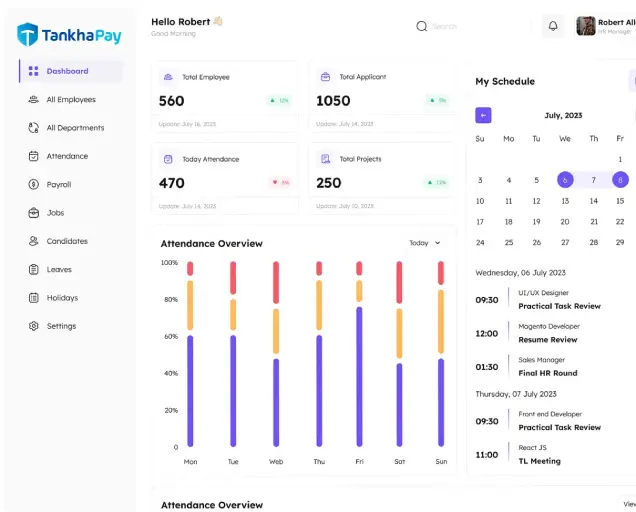
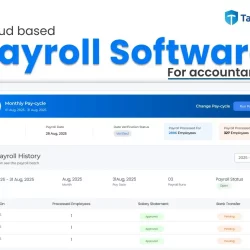
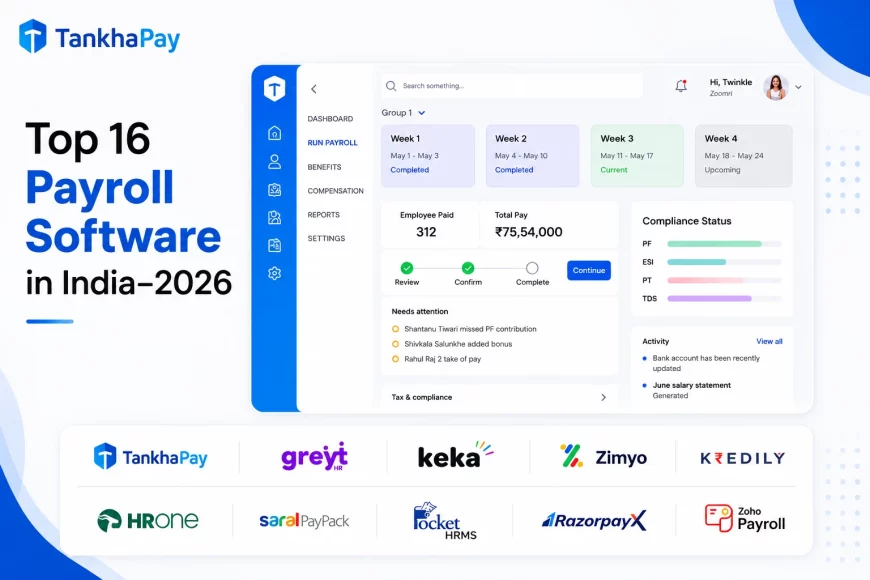
Top payroll software in India 2026 comparison featuring TankhaPay, GreytHR, Keka, Zimyo and Zoho Payroll dashboard

Table of Contents

TL;DR – Best Payroll Software in India 2026

  • greytHR is India’s most trusted SMB payroll platform – free for up to 25 employees, 15,000+ clients across 150+ cities
  • Keka HR is the top choice for IT companies – attendance, leave, and payroll run on the same platform with no monthly data export
  • TankhaPay saves up to 12 hours every pay cycle – 1,000+ organisations, scales from 50 to 10,000+ employees, zero statutory penalties on record 
  • Razorpay Payroll is the fastest to get started – ₹100/employee/month, full payroll running in under an hour

Nowadays, payroll software in India has become essential for organizations willing to remain compliant with all regulations. Paying for PF, ESI, TDS, Professional Tax in more than 26 states, LWF, statutory bonus, and Labor Codes manually will lead to non-compliance penalties. 

As per the survey conducted by KPMG (2024), it is seen that 67% of Indian organizations use payroll software, and by 2026, this figure would be higher than 85%.

This guide compares 16 payroll software platforms reviewed by TankhaPay’s compliance team on what actually separates them: India-specific statutory coverage, state-wise PT auto-handling, LWF automation, year-end compliance capability, Labour Code readiness, and pricing transparency. We have included our own product in this list and evaluated it by the same criteria as every other tool.

Who this guide is for: HR managers, finance leads, and business owners with 10 to 5,000 employees evaluating payroll software for the first time or considering a switch.

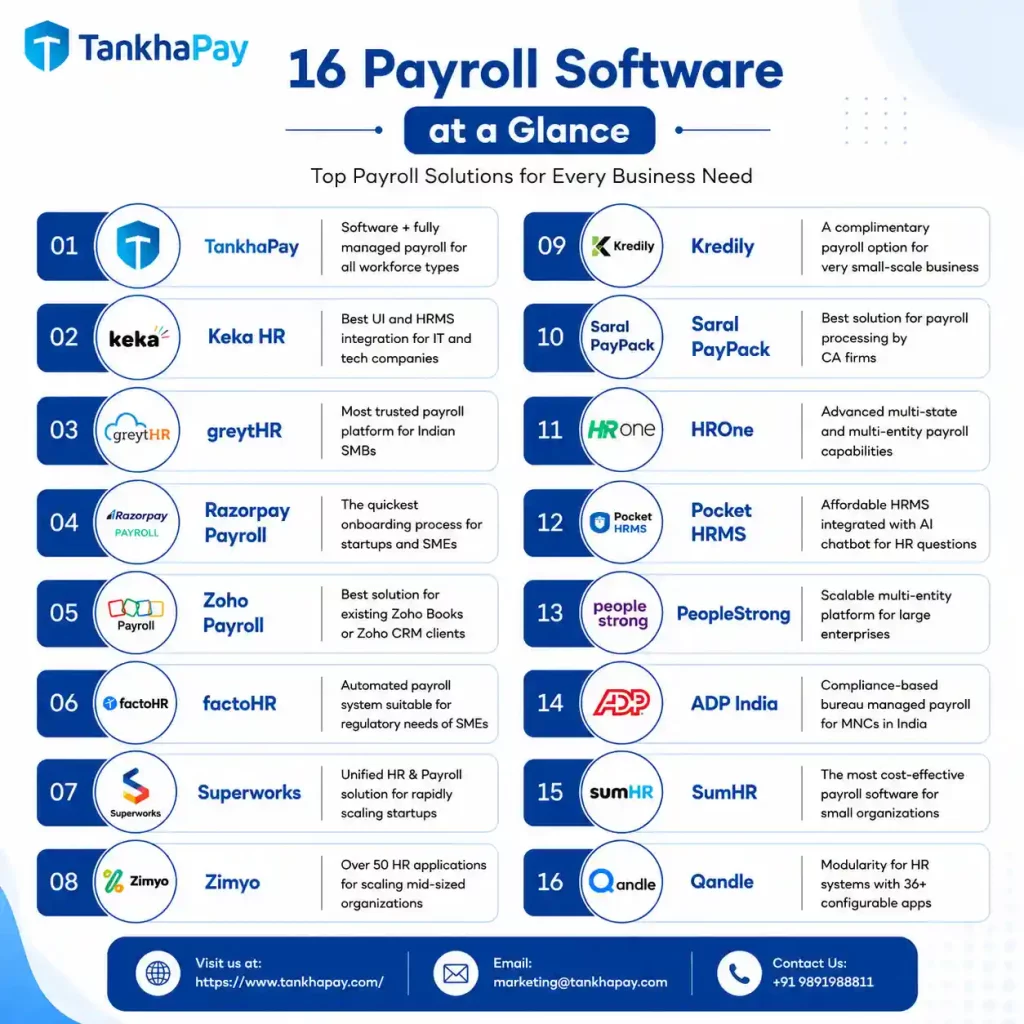
All 16 Payroll Software Names at a Glance

If you need a fast reference, here are all 16 tools covered in this guide:

  1. Keka HR – Best UI and HRMS integration for IT and tech companies
  2. greytHR – Most trusted payroll platform for Indian SMBs
  3. TankhaPay – Software + fully managed payroll for all workforce types
  4. Razorpay Payroll – the quickest onboarding process for startups and SMEs
  5. Zoho Payroll – Best solution for existing Zoho Books or Zoho CRM clients
  6. factoHR – Automated payroll system suitable for regulatory needs of SMEs
  7. Superworks – Unified HR & Payroll solution for rapidly scaling startups
  8. Zimyo – Over 50 HR applications for scaling mid-sized organizations
  9. Kredily – A complimentary payroll option for very small-scale business
  10. Saral PayPack – Best solution for payroll processing by CA firms
  11. HROne – Advanced multi-state and multi-entity payroll capabilities
  12. Pocket HRMS – Affordable HRMS integrated with AI chatbot for HR questions
  13. PeopleStrong – Scalable multi-entity platform for large enterprises
  14. ADP India – Compliance-based bureau managed payroll for MNCs in India
  15. SumHR – The most cost-effective payroll software for small organizations
  16. Qandle – Modularity for HR systems with 36+ configurable apps

Quick Comparison Table – Top 16 Payroll Software in India 2026

Software Best For Free Trial Labour Code Ready Blue-Collar Multi-State PT Auto
Keka HR IT and mid-market Yes Yes No Yes
greytHR SMBs and MSMEs Yes Yes Limited Yes
TankhaPay All workforce types + managed option Demo only Yes Yes Yes (all 26 states)
Razorpay Payroll Startups Yes (1 month) Partial No Yes (major states)
Zoho Payroll Zoho ecosystem users Yes (14 days) Partial No Yes
factoHR SME process-led payroll Yes Partial No Yes
Superworks Integrated HR + payroll Yes Partial No Yes
Zimyo SMBs with 50+ HR modules Yes Partial No Yes
Kredily Very small businesses Yes No No Limited
Saral PayPack CA firms and multi-client No Yes No Yes
HROne Multi-state growing companies Yes Yes No Yes (auto by location)
Pocket HRMS Budget MSMEs Yes Partial No Yes
PeopleStrong Multi-entity enterprises No Yes No Yes
ADP India MNCs with India operations No Yes No Yes (managed)
SumHR Lean teams and startups Yes No No Limited
Qandle Modular HR setup Yes No No Yes

Top 16 Best Payroll Software in India (2026)

Keka HR – Best for IT Companies and Mid-Market

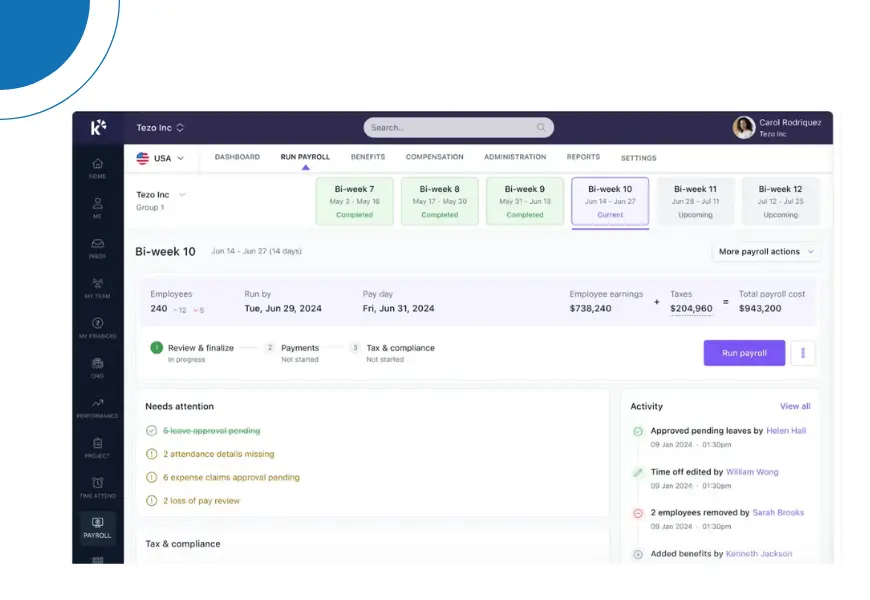
Image is display the payroll software dashboard of KeKa

Keka is the platform most IT companies and tech-forward mid-market businesses use – primarily because it has the cleanest interface in this category and the strongest native HRMS integration. Payroll, attendance, leaves, timesheets, and performance management all live on the same platform with no data export needed between modules.

Key features:

  • Same system as attendance and leave on the same database – no monthly exporting process
  • Delta processing for salary mid-cycle adjustment without having to reprocess the whole payroll process
  • Robust multi-state PT auto-configurator based on the employee’s place of work
  • Automated IT declarations and investments proof collection via Employee Self-Service Portal
  • Performance Management & Appraisal Cycles Integrated

Labour Code ready: Yes 

Blue-collar support: No 

Best for: IT companies, SaaS startups, and mid-market businesses with 100-2,000 employees and want the best user experience in Indian payroll software 

Limitation: Pricing can be expensive for companies under 50 employees compared to alternatives. Not suited for manufacturing or blue-collar workforce payroll.

greytHR – Best for Indian SMBs and MSMEs

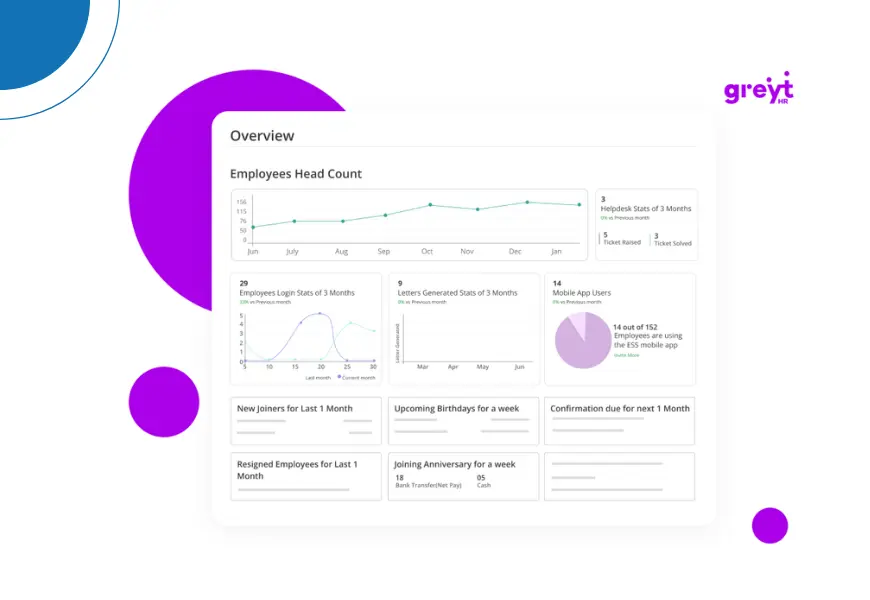
Image is display the payroll software dashboard of GreytHR

Being the most popular payroll software platform for SMBs in India, the product from greytHR is trusted by over 15,000 organisations across 150+ cities. This is ideal for organisations making their transition from Excel to an actual payroll software platform, as they provide a free version for up to 25 people.

Key features:

  • Free plan for up to 25 employees (compliance features on paid plans)
  • Full PF, ESI, TDS, PT, and LWF coverage with automatic statutory updates
  • Multi-state PT auto-configuration – one of the strongest in this tier
  • Inbuilt leave & attendance management
  • Mobile app supporting employee self-service, payslip, and leave requests

Labour Code ready: Yes

For blue-collar employees: No (primarily suited for white-collar workers)

Recommended for: Small to medium-sized Indian businesses between 25 and 500 employees needing more compliance knowledge than complex HRMS features

Limitations: The free version does not include statutory compliance; only payroll processing. Shift payroll management for blue-collar workers is minimal.

TankhaPay – Best for Mixed Workforce + Managed Payroll Option

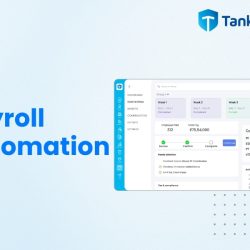
TankhaPay HR automation software dashboard showing payroll processing, compliance status, PF ESI tracking and employee pay summary

TankhaPay is the only platform in India combining payroll software with a fully managed payroll service under one company – meaning you can run payroll yourself or hand the entire function to TankhaPay’s compliance team without switching vendors. This matters most for companies with blue-collar workers, contract staff, or NATS apprentices alongside office staff, because most other tools handle only white-collar payroll.

Key features:

  • Statutory deductions complete coverage: PF deductions (12% by employer, 12% by employee), ESI (3.25%/0.75%), TDS under Section 192, PT for entire 26 states, LWF deduction depending on employment state of the employee
  • Monthly dashboard depicting PF, ESI, PT, and TDS liabilities alongside each other – the unique way to close compliance month-end without manual calculation
  • All kinds of employees covered: white-collar, blue-collar, grey-collar, contractual and NATS apprenticeship allowance disbursements
  • Attendance by biometric, geofencing and facial recognition automatically linked to payroll – no manual data entry
  • Employee salary register, form 9, form 10 and all statutory registers automatically generated for inspection by labour officer
  • Labour code compliance: 50% wage floor and monitoring of notifications at state level

Labour Code ready: Yes 

Blue-collar support: Yes 

Best for: Organizations with varied employee types; firms that need both the software and the complete outsourcing of payroll processing; manufacturing organizations, logistic services, staffing agencies

Limitations: There is no freemium or self-service option available here; a demo needs to be taken first before any software purchase. Pricing information for various tiers of software cannot be found.

RazorpayX Payroll – Best for Startups Needing Fast Setup

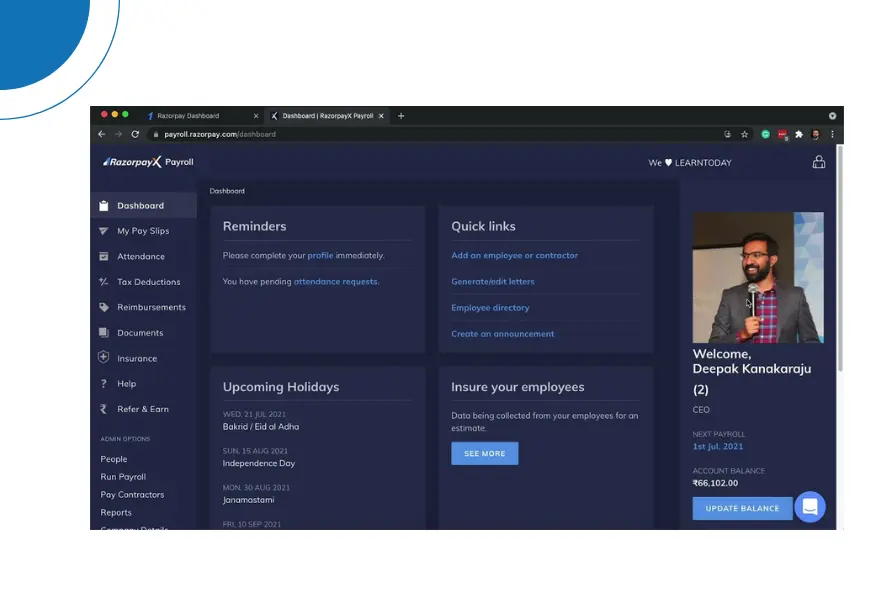
Image is display the payroll software dashboard of Rozarpay

Razorpay Payroll is built on Razorpay’s fintech infrastructure, which means salary disbursements happen faster than traditional payroll tools – and onboarding a new company takes under an hour. For startups with simple salary structures and under 200 employees, it covers everything they need without the complexity of enterprise platforms.

Key features:

  • Onboarding within a couple of hours (fastest in this group)
  • One-click PF, ESI, TDS filing with automated bank file creation
  • Free trail period for a month
  • Integration with Razorpay payment stack that enables same-day payroll disbursements
  • Also handles payments to freelancers and contractors along with employees

Labour Code ready: Partial 

Blue-collar support: No 

Best for: Tech startups and early-stage companies (under 200 employees) with simple salary structures and a priority on payment speed 

Limitation: Not designed for manufacturing, logistics, or mixed-workforce scenarios. Labour Code compliance updates are not the fastest in this category.

Zoho Payroll – Best for Zoho Ecosystem Users

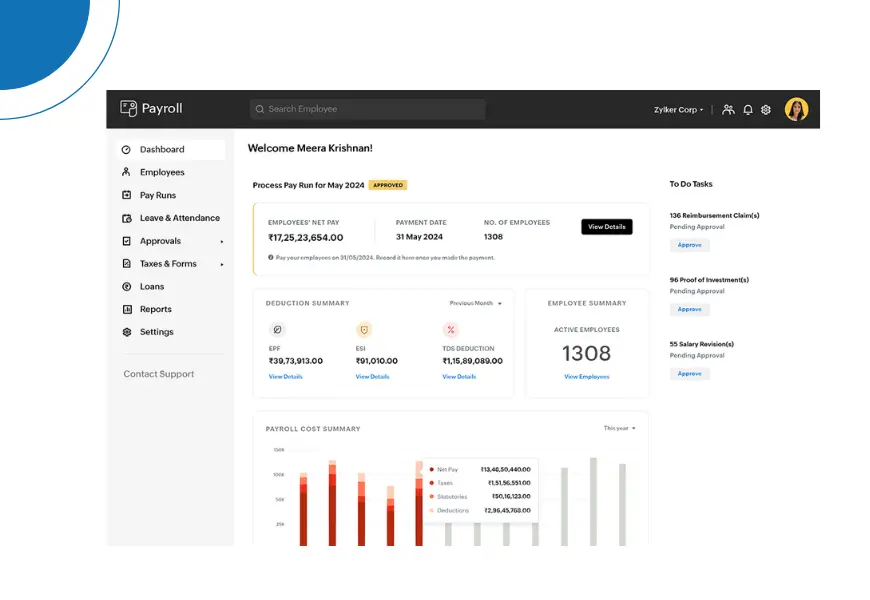
Image is display the payroll software dashboard of ZohoHR

Zoho Payroll is ideal when your business uses any of the other Zoho products such as Zoho CRM, Zoho Books, and Zoho People. Payroll and accounting are seamlessly integrated to help you generate payroll journal entries without manually reconciling them each month.

Key features:

  • Auto-synchronization of all payroll transactions from Zoho Books
  • PF, ESI, TDS, PT calculations & filing
  • Employee self-service portal to view Payslip, Form 16, and Tax Exemption Certificate
  • Payroll structure builder, available with customization
  • 14-day trial period

Labour code compliance: Partial

Support for blue-collar employees: Not included 

Most suitable for:  SMEs with existing Zoho products; organizations looking for cheapest cost per head along with partial compliance

Limitations: The advantage of the integration feature is negated if you’re not using any other Zoho product. The standalone payroll solution by Zoho does the job without any special features.

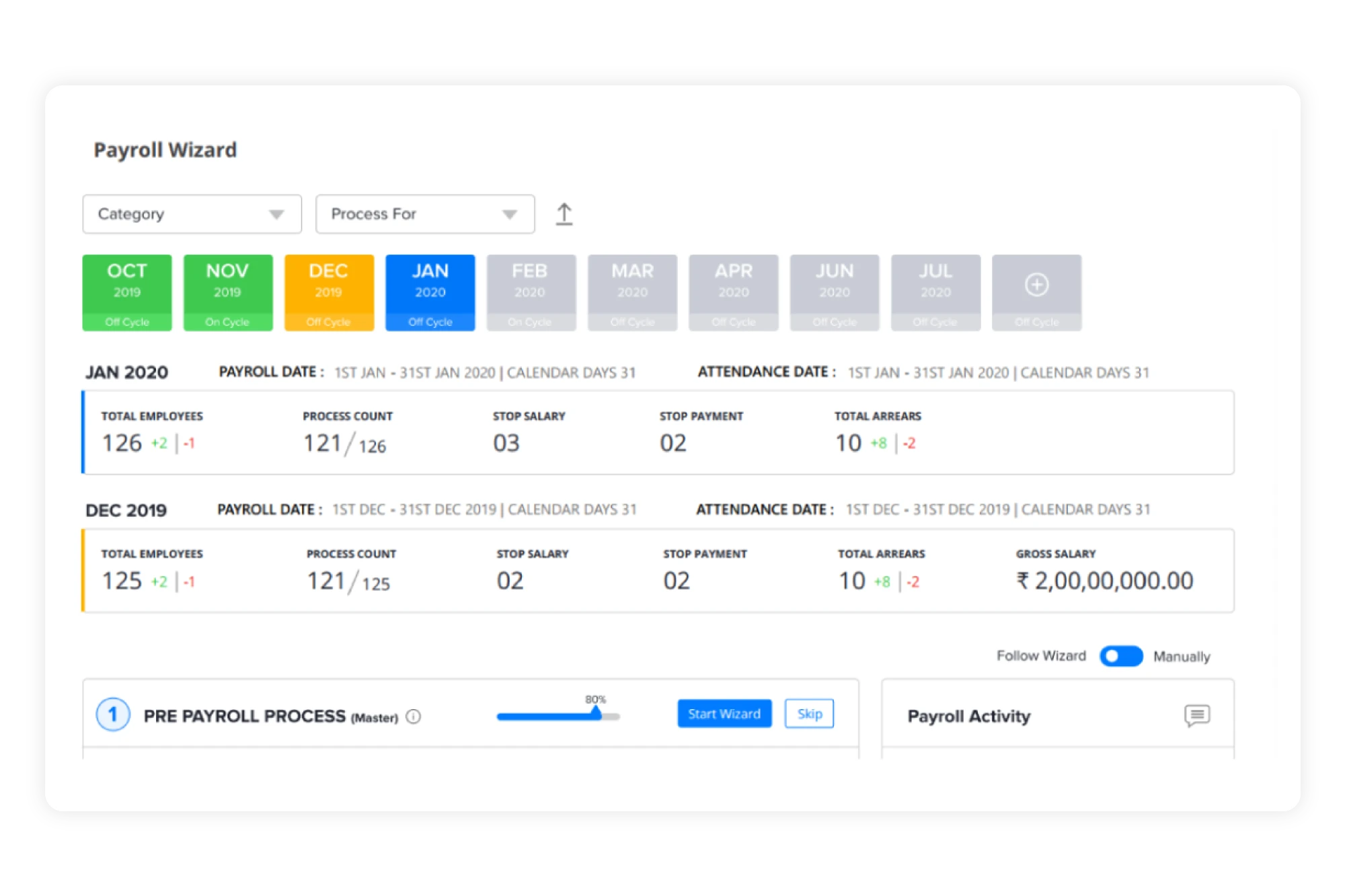
factoHR – Best Wizard-Driven Payroll for SMEs

factohr

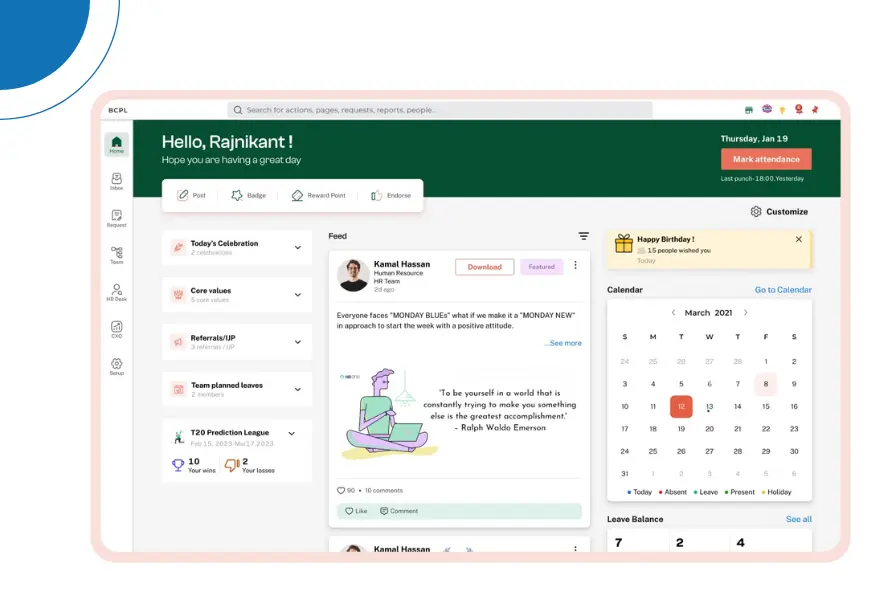
factoHR takes a process-guided approach to payroll, using step-by-step wizards that walk HR teams through payroll runs – making it one of the most accessible tools for companies without dedicated payroll expertise. It covers full Indian statutory compliance and generates 200+ pre-built reports.

Key features:

  • Payroll generated using wizard helps reduce errors on account of configuration from non-expert HR team
  • Includes full PF, ESI, TDS, and PT with auto-generated challans
  • More than 200 compliance and MIS reports available
  • Inbuild biometric attendance and geo-attendance
  • Multi-component payroll structure

Labour code ready: Partially 

Blue-collar support: Yes 

Best for: Small HR teams (50-500 employees) looking for a step-by-step, structured payroll process 

Limitation: Feature density may seem limiting for complex payroll structure enterprises. Not good for companies with more than 2,000 employees.

Superworks 

Superwork

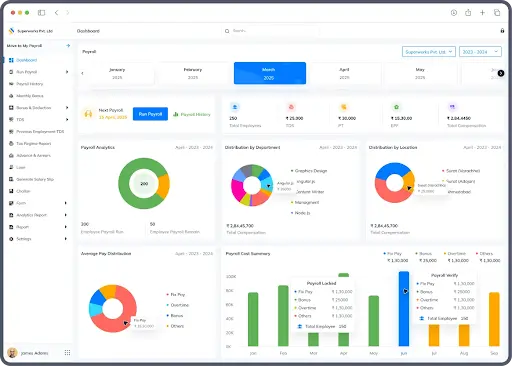
Superworks is a combination of HRMS and payroll software solution for dynamic companies that require HR, attendance, and payroll on a single dashboard right from the beginning. Superworks provides easy setup, an easy-to-use interface, and statutory compliances to the core in India without the need for a separate payroll department.

Key Features:

    • <li style=”font-weight: 400;” aria-level=”1″>

Automated Payroll with PF, ESI, TDS, and PT Calculations

  • Attendance, Leave, and Expense Management which integrates to Payroll
  • Built-in Performance Management and Appraisal Cycle System
  • Self-Service Portal for Payslip Generation, Income Declaration, and Leave Management
  • HR Mobile App suitable for both Managers & Employees

Pricing: ~₹70/employee/month 

Labour Code ready: Partial (monitoring updates) 

Blue-collar support: No 

Best for: Start-ups & growth businesses (fewer than 500 employees) seeking a single package that combines HR and Payroll functions

Limitation: Not recommended for Blue-collared & manufacturing payroll; compliance updates may take longer than dedicated Payroll Apps.

Zimyo – Best for SMBs Needing 50+ HR Modules

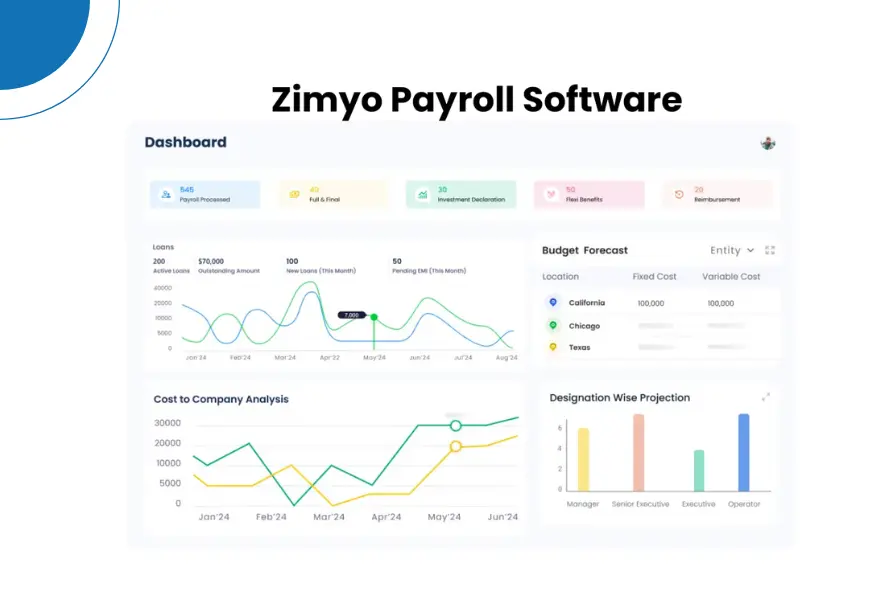
Image is display the payroll software dashboard of ZimyoZimyo’s pitch is breadth – it packs over 50 HR modules into one platform covering hire-to-retire processes, payroll, compliance, and analytics. For growing businesses that want to avoid stitching together multiple tools as they scale, Zimyo reduces vendor count significantly.

Key features:

  • Automation of Payroll along with PF, ESI, TDS, PT, LWF, and Statutory Bonus
  • Over 50 human resource modules, including Recruitment, Onboarding, Performance, exits, etc.
  • Inclusion of a loan & Advance management module in payroll
  • HR & Finance Dashboards with analytics features
  • Self-service portal and Mobile App for employees

Labour Code compliant: Partially 

Blue-collar worker compatible: No 

Suitable for: Small-Medium Businesses that need comprehensive HR features without worrying about subscribing to multiple software applications

Kredily – Best Free Entry-Point for Very Small Businesses

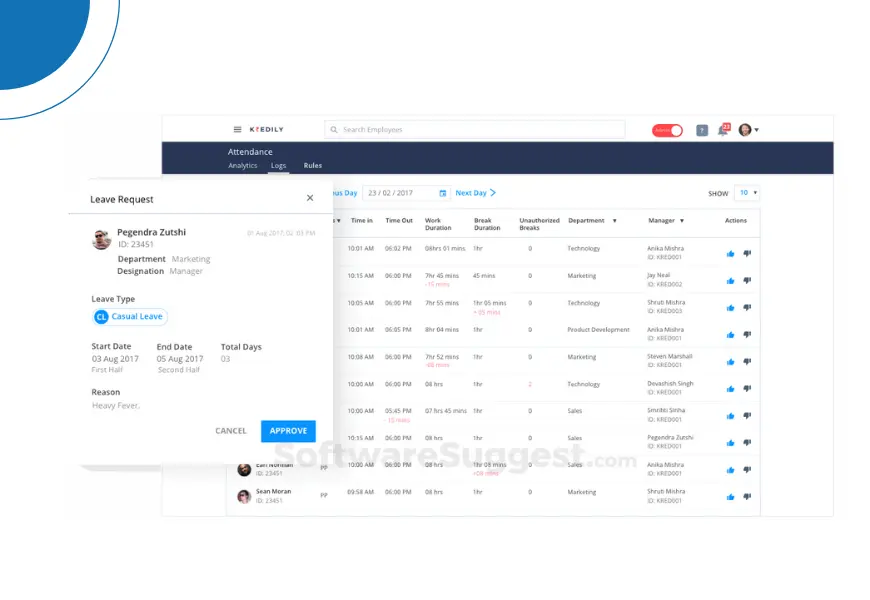
Image is display the payroll software dashboard of kredly

The Kredily payroll software provides a fully functional payroll system that does not come with a subscription fee. It is the best starting place for very small organizations that require minimal statutory requirements for their employees without paying anything monthly.

Key Features:

  • Basic Payroll with PF, ESI, and TDS calculation for very small teams
  • A completely free payroll solution for microbusinesses
  • Employees’ self-service portal
  • Scalability to paid plans with comprehensive HRMS

Labour Code ready: No 

Blue-collar support: No 

Recommended for: Small firms and tiny organizations (less than 20 employees) who want to experiment with payroll services for the first time

Limitation: The basic services can be availed free of cost, but more complex services like multi-state PT, LWF, Labor Law compliances, etc., need paid services.

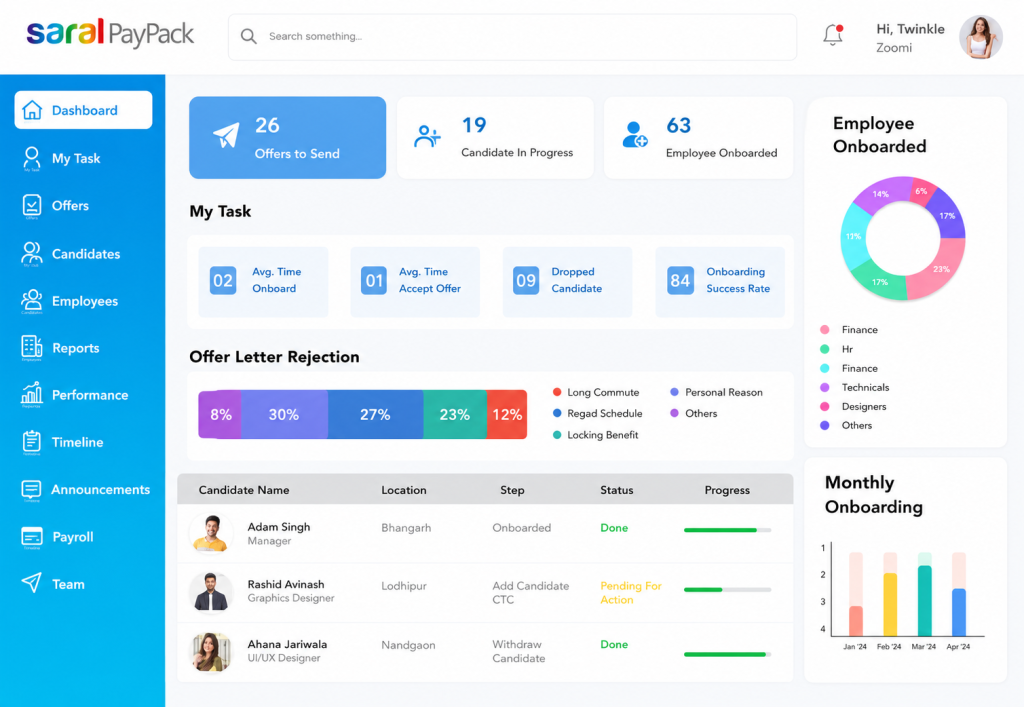
Saral PayPack – Best for CA Firms and Multi-Client Payroll Operations

Saral PayPack is neither a SaaS nor a subscription-based software – rather, it is an authorized payroll software which is tailor-made for the CA firms, payroll vendors, and compliance consultants dealing with payrolls of several clients using one installation. The multi-client dashboard and bulk filing features have made this software the benchmark software of payroll professionals.

Key features:

  • Multi-client management: process payroll for 50+ companies from one installation
  • Bulk PF ECR file generation and ESIC challan processing for all clients simultaneously
  • Form 24Q bulk generation with digital signature support for all clients
  • Form 16 bulk issuance
  • Offline operation – data stored on local servers (preferred by CA firms for data control)

Labor code supported: Yes

For blue-collar workers: No

Best suited for: CA firms, payroll consultancy agencies, and organizations providing payroll services to many clients

Disadvantages: The licensing nature implies that further updates will entail the need for buying licenses again. It does not have the feature of online accessibility.

HROne – Best for Multi-State Growing Companies

HROne positions itself for growing Indian companies expanding across states and needing automatic PT and LWF application by employee work location – one of the features it executes well. The platform also has strong 3D analytics reporting for HR and finance leads who need workforce cost visibility.

Key features:

  • PT slab allocation happens automatically based on employee work status – no manual setup for transfers required
  • Auto deduction of LWF based on applicable states
  • HRMS integrated with payroll, attendance, leave management, and performance management using single database
  • Employee analysis with custom MIS reports
  • A robust compliance calendar with automatic filing reminders

Labour code compliance is ready to be implemented: Yes

Supports blue-collar workers: No

Suitable for: Companies that are expanding their business (with 200-2,000 employees) and require automatic labour law compliance with employees residing in multiple states.

Drawback: High cost compared to other applications.

Pocket HRMS – Best Budget Option for MSMEs

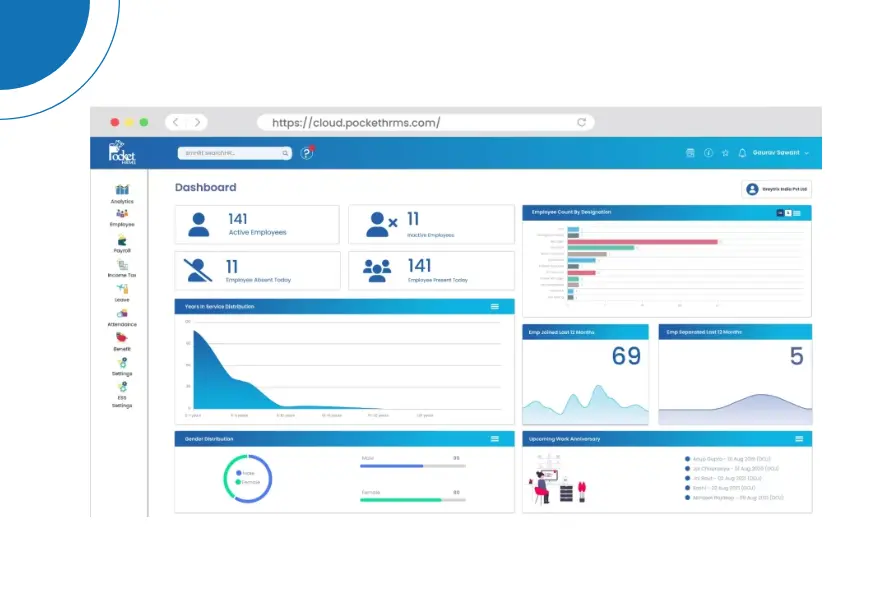
Image is display the payroll software dashboard of PocketHRMS

Pocket HRMS helps small businesses which require an entire HRMS suite at enterprise prices. The Pocket HRMS includes an AI chatbot feature to answer common questions about HR-related matters such as remaining leave balance, payslip details, etc., hence reducing the number of mundane requests in the queue.

Some important features of Pocket HRMS:

  • Automatic calculation of PF, ESI, TDS, and PT with compliance filings
  • AI chatbot for answering employee HR-related questions
  • Attendance tracking using biometrics and mobile attendance
  • Self-service portal for employees for filing tax investments

Labour Code ready: Partial

Blue-collar support: No 

Best for: MSMEs (50-500 employees) wanting budget-friendly HRMS + payroll with AI-assisted employee support 

Limitation: Advanced statutory compliance customisation (complex shift structures, multi-entity) is limited compared to higher-tier platforms.

PeopleStrong – Best for Multi-Entity Enterprise Operations

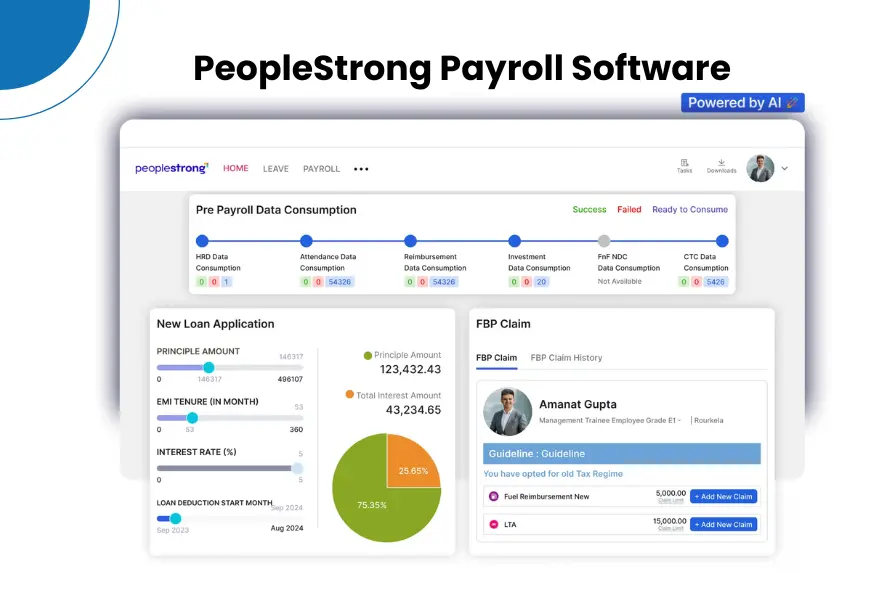
Image is display the payroll software dashboard of Peoplestrong

The PeopleStrong application is designed to meet the needs of Indian businesses handling their payroll within multiple legal entities, such as the parent company, subsidiaries, and JV’s, with diverse salary bands and compliance requirements, using one system. Its closest competitor would be Darwinbox at the level of large enterprises.

Key Features:

  • Multiple entities’ payroll consolidation using one dashboard
  • Automatic PT slabs and LWF computation based on entities and geographical locations of employees
  • Workforce management – headcount, financial reporting
  • ERP Integration with SAP and Oracle – finance transaction
  • Auto compliance updates through EPFO and ESIC filing

Labour Code compliance ready: Yes

Blue-collar compliance: No

Best for: Indian enterprises (between 1,000 and 10,000) who need payroll consolidation of various units/subsidiaries/different states

Restriction: Takes 6 to 12 weeks to implement; hence, not advisable for fast deployment.

ADP India – Best for MNCs with India Payroll

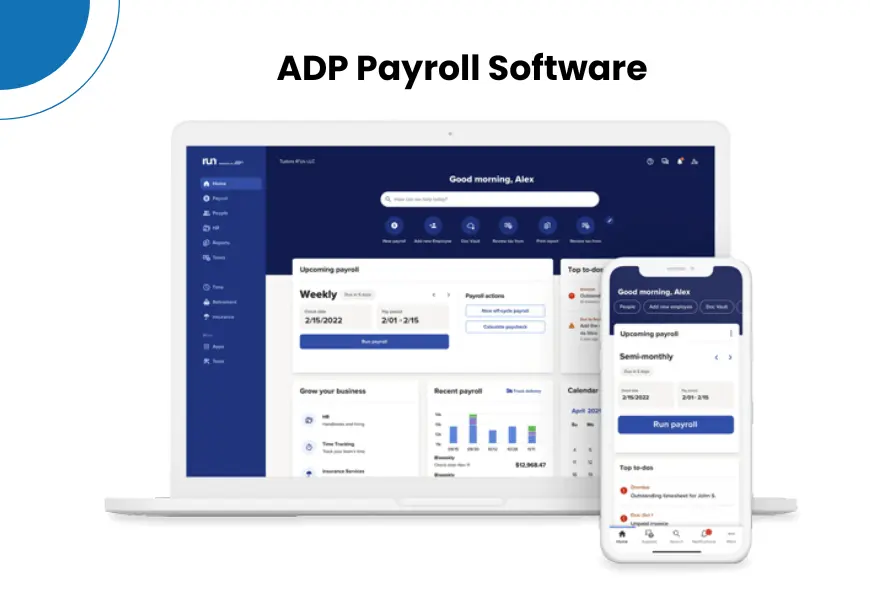
Image is display the payroll software dashboard of ADP

ADP India is India’s offering from the world’s leading payroll provider – a bureau-managed payroll solution where ADP manages payroll processing for you with a guarantee of full statutory compliance. For multinational companies requiring India payroll management through a reliable global provider with compliance expertise, ADP India ensures a very low internal risk level.

Key Features:

  • Bureau-managed payroll – ADP’s compliance experts manage payroll, not payroll software
  • Statutory compliance covering all of India’s statutory requirements, including PF, ESI, TDS, PT, LWF, Gratuity & Bonus
  • Centralized payroll management for multiple states
  • Integration with SAP, Oracle, Workday, and SuccessFactors
  • India payroll reporting according to global standards of compliance for the parent company

Labour Code ready: Yes 

Blue-collar support: No 

Good fit for: MNCs and big corporates (over 500 employees), looking for India payroll management services from an international provider 

Limitation: Longest implementation time among all the options (8-16 weeks). Not suitable for India SMBs and startups that require quick implementation.

SumHR – Best Low-Cost Entry for Lean Teams

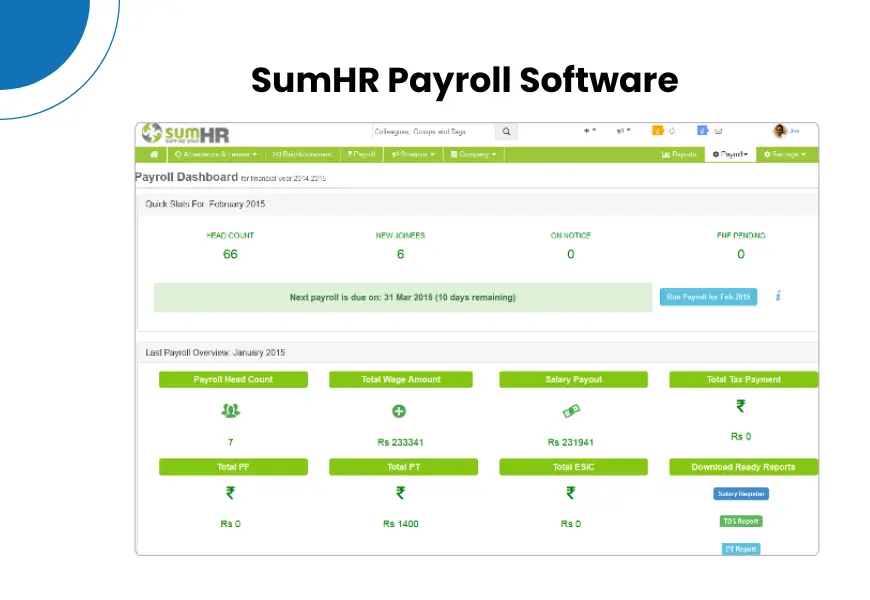
Image is display the payroll software dashboard of SumHR

SumHR is the most affordable choice in the list, which still offers good functionality in terms of HR. It costs only ₹29 to ₹49 per month per user and provides all standard services related to payroll automation.

Key Features:

  • Payroll management along with computing of PF, ESI, and TDS
  • Taxation and generation of payslips
  • Linkage with Biometrics System
  • Employee Self-Service Portal

Labour Code compliant: No 

Suitable for blue-collar workers: No 

Ideal for: Companies with a lean payroll structure, especially startups with less than 100 employees, budget being the most important criteria 

Drawback: It provides only basic compliance; it does not have multi-state PT/LWF labour code-compliant facilities. Unsuitable for large firms that have more than 200 employees.

Qandle – Best Modular HR Setup

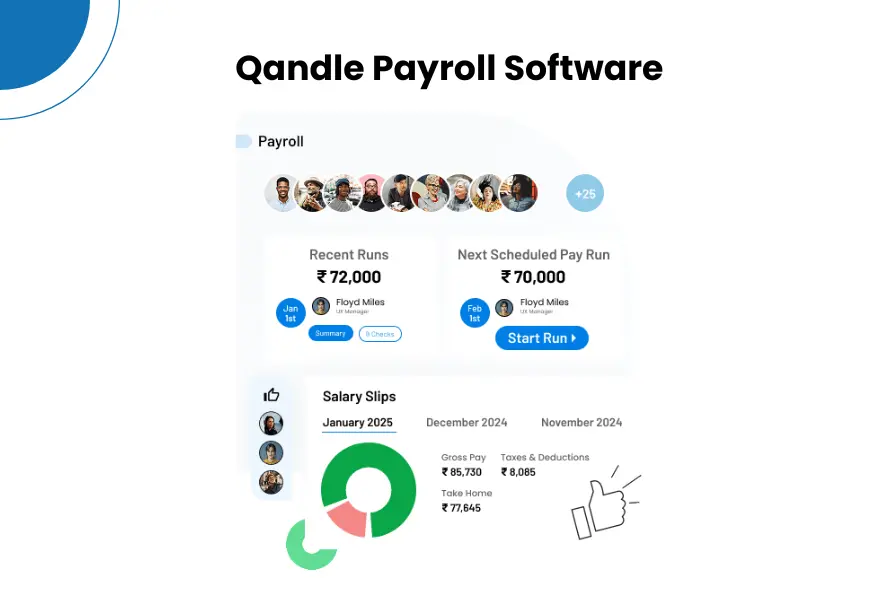
Image is display the payroll software dashboard of Qandle

The Qandle modular software solution allows organizations to use just the HR and payroll modules as per their requirement – ideal for those organizations who may be starting with payroll and then gradually introducing other modules such as recruitment, performance or expense modules without having to buy the whole package at once.

Key Features:

  • More than 36 HR apps to choose from and only use what is required
  • Compliance of Payroll with PF, ESI, TDS, PT
  • Attendance & Geo Tracking
  • Workflow Automation
  • Analytical Dashboards

Labour Code ready: No 

Blue-collar support: No 

Suitable for: Growing organizations (50-500 employees) seeking a configurable HR software package with payroll being an element of it 

Disadvantage: Updates regarding labour code compliance are not up-to-date compared to other software listed here

What is Payroll Software?

The payroll software in India refers to a tool that automatically computes salaries payable to employees, subtracts their respective statutory deductions (12% PF, 3.25% ESI if salary is ≤ ₹21,000 per month, TDS according to section 192, and state professional tax) and generates payslips, thereby eliminating the need for manual calculation, which requires 2 to 5 days from the HR team each month.

Good India payroll software goes beyond salary calculations. It handles multi-state Professional Tax slabs, Labour Welfare Fund deductions by state, Form 16 generation, IT declarations, and Labour Code monitoring – all of which manual payroll processes get wrong or miss entirely.

What Payroll Software Does and What It Does Not

What it handles:

  • Gross-to-net salary calculation, including all allowance and deduction components
  • Automated PF, ESI, TDS, PT, and LWF deductions
  • Payslip generation and distribution (portal, mobile, WhatsApp)
  • Statutory filings and challan generation
  • Form 16 issuance and Form 24Q quarterly returns
  • Full and final settlement on employee exit

What it does not handle:

  • Statutory disputes with EPFO or ESIC (e.g., disagreements on contribution amounts)
  • Legal advice on employment law
  • EPFO or ESIC notice responses and hearings
  • Labour officer inspections – these require managed payroll or an HR specialist

Payroll Software vs Tally vs Excel – Why Indian Businesses Switch

Factor Excel Tally Cloud Payroll Software
Compliance auto-updates Manual – you update the formula Manual – rule changes require configuration Automatic – vendor updates for all rule changes
PF/ESI/TDS filing Manual – export, portal upload Limited – partial integration Fully automated – ECR, challans, Form 24Q
Multi-state PT Manual formula per state Not supported natively Built-in, auto by employee work state
Error rate 3-8% per cycle 2-5% per cycle Near zero with pre-payroll validation
Employee self-service Not possible Not possible Yes – payslips, Form 16, leave, declarations
Form 16 generation Manual – one by one Limited Bulk auto-generation with digital signature
Audit trail Version-managed sheets Basic Full audit log per change

Most Indian SMEs switch from Excel when they cross 30 employees and the monthly payroll process starts consuming 3+ days. They switch from Tally when multi-state expansion creates more PT configurations than the finance team can manage manually.

How Does Payroll Software Work in India?

Payroll software in India runs a structured six-step process each month – replacing the manual calculation cycle that typically takes HR teams several days.

Step 1: Employee and Salary Structure Setup HR configures each employee’s CTC breakdown: basic salary, HRA, LTA, special allowance, performance bonus, and variable pay components. The software stores these configurations and applies them every cycle without re-entry.

Step 2: Attendance, Leave, and Variable Data Capture It integrates attendance records collected through various sources like biometrics, geofencing on mobile phones, or facial recognition systems while also synchronizing LOPs from the leave management module. The amount of Loss of Pay (LOP) will be auto-calculated for unauthorized absenteeism.

Step 3: Automated Gross-to-Net Salary Calculation Based on the salary structure and the attendance record of each employee, gross salary is determined, and based on LOP, a deduction is made to arrive at the net take-home salary of the employee.

Step 4: Statutory Compliance and Tax Processing This is when the true worth of Indian payroll software comes into play. The payroll system computes PF contributions (12% by employer & 12% by employee), ESI (3.25% by employer & 0.75% by employee for those who qualify), TDS under Section 192 in accordance with the income tax regime declared by the employee, state Professional Tax and LWF based on the work state of the employee. There is also a level of validation conducted prior to executing payroll calculations.

Step 5: Payslip Generation and Salary Disbursement The software generates payslips for all employees, delivers them via the self-service portal and optionally via WhatsApp or email, and generates a bank file for bulk salary disbursement.

Step 6: Payroll Reporting and Audit Readiness After the payroll is executed, the system produces salary registers, PF registers, ESI registers, and also statutory audit reports. All these are mandatory for labor officers’ inspections as per the Payment of Wages Act and Factories Act.

Why Do Indian Businesses Need Payroll Software?

The significance of payroll software for Indian businesses lies in the fact that manual payroll processes have an error rate of 3-8% per period, and every error means a financial impact. Given that 67% of Indian businesses are automating their payroll processing (KPMG 2024), companies working with Excel and Tally are behind in the race.

The compliance scenario in India is one of the most complicated around: with 28 states each having a unique slab of Professional Tax, 17 states having unique provisions under LWF, month-end mandatory filing of EPFO and ESIC returns, quarterly TDS returns, and, last but not least, notification of the four new Labour Codes state-wise. Failure to comply with even one of them can cost heavily, as damages for non-compliance in PF return can go up to 25% p.a.

Apart from being compliant, payroll software also gives HR managers more time to focus on strategic operations. The shift of payroll calculation from spending 3-5 days calculating manually to spending only 2-4 hours reviewing the data saves much of their valuable time.

What to Look for in Payroll Software in India

The right payroll software for Indian businesses covers India-specific compliance automatically – not through manual configuration updates. Here is what to evaluate before signing up.

Evaluation Criteria What to Check Question to Ask Vendor
India statutory compliance PF, ESI, TDS, PT, LWF, Gratuity, Bonus “Show me your compliance update cadence – how fast are rate changes applied?”
Multi-state PT Auto-applies PT slab by employee work state “Does PT update automatically when an employee transfers states?”
Attendance integration Live sync vs manual export “Show me live how attendance data flows into payroll – is it real-time or file transfer?”
Labour Code readiness 50% floor wage rule enforcement “Does your system flag CTCs where wages fall below 50% of total CTC?”
LWF auto-deduction Configured per employee work state “Does LWF apply automatically based on each employee’s state?”
Compliance dashboard Monthly PF/ESI/PT/TDS liability view “Can you show me the statutory liability dashboard for a month with multiple states?”
Year-end compliance Form 16 bulk generation, IT declarations “How does the system handle investment proof collection and Form 16 issuance?”
Blue-collar support Shift-based payroll, Factories Act “Does the system support daily wages, shift differentials, and overtime under the Factories Act?”

Which Payroll Software Handles State-Wise Professional Tax Automatically?

State-wise Professional Tax is the feature most HR managers underweight when evaluating payroll software – and it becomes a serious problem the moment a company expands beyond one or two states.

There is great variability in PT slabs among the Indian states. For instance, in Maharashtra, the tax can be as high as ₹2,500/year (₹200/month from salaries greater than ₹10,000). In Karnataka, the PT slab goes as high as ₹2,400/year. In West Bengal, the PT slab rate is also ₹2,400/year. However, there are other rates in Tamil Nadu, which charge ₹182/month from salaries greater than ₹21,00

Where the employee is transferred from Mumbai to Bengaluru, the PT structure needs to be updated accordingly. If a new employee comes on board in Hyderabad, the Telangana PT slabs should be used right from day one. Payroll system that needs reconfiguration manually for every transfer poses a compliance issue, which increases with the number of employees.

Tool PT Auto by Work State States Covered Updates on Transfer
TankhaPay Yes All 26 applicable states Automatic on state change
greytHR Yes All applicable Automatic
Keka HR Yes All applicable Automatic
HROne Yes (auto by location) All applicable Automatic
Zoho Payroll Yes All applicable Limited
Razorpay Payroll Yes Major states Semi-automatic
SumHR / Qandle / Kredily Manual configuration Varies Manual

The question to ask any vendor in your demo: “Can you show me what happens to PT when I transfer an employee from Maharashtra to Karnataka right now – live, not in a slide?”

Statutory Compliances Every Payroll Software Must Handle in India

Payroll software in India must cover eight categories of statutory compliance to be considered adequate. Here is what each covers and the specific rates your software must apply.

Provident Fund (PF) – ECR Filing by the 15th of Each Month

The employer’s share of the PF deduction is equal to 12% of the basic salary drawn by the employee. The employee share will be 12% of basic salary, which will include 3.67% in the EPF and 8.33% in EPS, the latter being up to a maximum limit of ₹1,250 per month because the EPS salary limit is ₹15,000.

Penalties for delayed filing as per Section 14B:

  • Delay up to 2 months: 5% per year
  • 2-4 months: 10% per year
  • 4-6 months: 15% per year
  • Over 6 months: 25% per year

Furthermore, interest charges of 12% per annum apply in case there is any amount left outstanding as per Section 7Q. A good payroll system will make ECR filing and submission absolutely risk-free.

Employee State Insurance (ESIC) – Challan by the 21st of Each Month

ESI applies to employees earning ₹21,000 per month or less. Employer contribution is 3.25% and employee contribution is 0.75% of gross wages. The ESIC challan must be deposited by the 21st of each month. The half-yearly return (Form 5) is due by January 12th and July 12th each year.

Failure to make payment of ESIC within its due time incurs simple interest at a rate of 12% per annum, as stated under Regulation 31C. Non-registration of employees by employers is a punishable offense according to Section 85 of the ESI Act.

Note: ESIC ceases to be applicable once the monthly salary exceeds ₹21,000. This must be detected automatically through payroll software.

TDS on Salary – New Tax Regime vs Old Tax Regime

TDS under Section 192 is deducted monthly from employee salaries based on their projected annual taxable income. The New Tax Regime (Section 115 BAC) is the default from FY 2024-25. Employees can opt for the Old Tax Regime by declaring it before April 1 of each financial year.

Old Tax Regime (if employee selects):

  • Exemption under HRA: least of [(HRA received/50% of Basic for Metro/40% for Non Metro/reasonable rent less 10% of salary)]
  • Maximum deduction under 80C – ₹1,50,000 (LIC premium, ELSS, PPF, Principal repayment on home loan, Tuition Fees)
  • Exemptions under 80D Health Insurance Premiums
  • Maximum Standard Deduction – ₹50,000

New Tax Regime:

  • HRA Exemption is not available
  • Maximum standard deduction – ₹75,000 (Effective from FY 2024-25)

Form 24Q (quarterly TDS return) must be filed by July 31, October 31, January 31, and May 15. Form 16 (TDS certificate) must be issued to all employees by May 31 each year. Payroll software must generate Part A (from Form 24Q data) and Part B (salary breakdown) with digital signature capability.

Professional Tax (PT) – 26 Applicable States

See the state-wise comparison in the What to Look For section above. PT applies in 26 states; Delhi, UP, Haryana, Rajasthan, Uttarakhand, Himachal Pradesh, and a few others do not levy PT.

Labour Welfare Fund (LWF) – Auto-Deduction by State

LWF is a state-specific levy that contributes to worker welfare schemes. The states with LWF include Andhra Pradesh, Karnataka, Tamil Nadu, Gujarat, Maharashtra, Madhya Pradesh, West Bengal, Telangana, Goa, Kerala, Odisha, and Punjab, among others.

There is a variation in contribution rates: ₹6 to ₹36 per month from employees, with contributions by employers that match or exceed the employees’ contributions in different states. Payments could either be made monthly or half-yearly.

What to check: Does your payroll software automatically apply LWF deductions based on each employee’s work state? Does it update when an employee transfers? Does it generate the state-specific LWF payment challans?

Statutory Bonus, Leave Encashment, and Notice Pay

Statutory Bonus (Payment of Bonus Act 1965): Eligibility of employees who earn wages up to ₹21,000 in a month. The minimum rate for the bonus is 8.33% of wages or ₹100 per month, whichever is higher. The maximum limit on bonuses is 20% of wages. It should be paid by November 30 as advance wages for Dussehra/Diwali or eight months after closing of the financial year.

Leave Encashment: Employees who leave the organisation can encash unutilised earned leave. Leave encashment on retirement or death is exempt from tax; encashment during employment is taxable. Payroll software must correctly calculate the taxable vs. exempt portion in the full and final settlement.

Notice Pay: In the case of an early exit where the notice period is not completed by the employee, the notice pay recovery is automatically calculated from the full and final settlement. In the case of termination of employment by the employer without notice, notice pay has to be included. This has to be accomplished in the payroll system through its F&F settlement module.

Year-End Payroll Compliance – Form 16, Tax Proofs, and IT Declarations

Year-end payroll in India runs from January through May – the busiest compliance window of the year.

January-February: Investment proof collection Employees submit proof of investments and rent receipts to claim deductions under the Old Tax Regime. Payroll software should have a self-service portal where employees upload documents and HR reviews and approves them. The software recomputes TDS for the remaining months based on approved proofs.

March: Final TDS adjustment The final TDS computation for the year runs in March payroll, including arrears adjustments for any discrepancies between projected and actual income or deductions.

April-May: Form 16 generation and issuance Form 16 Part A is generated from the Form 24Q annual return filed with the Income Tax Department. Part B is the detailed salary breakdown including all components and deductions. Deadline: May 31. Payroll software must generate digitally signed Form 16 for all employees simultaneously – not one by one.

Failure to issue Form 16 by May 31: Penalty of ₹100 per day per employee under Section 272A(2)(g) of the Income Tax Act.

Monthly Compliance Dashboard – PF, ESI, PT, TDS Liability View

A compliance dashboard shows each statutory liability – PF payable, ESI payable, PT payable, TDS payable – by month alongside challan payment status. This is what HR heads and finance leads need to close their monthly compliance checklist without manually tracking five different portals.

TankhaPay, greytHR, and HROne all offer this dashboard view. When demoing any payroll tool, ask the vendor to show you the “statutory liability view” or “compliance calendar” screen – this is a clear differentiator between purpose-built compliance platforms and generic payroll tools.

Salary Register and Statutory Registers

Payroll software should automatically generate the following:

  • Salary Register (Form I):  Monthly salary sheet for all employees
  • PF Register: Month-wise contribution records for all employees
  • ESI Register: Records the contributions of ESI-eligible employees month-wise.
  • Overtime Register: According to the Factories Act for the workers
  • Muster Roll (Form XXIII): Attendance Sheet for factory inspections

These documents are subject to inspection by labour officers under the Payment of Wages Act, Factories Act, and Shops and Establishments Act. Payroll software that auto-generates all registers reduces labour compliance risk significantly.

Is Your Payroll Software Ready for India’s New Labour Codes?

India’s four Labour Codes – the Code on Wages 2019, Code on Social Security 2020, Industrial Relations Code 2020, and Occupational Safety Code 2020 – are being notified state by state. As of mid-2026, 12 states have issued notifications for the Code on Wages.

The most important payroll impact: the 50% floor wage rule

The Code on Wages 2019 defines “wages” as all remuneration – and mandates that this definition of wages must constitute at least 50% of an employee’s total CTC. This sounds administrative but has a direct payroll consequence: companies that have structured CTCs with high allowances (HRA, special allowance, food coupons) to reduce the PF base may find their PF liability increase by 30-40% when this Code is fully notified.

What to ask your payroll software vendor:

  1. “Does your system flag CTCs where wages fall below 50% of total CTC?”
  2. “When a state issues a Labour Code notification, how quickly is it applied to active payrolls – and do I receive a notification?”

Payroll software that cannot answer both questions confidently is not Labour Code ready.

Common Payroll Challenges Faced by Indian Companies

1. Frequent Regulation Changes

The EPFO issues notifications on revisions to PF ceiling amounts and formats for the Employment Contribution Register. The ESIC issues notifications on revision to the wage ceiling. The states issue notifications related to the slabs of PT, LWF revision, and minimum wage notifications more than once a year. Payroll software that is not automatic will make HR people busy with following all notifications.

2. Multi-State Compliance Issues

An organisation which has workers working in five states requires five different PT arrangements, perhaps three different LWF arrangements, and Shops & Establishments Act requirements for each particular state. The manual handling of such things would result in cascading mistakes with an increasing number of employees.

3. Payroll Errors and Penalties

The error percentage in manual payroll is 3-8%. The cost of errors is higher than just the time taken to correct them:

  • PF delayed filing (Section 14B): 5-25% per year based on the period of delay
  • Failure in deducting TDS (under Section 201) can cost 1.5% per month
  • Late payments for ESIC contribution (Regulation 31C): 12% simple interest per year
  • Non-filing of Form 16 till 31st May (under Section 272A): Rs.100 per employee per day

Payroll software with the pre-payroll validation feature helps to avoid all such costs.

Also Read: What Are the Payroll Compliance Penalties in India?

4. Data Mismatch Between HR and Finance

If attendance is managed in one system, leave requests in another, and payroll management in yet another, errors are made every time reconciliation is done. Integration in an HRMS payroll that operates all three in one place for each individual will avoid such mistakes.

Payroll Software vs Traditional Payroll Methods

Factor Excel/Manual Tally Cloud Payroll Software
Compliance auto-updates Manual Manual Automatic
PF/ESI/TDS filing Manual portal upload Limited integration Fully automated
Multi-state PT Manual per-state formula Not supported Built-in, auto by state
Error rate 3-8% per cycle 2-5% per cycle Near zero
Employee self-service Not possible Not possible Payslips, Form 16, leave
Form 16 generation One by one manually Limited Bulk with digital signature
Labour Code readiness Manual tracking Manual tracking Automatic monitoring
Audit trail Version history (unreliable) Basic Full change log
Cost at 100 employees Staff time (2-5 days/month) Staff time + licence ₹5,000-₹15,000/month

The break-even point for cloud payroll software is typically around 25-30 employees. Below that, Excel is adequate. Above 50 employees, the compliance risk and staff time cost of manual payroll consistently exceeds payroll software costs.

Payroll Software vs Payroll Outsourcing: Which Is Better?

Factor Payroll Software Payroll Outsourcing / Managed Payroll
Who operates payroll Your in-house HR/finance team Provider’s compliance team (e.g., TankhaPay)
Statutory compliance liability Yours – penalties are your company’s responsibility Provider’s – compliance failures are the vendor’s problem
Cost model Per-employee SaaS subscription Managed service fee
Annual TCO at 100 employees Software ₹60,000-₹1,50,000/year + payroll executive ₹4-8 lakh/year Single managed service fee – replaces executive cost
Compliance risk Moderate – depends on your team’s expertise Low – provider has dedicated compliance specialists
Visibility Real-time dashboard Real-time dashboard
Speed of first payroll Days to weeks (implementation) 1-3 business days (TankhaPay EOR/managed payroll)
Best when You have a capable in-house HR/finance team You want compliance off your plate or lack payroll expertise

The honest answer: For companies above 50 employees in compliance-heavy industries (manufacturing, logistics, staffing), managed payroll often costs less than software plus a dedicated payroll executive – while eliminating compliance liability entirely.

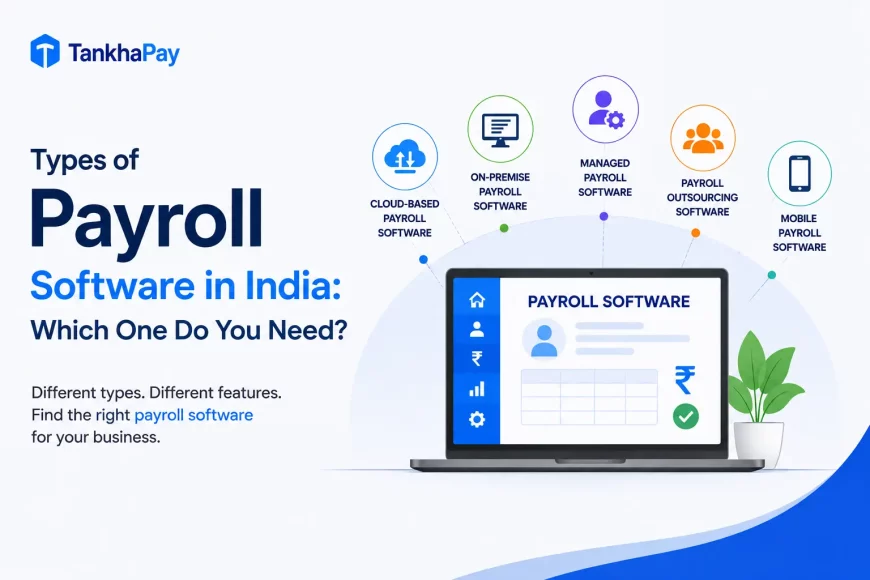
Types of Payroll Software in India

1. Cloud-Based Payroll Software

Available either through a web browser or through a mobile application via server hosting by the software vendor itself. Automatic compliance updates are possible. The option to gain access remotely exists regardless of the geographical position. SLAs that offer uptime of 99% or better prevent the payroll system from being disrupted.

2. On-Premise Payroll Systems

Installed on your company’s servers. Data stays within your infrastructure – important for organisations with strict data residency requirements. Requires IT team for maintenance and manual updates for compliance rule changes. Saral PayPack operates on this model.

3. HRMS with Payroll

The payroll module is part of a wider HRMS suite covering attendance, leave, performance, and recruitment. Payroll runs on the same employee data as all other HR functions – no monthly export cycle. Keka, greytHR, TankhaPay, and most modern platforms work this way. This is the architecture to prefer.

4. Payroll Software with Managed Services

Combination of software along with a human compliance team – the TankhaPay system. You receive access to our platform, along with a payroll manager who manages the entire process of the payroll cycle each month, prepares returns for you, and deals with any compliance-related issues. Not purely software-based and not outsourcing either; a combination of both.

Who Should Use Payroll Software in India?

Startups (Under 100 Employees)

Speed and cost are all that counts. GreytHR’s free version for up to 25 employees or the razorpay payroll service, which costs ₹100 per employee, with a quick 1-hour set-up process would be ideal for start-ups. If the company requires investor transparency and audits, then cloud-based payroll services right from day one is an absolute necessity.

MSMEs (100-500 Employees)

This is the segment where manual payroll becomes most dangerous – enough complexity to generate frequent errors, not enough HR headcount to manage it reliably. greytHR, Keka, and TankhaPay all serve this segment well. The decision point is whether you want software to operate yourself or a managed service.

Large Enterprises (1,000+ Employees)

Multi-entity organisations, global payroll for expatriates, and high-quality compliance reporting are the key requirements. Some examples of vendors for this category include PeopleStrong, Darwinbox, and ADP India. Project delivery times are between 6 and 16 weeks.

Multi-Location Companies

When employees work across three or more states, PT auto-configuration by work location stops being a nice-to-have. HROne, TankhaPay, and Keka all auto-apply state rules by employee location. This saves multi-location companies hours of monthly reconfiguration.

Contract-Heavy Organisations

Organisations which have contractors require payroll software that can manage the salaries of the contractors, as well as their PF and ESI. The software would be required to comply with the Contract Labour (Regulation and Abolition) Act too. The solution provided by TankhaPay is an EOR solution for contract employees of TankhaPay as the employer.

Manufacturing and Blue-Collar Companies

The majority of the payroll software applications here are targeted at white-collar office workers. Other industries like manufacturing and logistics have different payroll needs, including attendance systems based on shifts, overtime pay as required by the Factories Act (at 1.5 times), daily or weekly payroll, compliance with minimum wages as per states and industry type, and NATS apprentice payroll.

TankhaPay has covered all types of workforces in one solution. While looking for a payroll solution in the manufacturing industry, check whether the system has provisions for shift-based payroll, Factories Act overtime, and NATS apprentice payroll.

Multi-Entity and Multi-Company Operations

Multi-entity organisations, such as companies with holding companies and subsidiaries, companies with client payroll processing handled by CA firms, and staffing firms managing the payroll processing for several clients, require one dashboard that will organise their compliance data on an entity basis but provide consolidation capabilities for generating reports. TankhaPay, PeopleStrong, and Saral PayPack have multi-entity payroll capabilities.

How Much Does Payroll Software Cost in India? (2026 Pricing Guide)

The cost of payroll software in India is between ₹50 and ₹150 per head per month for most cloud-based solutions. Below are their prices.

Software Pricing Model Plan/Membership
Keka HR Slab pricing Foundation, Strength, Growth
greytHR Free ≤25 emp; monthly subscription Essential, Growth, Premium
TankhaPay Contact for pricing T-Pay Core, Business, 360
Razorpay Payroll Per employee/month Prime, Elite, Enterprise
Zoho Payroll Per employee/month Free, Standard, Professional, Premium
factoHR Per employee/month Free, Core, Premium, Ultimate
Superworks Per employee/month Startup, Professional, Premium, Enterprise
Zimyo Per employee/month Basic, Standard, Enterprise
Kredily Free basic tier Free, Payroll OS Plan, Professional, Enterprise
Saral PayPack One-time licence Standard, Corporate, Premium
HROne Per employee/month Basic, Professional, Enterprise
Pocket HRMS Per employee/month Standard, Professional, Premium
PeopleStrong Enterprise pricing Contact For Plans
ADP India Enterprise pricing Contact For Plans
SumHR Per employee/month Contact For Plans
Qandle Per employee/month Foundation, Regular, Plus, Premium, Enterprise 

Free vs Freemium – What’s Actually Free

Genuinely free options: greytHR (up to 25 employees, basic payroll), Kredily (basic tier with limited compliance features). These are useful for very small teams testing payroll software for the first time.

Freemium pitfall: Most payroll software providers have free versions that offer simple salary processing services but not those for multi-state compliances, LWF, statutory bonuses, and Form 16 generation – the important ones when you start increasing your workforce. It is always necessary to check the compliances included in the free version.

Fixed Pricing vs Per-Employee Pricing

Most platforms use per-employee pricing that scales with headcount. Keka uses slab pricing – this can be cheaper for companies near the top of a slab but more expensive near the bottom. Saral PayPack uses a one-time licence – effective for CA firms that do not want recurring SaaS costs.

Total Cost of Ownership Beyond the Monthly Fee

  • Although the monthly per-user cost might appear to be the true cost, there is more than that. There’s also:
  • Deployment cost: ₹50,000-₹200,000 per enterprise deployment (usually hidden in the contract terms)
  • Data migration fee: Moving historical payroll data from previous systems
  • Annual compliance update maintenance: Some vendors charge for compliance rule updates
  • Your payroll executive’s time: 2-5 days per month at a cost of ₹4-8 lakh per year – this is the biggest hidden cost most buyers ignore

For companies above 50 employees, managed payroll services often cost less in total than software plus the internal cost of running it.

How to Choose the Best Payroll Software in India

The right payroll software depends on three decisions in this order: workforce type first, then service model, then company size and budget.

Step 1: Workforce Type For workforces that consist solely of white-collar office workers, any one of these platforms will meet your needs. If your organisation comprises both blue-collar workers, shift workers, and/or NATS apprentices along with office workers, TankhaPay is the sole platform to cover them all.

Step 2: Software vs managed payroll If you have a capable payroll executive, software is sufficient. If you want compliance off your plate or if your team does not have the payroll expertise to handle multi-state compliances, reliably managed payroll is worth the higher cost.

Step 3: Company size and budget Less than 25 employees: greytHR (free version) or Kredily. Below 200 employees but require payroll processing: Razorpay Payroll or Zoho Payroll. Below 500 employees who need an HRMS solution: Keka or greytHR (paid version). More than 500 employees: TankhaPay, PeopleStrong, or HROne (based on complexity). Multi-Entity

Pre-Purchase Compliance Checklist

Check the following in the live demonstration of payroll software before signing on to any deal.

Features list:

  • The attendance feature demonstrates real-time synchronization (not file transfer)
  • Pre-payroll validation catches errors before the salary processing begins
  • Self-service enables access to Form 16, tax declarations, investment proof upload,
  • Processing payroll of all employees at once
  • Module for full and final settlement

Statutory compliance checklist:

  • PF ECR auto-generation and submission on portal by 15th
  • ESI challan auto-generation and submission by 21st
  • Auto-configuration of PT based on employee work location (“Tell me what will happen if I change an employee’s state?”)
  • Auto-deduction of LWF based on state requirement
  • Calculation of statutory bonus (8.33%-20% depending on the eligibility of employees)
  • Generation of Form 16 in bulk along with digital signature before 31st May
  • Labour Code: enforcement of 50% floor wages
  • Labour Code: notification update from state

Cost and pricing checklist:

  • Verify employee rate pricing and ensure compliance for all tiers
  • Verify implementation costs and costs associated with data migration prior to contract signing
  • Clarify compliance updating process – automatic or via vendor support ticket
  • Determine support level needed – dedicated account manager or shared helpdesk

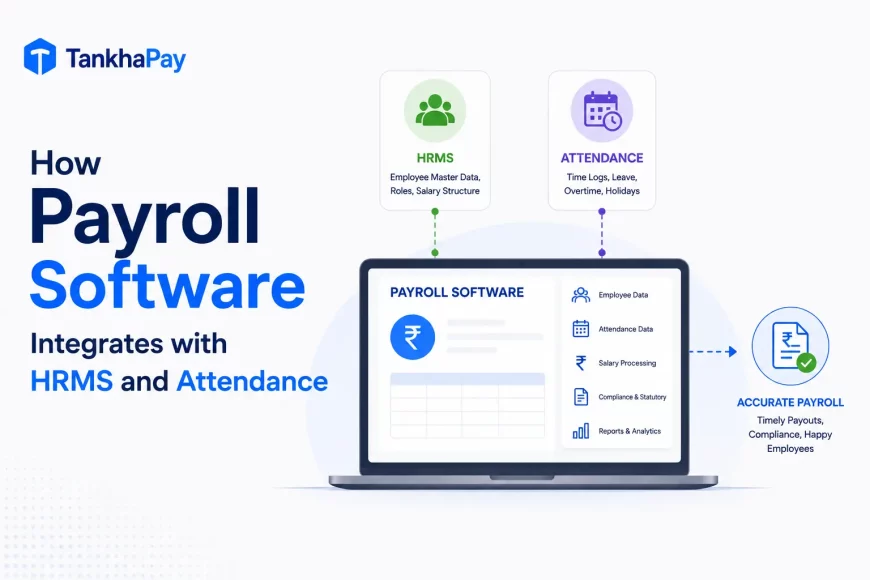
How Payroll Software Integrates with HRMS and Attendance

Payroll software connected to attendance with a live data feed saves 8 to 12 hours per month by cutting out the manual process of reconciling payroll and attendance. What people do not realize about payroll software that is affordable because it is stand-alone is the hidden expense of manually transferring the data each month.

Why integration matters: Whenever a person comes to work late, and this is captured by the attendance system, such details need to be sent to payroll for accurate calculation of LOP. When there is a need to export the attendance report to a CSV file, then import this data into the payroll system, there will be an error at every stage of the process.

Biometric and GPS attendance feeding into payroll:  Fingerprints, facial recognition, and location-based check-ins using GPS technology send data immediately to the payroll software. TankhaPay, Keka, greytHR, and HROne have built-in features for integrating biometric devices. Businesses that operate multiple locations receive instant access to their workforces in all the sites.

Leave management and LOP automation: If the employee applies for leaves, then LOP calculation is automatically adjusted. In case of an absence that is unapproved, then automatic calculation is made for LOP.

Expense reimbursements and payroll: Approved expense claims feed directly into the monthly payroll run – no separate manual payment required.

ERP and accounting integrations: TankhaPay integrates with Tally ERP (salary journal entry sync), Zoho Books, and SAP. Zoho Payroll integrates natively with Zoho Books. Keka integrates with SAP. These integrations remove the manual reconciliation step between payroll and accounting.

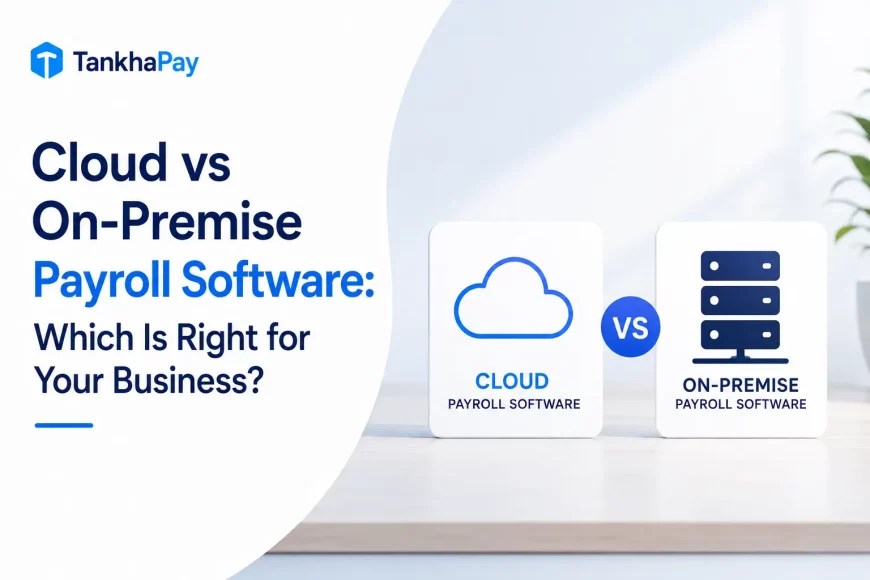
Cloud vs On-Premise Payroll Software

Factor Cloud Payroll On-Premise
Access Anywhere, any device Local network or VPN required
Data location Vendor servers (usually AWS/Azure in India) Your servers
Compliance updates Automatic, applied by vendor Manual – you or vendor updates configuration
Uptime 99%+ SLA from vendor Depends on your infrastructure
IT maintenance Vendor-managed Your IT team
Upfront cost Low (subscription) Higher (licence + hardware)
Data control Contractual – confirm in SLA Complete
Best for Most businesses – SMBs to large enterprises Companies with strict data residency requirements

Which should you choose? Cloud-based payroll systems are the way to go for companies that do not have stringent data residency requirements since they update compliance rules, eliminate the need to maintain servers, and provide remote access to human resources management. Premise-based payroll works well for organisations in highly regulated industries such as banking and defense.

Payroll Software Trends in India 2026

1. AI-Powered Payroll Intelligence

Payroll solutions are transitioning from automation to becoming intelligent. With the help of artificial intelligence-based anomaly detection, any unusual change in salaries can be identified, the manipulation of PF base is identified, and employees reaching the statutory limit (ESI cap and PF wage cap) are identified before running payroll. The pre-payroll validation for catching mistakes has transformed into proactive compliance.

2. Seamless HRMS and Attendance Integration

There is an accelerating trend towards a consolidation of the market through the adoption of HRMS payroll solutions. Payroll solutions that require monthly exportation of attendance data are becoming less relevant compared to integrated solutions, where all HR-related information is stored in one record. This fact has been revealed by the research conducted by Darwinbox.

3. Cloud-Based Payroll Platforms

However, the use of cloud services will still see an upward trend. The data from a KPMG (2024) survey states that 67% of companies in India use cloud-based payroll software, while by 2026, this ratio will rise even higher, surpassing 85%. The government’s policy regarding data localization implies that all service providers are obliged to store their servers in Indian regions of AWS and Azure clouds.

4. Compliance Built into the System

Static rules of compliance have been taken over by dynamic databases of legislation. The best platforms offer integration with EPFO and ESIC systems, access notification feeds from Ministry of Labour circulars database in real time, and send updates to payroll configurations dynamically, without the need for vendor intervention.

5. Employee-Centric Payroll Experience

Through WhatsApp-based payslips, mobile tax filing, investment certificate uploads through phone camera apps, and automated chatbots to answer any questions regarding payroll issues, payroll processes have been transformed into more direct interactions with their employees rather than back-office transactions. Organizations that have invested in self-service tools have reported a huge decline in HR service tickets, by 30%-40%.

6. Adoption Among MSMEs and Growing Enterprises

The highest adoption rate is observed with respect to India’s 63 million MSMEs, who form the most rapidly adopting segment of users for payroll software. Factors such as affordability, mobile compatibility, and the requirement to conduct EPFO and ESIC audits are among others contributing to their quick adoption rate.

7. Labour Code Monitoring and Automation

In view of the four Labour Codes being implemented from the central government level to the state level in India, it is essential for the payroll system to have state-wise tracking capability of notifications made and auto-updated regulations as per the notifications. Out of the 12 states that have notified the rules of the Code on Wages as of mid-2026, full-fledged national-level implementation is expected to be achieved till 2026-27.

FAQ

Payroll software matters because manual payroll processing has an error rate of 3-8% per cycle and each non-compliance issue entails financial liabilities. Filing of returns related to PF under Section 14B leads to penalties of 5-25% per year. Defaulting on TDS is penalised at the rate of 1.5% per month. The delay in ESIC payment leads to 12% per year. Since the payroll compliance in India includes eight regulations in 26 states - with the new Labour Codes pending at various stages - manual payroll processing is highly risky for employers.

The Indian payroll software should incorporate the following features, such as auto-generation of PF contributions (12% for Employer and Employee), ESIC contributions (3.25%/0.75%, Ceiling ₹21,000/month), TDS deductions on 192 for both FYs, Professional Tax computation for all 26 states where it applies, automatic deduction of LWF, Form 16 generation by 31st May, and tracking compliance of Labor Laws. In the case of Manufacturing/logistics company, the software will include shift-wise payroll, overtime calculations under Factories Act, and Minimum Wage Calculation Statewise.

Payroll software helps Indian MSMEs by eliminating the need for a dedicated payroll expert, automating monthly PF ECR filing (by the 15th), ESIC challan payment (by the 21st), and quarterly Form 24Q returns - and avoiding the penalties that routinely cost manually-operated MSMEs ₹50,000-₹200,000 per year. Most SME platforms, including greytHR (free for 25 employees) and Razorpay Payroll (₹100/employee/month), offer setup within hours and pricing well below the cost of a part-time payroll executive.

The prices of cloud-based payroll systems in India range between ₹50 and ₹150 per employee per month, except for greytHR, which does not charge any fee for up to 25 employees. Razorpay Payroll charges ₹100/employee/month, and Zoho Payroll charges ₹50/employee/month, while Keka charges approximately ₹70/employee/month. Managed payroll systems, though more expensive, save the annual expenses on hiring a payroll executive (₹4 to 8 lakh).

Late PF filing incurs a penalty in accordance with Section 14B of the EPF and Miscellaneous Provisions Act 1952. These include penalties of 5% per annum for a period not exceeding two months; 10% per annum for two to four months; 15% per annum for four to six months; and 25% per annum for a period of over six months. Additionally, there will be interest payable at 12% per annum on outstanding PF contributions in terms of Section 7Q.

In the case of payroll software, this would be a tool that is managed by your internal team, i.e., your HR or finance department would do the payroll processing, compliance work, etc. Payroll outsourcing will involve an outsourcer like TankhaPay, who will take care of everything related to payroll, starting from salary computation, filing of PF & ESI compliance, submitting TDS return, creating the payroll slips, etc. In case of software, there is no cost of outsourcing, but it requires technical knowledge within the company.

The Code on Wages 2019 introduces a 50% floor wage rule - wages must be at least 50% of total CTC - which directly increases PF liability for companies with high-allowance CTC structures. As of mid-2026, 12 states have issued notifications. TankhaPay, Darwinbox, greytHR, and HR One all maintain live statutory databases and apply Labour Code updates as states issue notifications. The specific question to ask any vendor in your demo: "Does your system flag CTCs where wages fall below 50% of total CTC?"

Small firms with fewer than 100 employees: greytHR is available for free for the first 25 employees while the compliant versions cost ₹1,495/month. The starting price of Razorpay Payroll is ₹100 per employee per month with a 1-month free trial period and 1 hour of set-up time. Zoho Payroll costs ₹50 per employee per month and is recommended if you are already using Zoho Books. If you are looking for zero compliance responsibility as a small business, particularly in manufacturing or logistics, go for TankhaPay’s managed payroll solution.

Most Indian payroll software is built for white-collar office staff and does not adequately handle blue-collar payroll.The requirements for manufacturing companies and logistics businesses include: shift payroll directly tied to payroll, overtime based on Factories Act at 1.5 times, wage payment on daily or piece rate basis, compliance of Minimum Wage Act along with notification at state level, processing of stipends of NATS apprentices, and automated generation of statutory registers for inspection by labor officer. TankhaPay caters to all kinds of workers, including white-collar, blue-collar, contractual workers, and NATS apprentices. Always check for shift payroll and Factories Act overtime specifically while selecting software for manufacturing business.

A compliance dashboard shows each statutory liability - PF payable, ESI payable, PT payable, TDS payable - by month, alongside challan payment status and filing deadlines. This gives HR heads and finance leads a single view to close monthly compliance without tracking five different government portals manually. TankhaPay, greytHR, and HROne all offer this dashboard view. When demoing any payroll tool, ask the vendor to show you the "statutory liability view" or "compliance calendar" screen before committing. Tools that cannot show this screen clearly are tracking compliance manually behind the scenes.

HRA allowance can be computed using payroll software in a way that the least of the following amounts becomes the exempted HRA: The actual HRA allowance, 50% of Basic Salary for metro cities’ employees (40% for other cities) and Rent paid less 10% of Basic Salary.Employees have to declare their choice between New Tax Regime or Old Tax Regime till March 31st. HRA deduction is not applicable for New Tax Regime. In any case, good payroll software should enable the user to work under both regimes at once, accept employees’ declarations and rent documents as well as calculate TDS every month accordingly.

The year-end activities are executed via three integrated processes by the payroll system. The first process is the proof of investments submission process (January - February), where the employees provide evidence of rent payment, payment of premium insurance, and investments from the self-service portal, and the payroll department recalculates the TDS for other months based on the submitted evidence. Third, Form 16 generation (April-May): the software generates Part A from the Form 24Q annual return and Part B as the salary breakdown, digitally signs both, and issues them to all employees simultaneously - deadline May 31. Non-issuance by May 31 carries a penalty of ₹100 per day per employee.

Conclusion

In India, payroll solutions have become more than just a luxury but a mandatory requirement for any enterprise employing over 25 individuals. The key to picking the right one lies with the category of employees – if your staff consists of blue-collar, industrial or varied employee categories, you can pretty much scratch everything off this list. But if you’re running an office with white-collar staff, your options lie only between in-house payroll solutions and fully managed services.

The following three questions will help you decide faster than any other feature comparison:

  1. Can the software work for your particular type of employees – such as shift workers, contract workers, or apprentices, if any?
  2. Does it automatically update PT, LWF, and statutory provisions state-wise without any reconfigurations?
  3. Is the software Labour Code compliant, i.e., does it implement the 50% floor wages rule?

Ready to see how TankhaPay handles your specific payroll scenario? Book a free demo – tell us your headcount, workforce type, and the states you operate in, and our compliance team will walk you through a live payroll run for your business.

Please Rate the Post

Click on a star to rate it!

Average rating 4.3 / 5. Vote count: 3

No votes so far! Be the first to rate this post.

(Visited 1,311 times, 1 visits today)
Close